
5 October 2018
Brussels, Belgium, October 4, 2018 Commercial Ka-band broadband services in Sub-Saharan Africa have been launched bySatADSL, bringing cost-effective coverage to communities and businesses.
Utilizing Avanti’s High Throughput Satellite (HTS) HYLAS 4, the new offering will provide consumer and corporate business connectivity which Internet Service Providers (ISPs) will be able to easily offer to consumers via SatADSL’s Platform-as-a-Service (PaaS) solution, the Cloud-based Service Delivery Platform (C-SDP). This includes VNO Flex and voucher-based services which are not currently available via other Ka-band offerings in the region.
“Providing fast, reliable and affordable connectivity is at the heart of what we do, and our latest solution empowers ISPs in Africa to cost-effectively provide satellite broadband to entire communities,” said Caroline De Vos, Chief Operations Officer and co-Founder of SatADSL. “This is made possible by our innovative C-SDP which mitigates the high investment costs traditionally associated with deploying satellite services.”
Through the Ka-Band offering, SatADSL intends to significantly improve the penetration of high capacity Internet in the region, offering connectivity in regions barely covered by mobile operators and where fiber access remains unavailable. The new services are expected to be fully up and running by the end of this year.
SatADSL’s C-SDP provides a complete OSS/BSS, carrier-grade, fully redundant platform to deliver satellite services via the cloud, eliminating the expense of deploying physical infrastructure. It lets satellite and teleport operators easily offer any service, including pre-paid, post-paid, volume-based, customer VNOs, contention-based, multicasting, and more, independently of the communications technology used.
Kyle Whitehill, CEO of Avanti, said: “We’re delighted to extend our partnership with SatADSL and support the delivery of affordable broadband across Africa. Our new satellite HYLAS 4 completes our coverage of Sub-Saharan Africa and with our reliable high-speed connectivity, we look forward to building on this partnership to help liberate the potential of people and businesses, wherever they are on the continent.”
The new services leverage the Newtec Dialog® multiservice platform and Newtec’s MDM2210 IP Satellite Modems, which feature an embedded Wi-Fi-router. This modem delivers throughputs of more than 100 Mbit/s and enables end-users to easily add numerous devices to the same satellite subscription.
For more information about the new offering, visit:www.avantiplc.com/hylas4.

14 September 2018
Agreement will enable SatADSL to deliver its services globally while its Cloud-based Service Delivery Platform (C-SDP) will expand Marlink’s offerings
Brussels, Belgium, and Paris, France, September 14, 2018 – SatADSL, a provider of professional VSAT services via satellite, and Marlink Group (Marlink) today announced a new partnership which will grow both companies’ offerings worldwide.
Under the agreement, SatADSL will be able to link directly to Marlink’s Newtec Dialog® platform to provide high-bandwidth C- and Ku-band VSAT services across its coverage footprint. This will give SatADSL a global presence for the first time.
Marlink, the world’s leading provider of end-to-end managed connectivity and IT solutions, will utilize SatADSL’s Cloud-based Service Delivery Platform (C-SDP) to extend voucher-based and congestion-based services to customers, expanding its technology-leading portfolio of business-critical solutions.
“We are very pleased to be entering into this partnership with SatADSL which will allow us to further build on our smart connectivity strategy and existing value proposition,” said Olivier Gommes, Director of Technology and Innovation at Marlink. “The capabilities of the C-SDP will be offered as an add-on to our customers, helping them to manage their connectivity solutions more efficiently.”
SatADSL’s C-SDP provides a Platform-as-a-Service (PaaS) solution, supporting operators in delivering a full range of satellite-based connectivity services without investing in physical infrastructure.
“By securing this partnership and combining our C-SDP with Marlink’s expertise, we will be able to provide our breadth of services worldwide for the first time,” said Michel Dothey, CCO and Co-founder of SatADSL. “This will open up our services to new markets, helping to bridge the digital divide by providing cost-effective satellite solutions in areas currently underserved by terrestrial networks.”
SatADSL will showcase its services and highlight the benefits of its C-SDP at IBC2018 at booth 5.C31. For more information, please see: www.satadsl.net.
ENDS
About SatADSL
SatADSL (www.satadsl.net) is a satellite Service Provider which designs and offers innovative satellite networking solutions to banks, microfinances, broadcasters, NGOs, Governments, ISPs, telecom operators and other companies in Africa and the Middle East in remote areas or where terrestrial infrastructure is not reliable.
Founded in 2011, SatADSL has already installed more than 3,000 VSAT networks in more than 45 countries. It specializes in providing tailor-made solutions based on customers’ specific requirements and flexible service plans that meet its clients’ budgets.
About Marlink Group
The Marlink Group is the world’s leading provider of end-to-end managed connectivity and IT solutions. The group which includes Marlink, Telemar, Palantir, Livewire Connections and OmniAccess, provides maritime and enterprise customers with an integrated offering of reliable broadband communications and IT, digital solutions, bridge electronics, and flexible service and maintenance.
The Marlink Group’s unrivalled portfolio of multi-band communication solutions covering Ku-, Ka-, C- and L-band services is augmented with mobile and terrestrial links and an industry-unique range of digital solutions. With more than 1000 employees worldwide, the Group serves enterprise and maritime customers globally, including: Shipping, Offshore, Cruise & Ferry, Yachting and Fishing, as well as Mining, Oil & Gas, Utilities, Humanitarian & NGO, Media & Events.
The Marlink Group delivers solutions with unrivalled service and support through an enhanced global footprint, including a network of sales and service locations ensuring customer proximity. Our 24/7 service desk, local presence on all continents and a network of 1250 service points staffed with highly qualified service engineers support our customers globally to operate their business in an ever smarter, safer and more profitable way.
More than 70 years’ experience, combined with our strong satellite network and hardware manufacturer partnerships, enables Marlink to bring the power of smart connectivity solutions to customers worldwide, helping them to digitalise their remote business operations wherever they are.
The Group is led by Erik Ceuppens as CEO.
www.marlink.com
www.telemarspa.it
www.palantir.no
13 September 2018
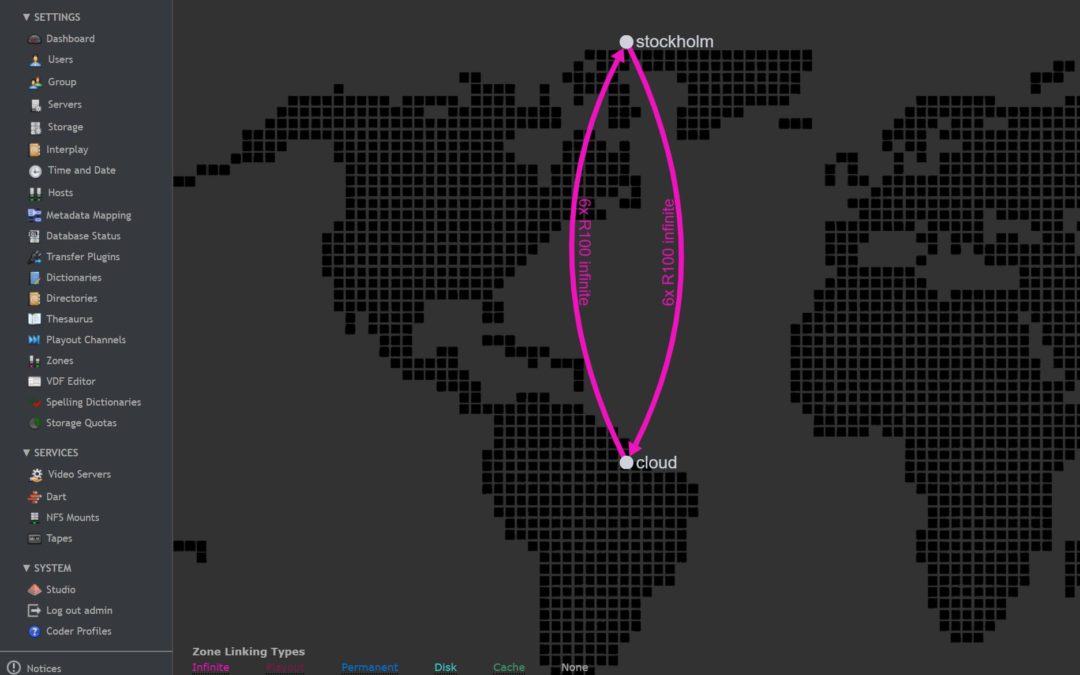
The new version extends Viz One with higher resource efficiency across multiple cloud infrastructure zones and increased automation, while leveraging Cloud Technologies to improve video production workflows and IT return on investment.
At the 2018 IBC Show, Vizrt, the leader in powerful visual storytelling tools for the media industry, will present the latest version of its media asset management (MAM) system on stand 7.B01. Viz One 6.1 introduces a new smart transfer system, optimized search for millions of assets and extended media support.
MAM across multiple cloud infrastructure zones
Media companies have the flexibility to access their content anywhere with Viz One on Amazon Web Service. The new cloud infrastructure zones allow Viz One to manage compute, storage and transcode resources across multiple cloud and on-premise zones. This technology is also extremely useful for connecting multiple physical data centers or production facilities under a single Viz One system. Amazon Web Services support includes Amazon EC2, S3, Glacier, RDS/PostgreSQL, EFS and EBS. Support for these technologies enables both cloud and hybrid architectures.
“Viz One with multiple cloud infrastructure zones give media companies added flexibility by coherently managing both in-cloud and on-premise resources,” said Vizrt Product Manager for MAM Oscar Tengwall. “This allows pre-existing infrastructures to be connected and augmented with the most attractive cloud services. Users can securely access content on Viz One from any location using the improved two-factor authentication in-cloud or on-premise.”
A smarter transfer system
The new smart transfer system adds optimized restore decision for tape libraries, saving up to 10x in restore time for common restore scenarios. It also introduces group-based storage quotas. This enables different production teams to work on the same system without using each other’s resources. The transfer system supports automatic playout staging of media to multiple tiers of storage with different timings. In addition, it adds the ability to send stories across different sites.
Optimizing search for millions of assets
The search engine has been optimized for large datasets with millions of assets. This improves the responsiveness and user experience of working with these large systems. Improvements have also been made to the search system.
A more interactive thesaurus allows users to make changes to an existing thesaurus to keep it relevant, while providing managers with review functionality to keeping it consistent.
Viz One will be part of the Journalist at the Center of Production presentation at the Vizrt Live Stage on stand 7.B01.
About Vizrt
Vizrt is a worldwide market leader in the areas of real-time 3D graphics, studio automation, sports analysis and asset management tools for the media and entertainment industry. This includes interactive and virtual solutions, animations, maps, weather, social media, video editing, compositing, and multiplatform VOD and live playout tools. Vizrt has customers in more than 100 countries worldwide including CNN, CBS, Fox, BBC, BSkyB, Sky Sports, CBS Sports, Fox Sports, Al Jazeera, NDR, ITN, ZDF, VICE, The Washington Post, TF1, CCTV, NHK and the list keeps growing. Vizrt has nearly 600 employees and operates in 40 offices worldwide. Vizrt is a privately owned company by Nordic Capital Fund VIII. For further information please refer to www.vizrt.com

13 September 2018
New use of Ka-Band will also simplify deployments for end users without compromising on speed of connectivity
London, UK, and Brussels, Belgium, September 12, 2018 – A new low-cost satellite broadband service will be launched across Iraq and Afghanistan as SatADSL, a provider of professional VSAT services via satellite, and Talia agreed to expand their long-term partnership.
The two companies’ current agreement lets SatADSL link directly to Talia’s teleport to provide services across the whole of Africa, with Talia’s equipment providing high performance and low-cost per megabit. Under the new deal, SatADSL will also be able to access Talia’s new platform in Jordan Media City, enabling it to offer Ka-band services across Iraq and Afghanistan.
“We are taking our relationship with Talia to the next level by using its facilities to offer our innovative services across Iraq and Afghanistan,” said Caroline De Vos, Co-founder and Chief Operations Officer at SatADSL. “The use of Ka-band High Throughput Satellite capacity, combined with Talia’s equipment means the services we provide can be quickly and easily installed by users and offered at an extremely competitive price, taking a significant step towards bridging the digital divide.”
By connecting its Cloud-based Service Delivery Platform (C-SDP) to Talia’s hub, SatADSL will be able to offer the full range of services available on its platform in Iraq and Afghanistan, including vouchers, VNOFlex, Wi-Fi Hotspots, etc. The C-SDP is a Platform-as-a-Service (PaaS) solution which enables operators to deliver a full range of satellite-based connectivity services without investing in physical infrastructure. SatADSL expects to have worldwide coverage by the end of the year, further expanding the reach of its C-SDP.
To enable connectivity, Talia uses capacity on the Arabsat 5C Ka-band satellite, located at 20o East. Talia is offering its services based on the Newtec Dialog® multiservice platform which features small VSAT antennas (75cm) on the remote site to create a new lower price point for Internet access and innovative setup guides for self-installation via a smartphone app. A variety of Newtec’s broadband satellite modems have also been deployed, supporting different bandwidth allocations to ensure optimal bandwidth usage. This includes Newtec’s dynamic Mx-DMA technology to achieve the efficiency of SCPC with the dynamic bandwidth allocation of MF-TDMA.
“We see this next chapter with SatADSL as building upon what has so far been a hugely successful partnership in Africa, enabling many developing countries to have access to affordable fast satellite Internet,” said Jack Buechler, VP Business Development at Talia. “Just as in Africa, the services which SatADSL will provide in Afghanistan and Iraq, using our infrastructure will help bridge the digital and economical divide and transform societies for the better.”
SatADSL will showcase its services and the benefits of its C-SDP at IBC 2018 at booth 5.C31. For more information, please see: www.satadsl.net.
About SatADSL
SatADSL (www.satadsl.net) is a satellite Service Provider which designs and offers innovative satellite networking solutions to banks, microfinances, broadcasters, NGOs, Governments, ISPs, telecom operators and other companies in Africa and the Middle East in remote areas or where terrestrial infrastructure is not reliable.
Founded in 2011, SatADSL has already installed more than 3,000 VSAT networks in more than 45 countries. It specializes in providing tailor-made solutions based on customers’ specific requirements and flexible service plans that meet its clients’ budgets.
Through its carrier-grade Cloud-based Service Delivery Platform (C-SDP), which integrates the most advanced technologies, SatADSL provides custom-made networking solutions, tailor-made service plans and value-added services, including hierarchical service control and monitoring, traffic prioritization and online billing and payments, for any frequency band and any access technology.
About Talia
Talia (https://www.talia.net/) is a market-leading teleport, satellite and terrestrial network operator and systems integrator; providing global ICT solutions that allow enterprises to thrive. Our hybrid infrastructure supports international businesses with connectivity wherever and whenever they need it.
With headquarters in the UK, Talia owns and operates their teleport facility in Germany. With international offices across the Middle East, Africa, South Asia, Europe, North and South America, Talia is ideally positioned to meet the growing demand of today’s global market.
Talia delivers solutions for enterprises, media companies, NGOs, government agencies and many others.
SatADSL
Caroline De Vos
Co-Founder & COO
+32 478 31 13 76
Caroline.devos@satadsl.net
and
Jayne Brooks
+44 1636 704 888
jayne.brooks@proactive-pr.com

10 September 2018
Australia’s ABC has complained about the blocking of its website in China. Access to the website and mobile applications of the Australian Broadcasting Corporation have been cut off in China for ten days, said the ABC’s board on 3 September.
The Central Cyberspace Affairs Commission, which is directly controlled by Chinese President Xi Jinping, confirmed that it has classified ABC as a media “damaging [China’s] national pride” that should be banned.
ABC’s critical coverage of China, especially its publication of a 2017 report denouncing the growing influence of the Chinese Communist Party (CCP) in Australia, appears to have triggered Beijing’s recent shutdown of the Australian broadcaster’s service.
According to the ABC, officials at two separate Chinese government departments have declined to specify how the ABC allegedly violated Chinese laws or cite any content as an example. Access to other Australian news websites inside China, including those of Fairfax, News Limited and SBS, appears not to have been affected.
In a statement, Reporters Without Borders (RSF) denounced China’s increasing censorship of foreign media. “Given the Chinese government’s stranglehold on the media, foreign websites such as ABC are the only platforms providing independent information to Chinese citizens,” said Cedric Alviani, director of the RSF East Asia bureau. “By adding ABC to its blacklist, which already counts more than 8,000 domain names, Beijing again demonstrates its commitment to keep Chinese citizens in ignorance.”
According to official sources, over two million people are involved in China’s censorship and internet surveillance effort. The “Great Firewall of China” keeps 800 million Chinese netizens away from a wide range of foreign news websites, including Wikipedia, Radio Free Asia, the New York Times, BBC and Bloomberg News.
China is towards the bottom of the 2018 RSF World Press Freedom Index, ranking at 176 out of 180 countries.
4 September 2018
SatADSL defines itself as a business-oriented company. It is currently present in some forty countries and develops specific solutions for niche sectors, including hotels, microfinance institutions, schools, and rural radio broadcasting companies. Let’s discuss the strengths and strategies of the company with Thierry Eltges, CEO and co-founder of SatADSL.
What are the assets and specificities of SatADSL?
Thierry Eltges: One of our competitive strengths is that we have our own service platform: the Cloud-Services Delivery Platform (C-SDP). This platform allows us to provide an offer that is unique from our competition today: any operator or Internet Service Provider (ISP) can now start a satellite business anywhere in the world and without infrastructure investments. You should know that it takes a small fortune to start such a business and the financial risk is high. Operators or ISPs wanting to start selling their own services have to invest in a satellite hub and enter into a contract to lease satellite capacity for several years.
And the SatADSL C-SDP can offer advantages that other companies cannot match?
Thierry Eltges: First, there is no need to buy expensive equipment. Operators and ISPs who start their business using our services only need to buy satellite terminals that are relatively easy to install and use. You could say that SatADSL assumes the financial risk. Secondly, our C-SDP is connected to several teleport operators. This means that in case of an outage in one operator’s network, we can quickly switch to another operator.
How important is your network of local partner distributors?
Thierry Eltges: This is certainly another of our strengths that sets us apart from our competitors. We actually have two types of partners: on the one hand, we work with a network of distributors ‒ mostly African companies with local VSAT and Internet licenses offering satellite services. They must be able to carry out installations and provide after-sales service themselves. SatADSL invoices the connectivity services – subscriptions or vouchers – to these distributors, who in turn invoice their own services to their end users. On the other hand, we work directly with end-user customers, including European companies active in Africa. We rely on the same network of distributors to do the technical installations, provide the licenses, etc. These distributors invoice us for their services and SatADSL invoices the end-user customer.
What is your strategy for the future of SatADSL?
Thierry Eltges: We will continue to invest heavily in research and development. More than a third of our team is dedicated to innovation and we work extensively with the European Space Agency (ESA). We also want to expand geographically. We already have customers in Africa and the Middle East and we want to go to Asia and South America. This is, by the way, another reason why we invest so much in our C-SDP: we want to be able to provide both global connectivity and multi-technology capacity. It is part of our “horizontal” business model to encourage cooperation with teleport and satellite operators. This model challenges the “vertical” model endorsed by some large satellite operators to the benefit of the end customer, who can enjoy an optimal service at the lowest price.
Does this mean that the satellite capacity available on the market will increase significantly in the coming years?
Thierry Eltges: Absolutely! On all five continents, more and more companies and operators are investing in new satellite technologies. Our goal is to continue developing our C-SDP to make it a truly open platform, including all technologies, satellites, frequency bands and operators. This will allow us to continue providing the best solutions using the best available technologies at the best price. The satellite market is currently undergoing major changes and very large projects are under study. For example, Google wants to launch 800 satellites into low orbit. Facebook also wants to be present in the stratosphere. This involves many different technologies, sometimes even beyond satellite technology. And we need to be ready!
What else can be said about the technological developments?
Thierry Eltges: Until now, geostationary satellites are mostly used as communication satellites. They circle 36,000 km above the Earth’s equator at a fixed position and use spot beams to cover an entire continent. This technology requires very large receiving antennas and powerful antenna amplifiers, leading to very high costs. As a result, the main technological evolution today is to increase the frequency and to narrow the beams with high-throughput satellites (HTS) to 30 to 50 small spot beams, instead of one large spot beam. This technology makes it possible to concentrate power in a limited area and to have more capacity available at a lower price. But there is only room for a few hundred satellites on this specific orbit arc and the orbital positions are allocated to each country depending on its size. This is one of the reasons why several operators are preparing to launch mega-constellations of low Earth orbit (LEO) satellites, to which our C-SDP will also be able to connect in the future.
