UN Special Rapporteur on Iran “deplores” the persecution of BBC Persian staff and their families

UN Special Rapporteur on Iran “deplores” the persecution of BBC Persian staff and their families

The UN Special Rapporteur on the situation of human rights in Iran, Professor Javaid Rehman, has presented his first report to the United Nations Human Rights Council.

In his address, Professor Rehman raised with concern the ongoing persecution and harassment of BBC News Persian staff and their families by Iran.

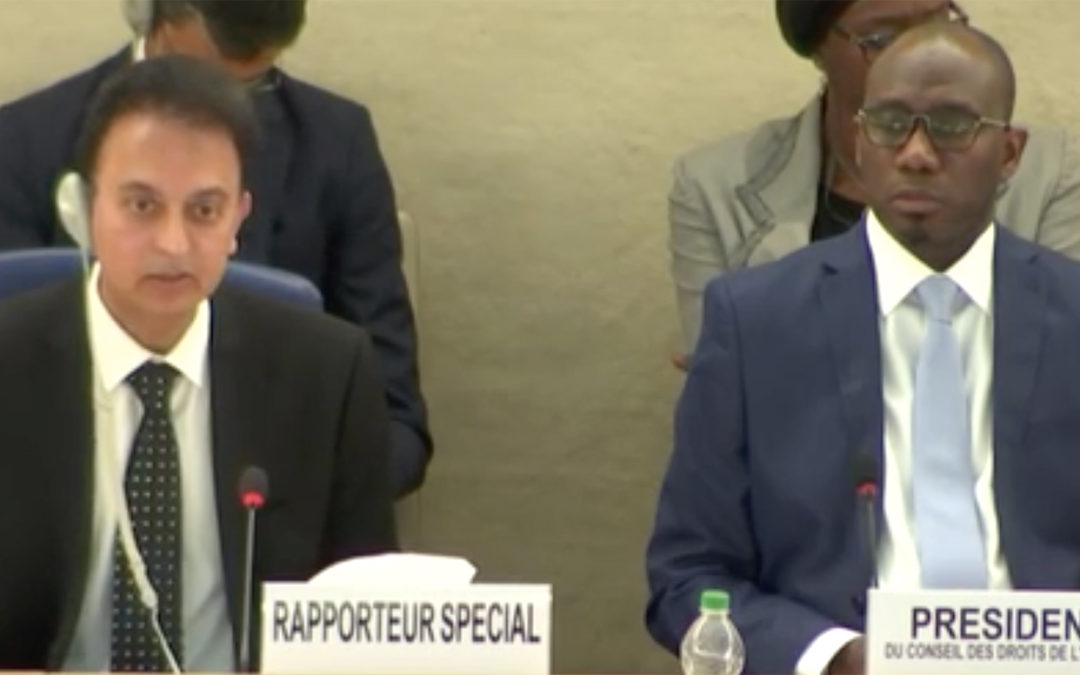
Professor Rehman (pictured addressing the UN Human Rights Council in Geneva on 11 March 2019) said he “deplores” the harassment of BBC Persian staff. His remarks raised concern about the ongoing, collective criminal investigation of BBC Persian staff and the asset-freeze which affects them and their families in Iran. He reiterated the seriousness of the persecution, which was also raised by his predecessor Asma Jahangir, including arbitrary detention and interrogation of family members in Iran. Professor Rehman also raised concern about the attacks on BBC Persian journalists in Iranian state media, in particular with fake and defamatory news being published to undermine their reputations.

The BBC made its unprecedented urgent appeal to the UN in late 2017. It is the first time in BBC history that the BBC has engaged with the UN over the protection of its journalists. Both the UN Special Rapporteur and the UN Secretary-General Antonio Guterres raised concern about the persecution of BBC Persian in their reports to the 40th session of the Human Rights Council.

The UK government mission to the United Nations raised concern with the “deteriorating” situation for freedom of expression in Iran. The UK highlighted that the “judicial harassment of BBC Persian staff and their families continues” and called upon Iran to cease the criminal investigation into BBC journalists and the harassment of their families.

Rana Rahimpour, a BBC Persian presenter (pictured in Geneva with AIB CEO Simon Spanswick), addressed the Council about her personal experience of the persecution, explaining how her father was subjected to a travel ban to prevent him from visiting her after her first child was born. She thanked the UN Secretary General for raising the case and raised concern about the reprisals against BBC Persian staff, explaining that “my colleagues have been warned against participating in our UN advocacy work by the Iranian authorities.”

International counsel for the BBC World Service, Caoilfhionn Gallagher QC and Jennifer Robinson, have filed a further UN complaint over the reprisals BBC Persian journalists have faced for engaging with the UN. They said, “Reprisals against BBC Persian journalists and their families for engaging with the UN is not just an attack on freedom of expression, but an attack on the integrity of the UN system. Such reprisals must be condemned in the strongest possible terms.”

Michelle Stanistreet of the National Union of Journalists said: “The Iranian authorities have been systematically targeting BBC Persian journalists in the UK, and their families in Iran, since the service launched satellite television in 2009. Our campaign to stop the harassment will persist until the authorities stop targeting NUJ members for simply for doing their jobs. Both the asset freeze and criminal investigations into the activities of journalists and other staff working for BBC Persian should be dropped.”

An event was held today at the Human Rights Council co-hosted by the BBC, the International Federation of Journalists and Doughty Street International to discuss the broader implications of the persecution of BBC Persian.

Simon Spanswick from the Association for International Broadcasting – a network of broadcasters that reach one billion viewers and listeners each week – explained how the persecution of BBC Persian is “among the worst cases globally” and is indicative of a worrying trend of harassment of journalists and broadcasters in their network.

At the event, the UK Permanent Representative to the UN in Geneva, Julian Braithwaite, said “UK calls on Iran to cease the harassment of BBC Persian staff and their families – and the persecution of all independent journalists whether affiliated with the BBC or not”. He condemned the reprisals faced by BBC Persian staff.

Referring to the recent media freedom initiative announced by Foreign Secretary Jeremy Hunt, Ambassador Braithwaite said: “This case is one of the reasons we are making press freedom a particular focus for the UK. Iran’s treatment of BBC journalists will be a key part of our upcoming media freedom summit.”

The UN Special Rapporteur Professor Rehman reiterated at the event in Geneva on 12 March: “I will continue to urge Iran to cease its harassment of BBC Persian staff and their families.”

Media freedom to Brexit to tenders – all covered in latest AIB Member briefing

Media freedom to Brexit to tenders – all covered in latest AIB Member briefing

As part of its regular work for Member companies, the AIB has released its latest market intelligence briefing. This new edition covers a range of subjects from media freedom – including an examination of the challenges facing broadcasters covering stories in Europe, until recently a bastion of media freedom – to the most up-to-date information on TV channel licensing post-Brexit. There’s also a summary of tenders related to the broadcasting industry internationally, allowing AIB Members to see what competitors are renewing and to allow commercial companies to assess where there are business opportunities.

AIB market intelligence is one of a range of services that the Association’s Members receive throughout the year. For information on how to take advantage of the AIB membership package, talk to us at the AIB Secretariat on +44 20 7993 2557.

AIB moves ahead with media freedom initiative

AIB moves ahead with media freedom initiative

In November 2018, the AIB convened a meeting of senior representatives of major national and international broadcasters to discuss ways to work together on issues around media freedom. The meeting in London was chaired by Peter Greste, who was imprisoned while reporting for Al Jazeera in Egypt, and Simon Spanswick, AIB CEO.

Broadcasters are constantly being tested and harassed by authorities that seek to restrict citizens’ access to free, fair and impartial information. Journalists are constantly being intimidated in countries across the world. At the same time, the UN’s Sustainable Development Goals, signed by many of these countries, include media freedom as one of the key objectives.

There’s a clear disconnect, and broadcasters made a commitment at the November meeting to work together, share intelligence and devote resources to tackling this issue, with the Association for International Broadcasting leading the collaborative efforts between broadcasters.

It is important that this initiative does not duplicate existing work being carried out by NGOs and others, and that’s why the AIB invited a range of key organisations to the November meeting and will be sharing the work programme and other intelligence with those organisations that are carrying out important work in media freedom internationally.

At its meeting in January, the AIB Executive Committee agreed that the Association can now start work on developing a collaborative work programme. The Secretariat is in discussion with broadcasters to establish a steering group and to decide on the mechanisms to develop this crucial initiative.

The AIB is grateful to Al Jazeera Media Network for providing support for the initiative which now moves into a wider, global arena.

AIB publishes new update on Brexit for Members

AIB publishes new update on Brexit for Members

AIB publishes new update on Brexit for Members

As part of its continuing work on issues facing TV broadcasters as the deadline for the UK leaving the European Union approaches, we’ve just released our latest briefing for Members. It brings them up-to-date with developments of the last couple of weeks, from no-deal scenarios to immigration.

“This is something that is critical for many of our Members,” says Simon Spanswick, AIB CEO. “That’s why we’re keeping fully abreast of all developments so that we can assist our Members develop the right strategy to remain available to viewers in all the European markets they serve.”

Members have access to this briefing and all the other in-depth documentation that the AIB publishes on Brexit and other subjects.

AIB December industry briefing published

AIB December industry briefing published

The AIB has published the latest edition of its regular Industry Briefing that reaches well over 27,000 people in media and related industries worldwide. Offering an insight both into the work of the Association for International Broadcasting and developments at AIB Members, the industry briefing is a useful tool for anyone who wants to gain a rapid overview of interesting news from across the media industry, ranging from new appointments to strategy.

Read the briefing here

If you’re interested in harnessing the power of the AIB’s global reach into media companies large and small, talk to us about the opportunity for advertising within the briefings. And we’re always happy to discuss how Membership of the Association can help your business. Contact the AIB head office on +44 20 7993 2557 and ask for Tom Wragg. He – and any one in the AIB Secretariat – will be pleased to talk with you about the opportunities!

Sign up to receive the AIB Industry Briefing straight to your inbox at http://cfb.d5c.myftpupload.com/sign-up-to-the-aib-industry-briefing/.

One year on, Reuters journalists remain imprisoned in Myanmar

One year on, Reuters journalists remain imprisoned in Myanmar

News organisations across the world have marked the one-year anniversary of the jailing of two Reuters journalists in Myanmar.

Wa Lone and Kyaw Soe Oo were convicted of breaching the country’s official secrets act, despite a lack of credible evidence against them and in the face of international condemnations from governments and civil society organisations.

On 12 December, fellow journalists and others working in the international news industry came together to demonstrate their solidarity with Wa Lone and Kyaw Soe Oo as our selection of images shows.

At the AIB, we too have marked the anniversary. We have raised the issue with the Myanmar Ambassador in London – although we have yet to receive any acknowledgement or response from the Embassy. Along with other organisations involved in media freedom, we will continue to seek the release of the Reuters journalists, as well as pressing home the need for media freedom through a new collaborative venture that the AIB is developing with its Members across the world.