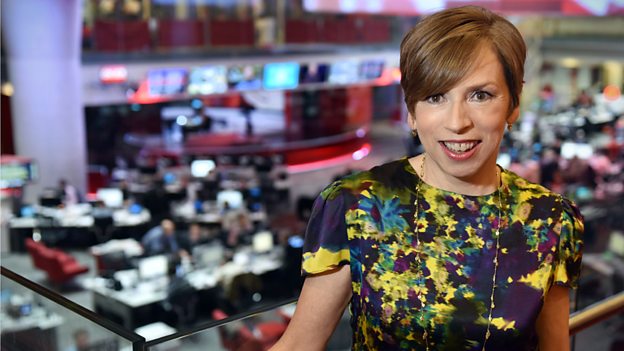
The BBC has announced that Fran Unsworth is to be the new Head of News and Current Affairs.
Fran Unsworth is currently Director, BBC World Service Group and deputy director of News and Current Affairs. In her new post she will be responsible for all the BBC’s domestic and international news services.
Fran joined the BBC in local radio before moving to London and the Newsbeat programme on the pop music station Radio 1. She spent some time as a network radio producer in Washington DC, and later joined Radio 4’s The World At One and PM. Fran was appointed the BBC’s Home News Editor and then, in 2001, Head of Political Programmes. In 2005 she became Head of Newsgathering, running one of the world’s largest newsgathering operations with bureaux across the world.
For periods between November 2012 and June 2013, Fran was the BBC’s Acting Director of News and Current Affairs. Fran Unsworth was made Director of the BBC World Service Group in December 2014. In this role she led the BBC’s global news services – BBC World Service, BBC World News and BBC.com/news – as well as BBC Monitoring. Prior to her appointment to the World Service Group, she was Deputy Director of BBC News and Current Affairs.
Tony Hall, Director-General of the BBC, says “The Director of News and Current Affairs is one of the most demanding of any in broadcasting.
“News is at the very heart of the BBC. I am delighted Fran Unsworth is taking up the role. She brings a combination of excellent news judgement, authority, management knowhow, and the trust of her colleagues both in news and across the BBC.”
Fran Unsworth says: “I am delighted to lead BBC News and Current Affairs. We are living through a period of significant change at home and abroad. In a complex world, the BBC’s journalism matters more than ever. I am proud to lead a team of such dedicated and talented people.”
With an 86% reach of satellite TV households in the Kingdom of Saudi Arabia (KSA), Arabsat is now gearing up to offer the next generation video and connectivity experience to viewers.
A recent analysis by Frost & Sullivan, global research and consulting company finds that Arabsat, one of the world’s leading satellite operators, reaches 86% of satellite TV households in the Kingdom of Saudi Arabia (KSA) and nearly 78% in GCC, including Bahrain, Kuwait, KSA, Oman, Qatar, and UAE.
Arabsat, carries over 500 TV channels, 200 radio stations, pay TV networks and a wide variety of HD channels reaching nearly 4 million households in GCC. Operating six satellites at 3 orbital positions, the operator offers the youngest regional fleet with widespread coverage over the region.
“Satellite services continue to be an essential way of providing entertainment and communications across the entire MENA region where network connectivity is not uniform,” says Y.S.Shashidhar, Managing Director, Frost & Sullivan MENA. “Arabsat with its constant emphasis on innovativeness and partnerships is firmly poised to help its broadcaster customers connect to a wide user base in the region.”
Frost & Sullivan’s Research Director, Vidya S Nath adds, “Arabsat’s exclusive and strategic partnerships with leading international and regional broadcasting networks have enabled it to establish a significant footprint over GCC, especially KSA.”
Frost & Sullivan finds growing demand among end users for high quality of transmission resulting from the rapid increase in the penetration of 4K and HDR TV sets, receivers, Internet streaming boxes as well as cellular hand-held devices. Broadcasters and service providers eyeing viewership retention for boosting their revenue need partners that can offer optimal quality of transmission as well as the widest reach.
“Innovativeness to ensure the highest quality of experience for the viewer stands as our core undertaking and motto,” says Khalid Balkheyour, President and CEO, Arabsat. “Such keenness on innovativeness has both motivated and helped us build an exclusive portfolio of leading regional networks in the region, including the foremost MBC Pro Sports along with exclusive rights to broadcast the Saudi Football League, MBC full HD bouquet, and Rotana full HD bouquet,” he said. “Alongside, to establish our footprint in the Maghreb region, we have launched several strategic initiatives. We want to offer the viewers in Maghreb unparalleled content offering and hence we have on board exclusive access to the complete Mauritanian bouquet, the complete FTA MBC bouquet, the My-Maghreb package as well several other attractive channels across different genres.”
ARABSAT’s ability to ensure localisation combined with international diversity of content makes it a platform of choice for both broadcasters as well as viewers in the MENA region. It has a strong portfolio of exclusive first-class channels for the region such as France 24 Arabic and English HD, TV5 Monde Style HD, among several others.
BBC World Service has called on the Iranian authorities to reverse a new order which appears effectively to freeze the assets of BBC staff in Iran, preventing them from selling or buying property, cars and other goods.
BBC World Service Director Francesca Unsworth said: “We deplore what appears to be a targeted attack on BBC Persian staff, former staff, and some contributors. It is appalling that anyone should suffer legal or financial consequences because of their association with the BBC.
“We call upon the Iranian authorities to reverse this order urgently and allow BBC staff and former staff to enjoy the same financial rights as their fellow citizens.”
The BBC’s Persian Service is banned in Iran and BBC Persian staff and their families routinely face harassment and questioning from the authorities.
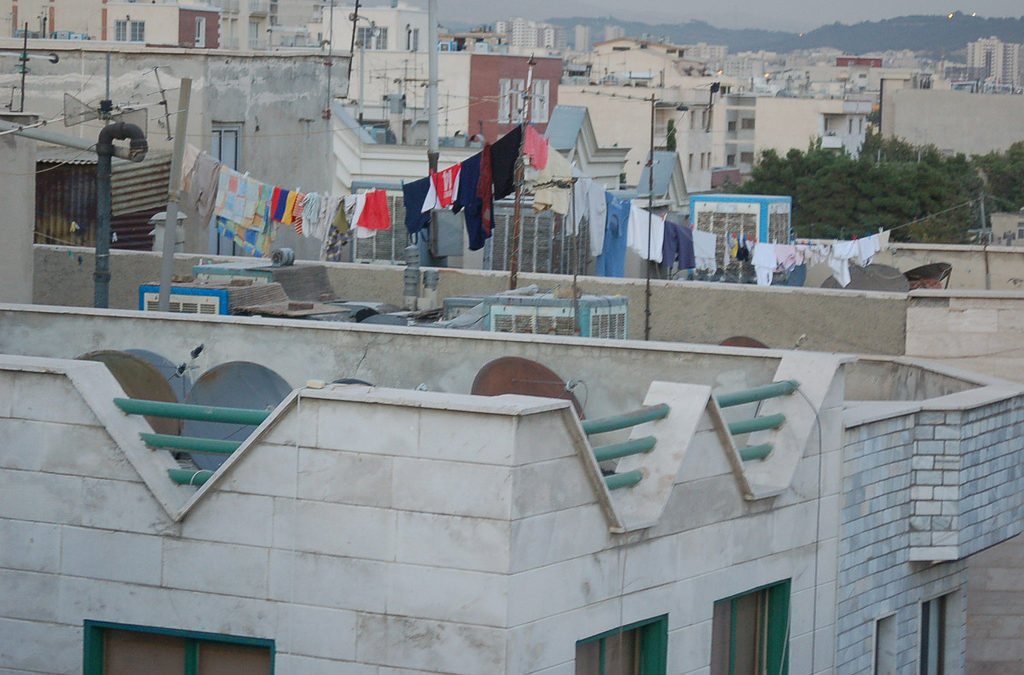
Reception of foreign TV and radio via privately-owned satellite dishes is banned in Iran, although there is widespread flouting of this rule. Dishes are often hidden on balconies and below rooftop parapets, as the image above from BBC Persian shows.
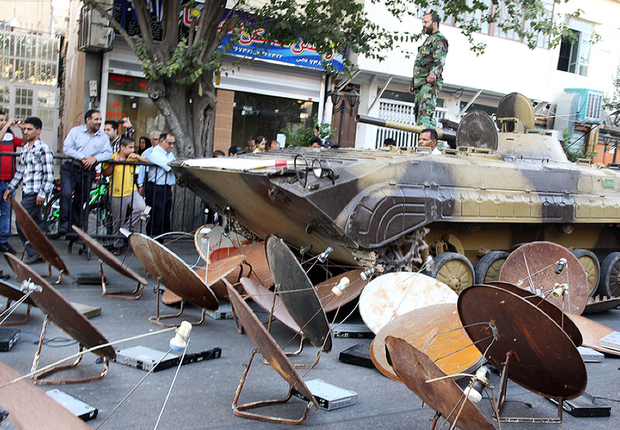
In July 2016, authorities seized and destroyed a reported 100,000 satellite dishes and receivers. According to media reports from Iran, General Mohammad Reza Naghdi, the head of Iran’s Basij militia, oversaw a destruction ceremony in Tehran after the equipment was confiscated and warned of the impact that satellite television was having in the country.
“The truth is that most satellite channels… deviate the society’s morality and culture,” AFP news agency reported him as saying. “What these televisions really achieve is increased divorce, addiction and insecurity in society.”
Naghdi claimed that a total of one million Iranians had already voluntarily handed over their satellite dishes to authorities. Iranian conservatives regularly denounce the channels as an attempt to corrupt Iranian culture and Islamic values and the police regularly raid neighbourhoods and confiscate dishes from rooftops. Under Iranian law those who distribute, use, or repair them can be fined up to $2,800.
Despite the ban on the BBC, the latest figures show the BBC World Service has an audience of 13m in Iran, making it BBC News’ seventh biggest market worldwide.
The AIB is saddened to learn that Les Murray, the former football broadcaster and known to football fans across Australia as “Mr Football”, has died aged 71.
Regarded by many as the voice of Australian football, Murray had been battling a long-term illness, according to his long-term employer SBS. He had retired from his role on the The World Game in July 2014, having played a major role in the game’s development in Australia since the 1980s.
In a statement, SBS said: “Les will be remembered not just for his 35-year contribution to football in Australia, but for being a much-loved colleague, mentor and friend who has left a unique legacy. To say he will be sorely missed is an understatement.
Murray pioneered football broadcasting in Australia following the launch of the National Soccer League in 1977, initially on Channel 10, and went on to become the voice of World Cup coverage on SBS for several decades. He hosted eight World Cups in total, his debut coming at Mexico 1986.
He also worked across the Asia-Pacific region as Chair of the ABU Sports Group for more than 10 years, and had been an advisor to the Association for International Broadcasting. Murray was also a member of the FIFA Ethics Committee.
Murray came to Australia from his native Hungary at the age of 11 after the 1956 uprising, without any knowledge of the English-language. Murray began his career at SBS in 1980 as a Hungarian subtitle writer, but it was his passion for football that rapidly brought him into the network’s sports team. By 1986, he was hosting SBS’s World Cup coverage. As an SBS football commentator and presenter, he covered eight World Cups before retiring in 2014.
Tributes have flown from all circles, with Australian Prime Minister Malcolm Turnbull, the football community and fans sharing their accolades of the lauded sports commentator.
Over his career, he championed the cause of immigrants in Australia, devoting much time to breaking down the many barriers that newcomers to the country had to face and helping to develop the country as a model of tolerance to all races. It was fitting that he worked for SBS, Australia’s multicultural network.
Les Murray will be greatly missed by his colleagues at SBS, the AIB, ABU and across the world of football and sports broadcasting.
The second World .Radio Advisory Board meeting was held in Geneva on 4 July 2017 at the headquarters of the EBU. This Board, chaired by AIB Chief Executive Simon Spanswick, steers the development of the new .radio top level domain and resolves issues surrounding name allocations in the new TLD.
At present, the .radio TLD is being offered through the Pioneers Programme. This allows companies that have a serious interest in using – and promoting – the new .radio extension to gain exposure globally. The Association for International Broadcasting is a pioneer, providing a special web site for its annual awards – the AIBs – at www.theaibs.radio. Companies interested in becoming a .radio pioneer and having use of a .radio domain in advance of the opening of registration requests can contact the AIB for more information.
In August, “sunrise” registrations will be opened, with general availability from 15 November 2017.
“The .radio top level domain will allow every organisation with radio operations, or companies and individuals with close links to radio, to demonstrate their involvement in the radio industry,” commented Simon Spanswick, WRAB President and Chief Executive of the Association for International Broadcasting. “This is the first community domain in the world, and it’s great that the radio industry is able to lead this new global domain initiative.”
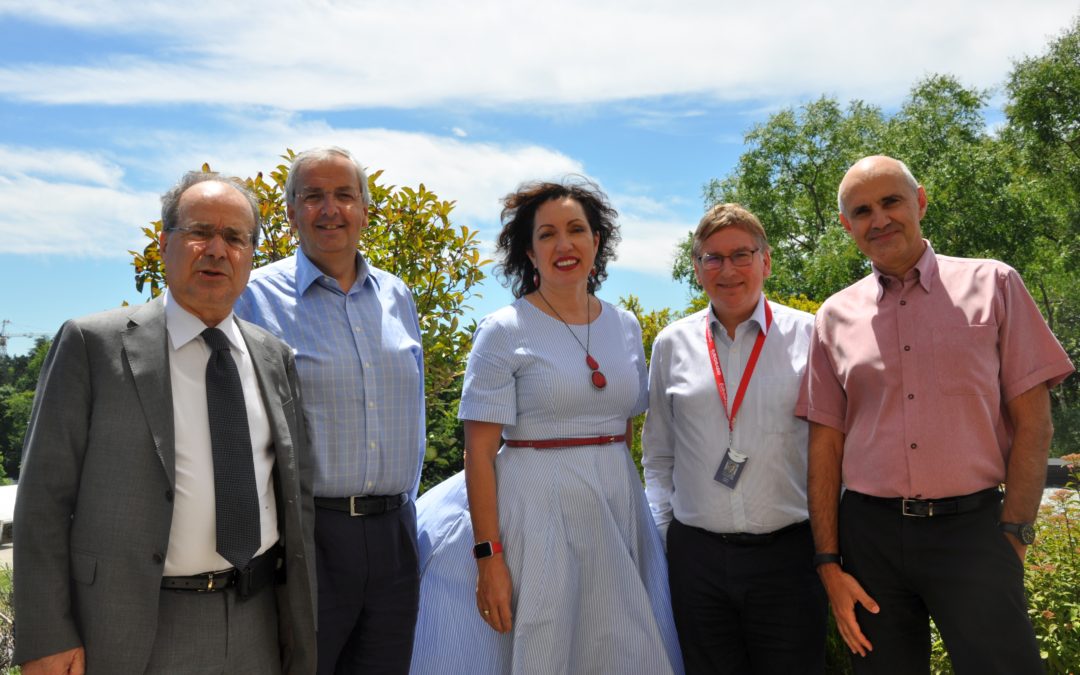
Pictured above, from left: WRAB Members at the Geneva meeting – Giacomo Mazzone (EBU); Simon Spanswick (AIB); Olya Booyar (ABU); Graham Dixon (EBU); Alain Artero (EBU)
The ransomware attack that was unleashed on to computers in over 100 countries on Friday 12 May demonstrated just how important it is for media companies to take the issue of cyber security seriously.
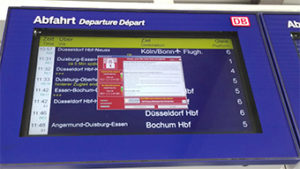
Companies and organisations as diverse as Britain’s National Health Service, Germany’s Deutsche Bahn rail network (pictured left), Spanish telecommunications company Telefonica and car manufacturers including Nissan and Renault, each suffered from the consequences of this immense cyber attack. The Association for International Broadcasting’s own Cyber Security Working Group is actively collating data on any impact there has been on media companies from this attack.
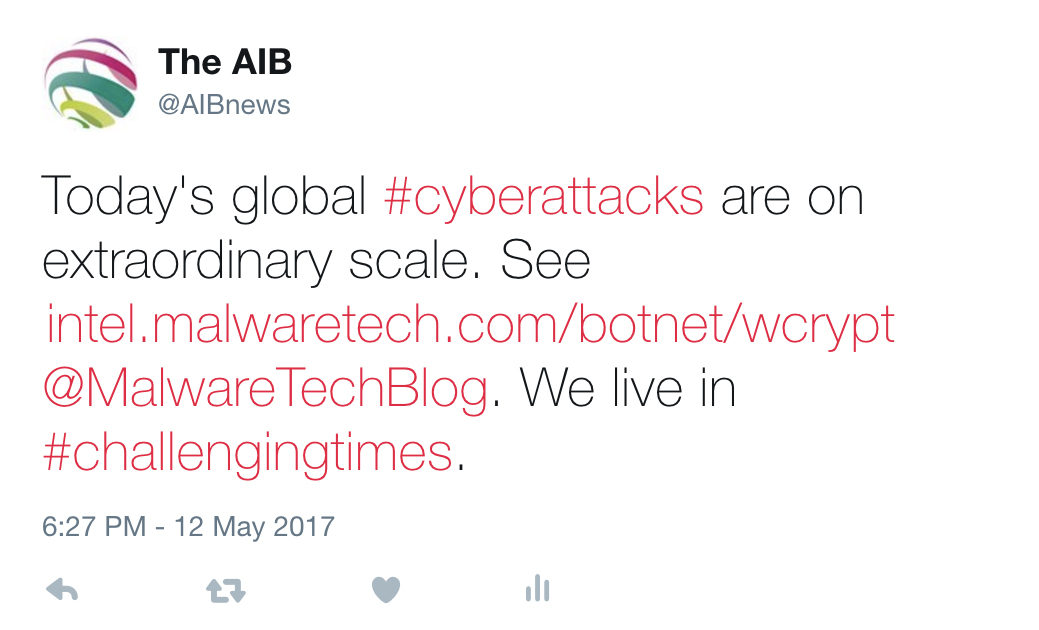
On Friday evening, the AIB’s Twitter feed (right) linked to a map of incidents traced around the world produced by a UK-based IT expert going under the name of Malwaretechblog. This 22-year-old was subsequently reported to have discovered the “kill switch” for the ransomware, bringing much of the attack to a halt (http://www.bbc.co.uk/news/technology-39907049).
“The Association for International Broadcasting has been actively working on the issue of cyber security with its Members,” said Simon Spanswick, chief executive of the AIB. “Since the attacks on Sony and TV5 Monde, the AIB has been bringing its Members together to share information and intelligence and to explore how to encourage the entire media industry to work together, and with suppliers, to combat the threat of attack. We have been telling media companies that the issue of cyber security is one of their major governance challenges. It requires board level discussion and for a board member to take responsibility for the issue as this is not simply an IT issue. It goes to the heart of a company’s responsibility to protect itself and its employees, and to ensure that it can continue to operate in a worst case scenario. The AIB is there to support its Members on this crucial, mission-critical issue.”
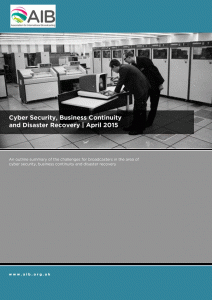
As part of the AIB’s work on cyber security, the Association is pressing home the need to take the entire security issue seriously at the highest levels in all organisations. In April 2015, the AIB published advice to its Members in a briefing document that remains relevant today. AIB Members can request a copy from the Secretariat.
In October 2015, the AIB worked with Deloitte to deliver a high-level confidential briefing event on the issues of cyber security. The one-day conference brought together representatives of many AIB Members, as well as key players in cyber security including Britain’s GCHQ that has responsibility for the nation’s cyber security (now separated into the National Cyber Security Centre). At that event, high-level GCHQ speakers noted the need for governments to include media companies in national work on cyber security and their classification as critical national infrastructure.
Since then, the AIB’s cyber security working group has developed a work programme that aims to share information and intelligence among AIB Members while at the same time pressing suppliers to the industry to respond to broadcasters’ security needs and requirements. The chair of the working group, Denis Onuoha (CISO at UK transmission company Arqiva), has spoken at major broadcasting events including NAB to highlight the ever more urgent need for the entire media industry – broadcasters and suppliers – to respond to the constantly increasing number of threats that exist from both nation states and cyber criminals.
At the European Broadcasting Union’s International Broadcasting Assembly in Sofia on 18-19 May, the AIB will be presenting to a range of international broadcasters about the threat posed to their businesses from cyber attack. In June, the AIB will be meeting with national security agencies to develop collaborative links that benefit AIB Members in protecting their businesses against cyber attack.
“This is a piece of work that will continue to develop and grow over the coming months and years,” says Simon Spanswick. “The AIB is working hard on behalf of its Members to ensure that they can protect themselves, their brands and their reputations in a world where the threats from cyber criminals has never been more challenging. The media industry needs to stay one step ahead of those who work to wreck businesses and those who – knowingly or unknowingly – derail broadcasters from their missions to inform, educate and entertain.”


 Companies and organisations as diverse as Britain’s National Health Service, Germany’s Deutsche Bahn rail network (pictured left), Spanish telecommunications company Telefonica and car manufacturers including Nissan and Renault, each suffered from the consequences of this immense cyber attack. The Association for International Broadcasting’s own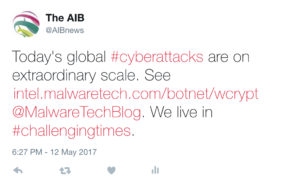
 As part of the AIB’s work on cyber security, the Association is pressing home the need to take the entire security issue seriously at the highest levels in all organisations. In April 2015, the AIB published advice to its Members in a briefing document that remains relevant today. AIB Members can request a copy from the