
8 January 2018
RNZ has announced a content-sharing agreement with the Auckland-based publisher Indian Newslink.
Indian Newslink publishes a fortnightly newspaper with a readership of more than 65,000, making it the most-read Indian newspaper in New Zealand. It also runs several news websites http://www.indiannewslink.co.nz, and is prominent in organising a number of awards for the New Zealand Indian community.
The new arrangement maintains RNZ’s policy of sharing content with media partners and extends to 13 the number of agreements in place with a range of media organisations. Glen Scanlon, RNZ’s head of digital, said the agreement with Indian Newslink was in keeping with RNZ’s push to work with different media outlets and reach more New Zealanders. “We really want to be a helpful partner to the broader journalism industry and believe these kind of deals allow us to do that while making sure we meet all of our charter commitments to reach Kiwis with their stories. We expect to announce more partnerships in the future.”
Editor and general manager of Indian Newslink, Venkat Raman, emphasised the importance of the new relationship. “While accuracy is paramount and sacred to any news organisation, speed is equally important in today’s world, which constantly looks for news updates. Digital technology makes that requirement standard, and our tie-up with Radio New Zealand will also enhance credibility and quality. This is an exciting development in media relationship and we in Indian Newslink look forward to meaningful and professional partnership with Radio New Zealand. The South Asian community is of growing importance to New Zealand and to the world and we believe that with Radio New Zealand, we will be in a better position to disseminate information through reports and features.”
(Source: RNZ press release)

20 December 2017
2017 saw an unusually high number of women among the 68 journalists killed doing their jobs this year, according to Killing the Messenger, a biannual analysis of journalist casualties by the International News Safety Institute (INSI).
Out of the 68 journalists and media workers killed in connection with their work this year, nine were women. That is 13 percent of the total. Last year, the figures were three women out of 112 killed, or nearly three percent. In 2015 there were 10 women out of 101 casualties, or 10 percent.
This disproportionately high number of female casualties comes after a year when women across the industry spoke out en masse against the abuse and harassment they have experienced at the hands of sexual predators.
“This is the highest proportion of women killed in comparison with their male colleagues in the eight years since I joined INSI, and it is a particularly egregious finding in the current climate,” said INSI director Hannah Storm.
High profile female deaths in 2017 included Kim Wall whose headless torso was discovered in the sea near Copenhagen; Shifa Gardi, a pioneering Kurdish journalist; Gauri Lankesh who became the most high-profile journalist killed in India in recent years; and Miroslava Breach who spent the days before her murder in March documenting the murders of others in Mexico’s drug war.
Afghanistan, Mexico, Iraq, Syria and the Philippines were the five most dangerous countries for journalists in 2017, according to Killing the Messenger which is compiled for INSI by Cardiff School of Journalism.
Statistically speaking, the overall number of journalists killed is lower than in recent years, and insecurity does not discriminate on the basis of gender.
Out of the 68 media casualties, 32 men and women died in countries supposedly at peace such as Mexico, India and Malta.
The vast majority of casualties were local journalists, living and working where they died.
Four citizen journalists lost their lives this year, all but one of them in Syria where access for professional media workers continues to be difficult and dangerous.
INSI identified nine cases where suspects were identified, arrests made and legal proceedings initiated. These include Peter Madsen who has been charged with the murder of Wall and three men charged in connection with the killing of Malta’s Daphne Caruana Galizia, an investigative journalist blown up by a car bomb in October.
“At INSI we pay tribute to every journalist killed doing their work, whatever their gender, ethnicity or religion. The 68 men and women killed this year have paid the ultimate price and every single one leaves a legacy of loss,” said Storm.
(Source: INSI press release)
7 December 2017
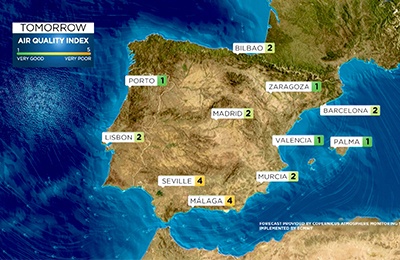
The Copernicus Atmosphere Monitoring Service and the Copernicus Climate Change Service, both implemented by ECMWF, have joined forces with Euronews to provide an exclusive daily 24-hour air quality forecast for Europe and a monthly climate update dedicated to the planet’s changing climate.
With the exclusive Air Quality Forecast provided by the Copernicus Atmosphere Monitoring Service (CAMS) and broadcast on Euronews, people can now find out about the expected air quality where they live, work or are planning to visit.
In view of a recent European environmental report* detailing how poor air quality, particularly in urban areas, has a significant economic impact, increases medical costs and reduces productivity, being able to check the air quality will help people make informed choices about the activities they undertake in the hours ahead.
The monthly Climate Update is based on Copernicus Climate Change Service (C3S) data and will highlight a number of recent events that are related to our planet’s changing climate. Major floods, droughts and wildfires have impacted large parts of Europe.
C3S and CAMS are part of Copernicus, the European Commission’s ambitious Earth observation programme, providing environmental data and information services. This data is collected by a series of advanced satellites, called Sentinels, and together with additional data from dozens of other satellites from global organisations and thousands of ground sensors it is processed by the ECMWF and can be downloaded free of charge.
* www.eea.europa.eu/publications/air-quality-in-europe-2017 p.9
Air quality: an exclusive and daily air quality forecast programme
|
Everyday, Euronews offers to its European viewers air quality forecasts of major European cities. Each city is featured with an air quality index, from 1 to 5 (very good to very poor)
Broadcast several times a day with updates every morning and evening, an animated map of Europe shows Copernicus Atmosphere Monitoring Service (CAMS) exclusive air quality data.
to watch a preview: click here |
| Duration: 1′
1st morning broadcast at 06:45 CET
1st evening broadcast at 18:40 CET |
Climate Update: our planet’s changing climate
|
Each month, the new Climate Update focuses on a specific topic related to Earth’s changing climate.
Euronews highlights a recent climate-related event that occurred in Europe and shows data and maps to understand it. Thanks to the Copernicus Climate Change Service (C3S), the Climate Update explains how climate change affects our surroundings.
to watch the first episode: click here |
| Duration: 1′
first broadcast: every 15
of the month at 8:15 CET |

4 December 2017
Available on more than 30 airlines worldwide*, Euronews joins EasyJet’s newest Air Time entertainment offer, developed by Immfly, currently deployed on the British carrier’s fleet.
Thanks to the onboard wireless network, travelers of the Europe’s second largest airline company (with more than 78 million passengers per year) can now access the free service via their personal devices.
Euronews’ inflight offer on board EasyJet includes articles on international news, business, culture, sci-tech and European affairs, all available in five languages: English, French, German, Italian and Spanish.
The inflight entertainment and services platform is developed in partnership with Barcelona-based company Immfly, which also offers Euronews on Iberia Express, Volotea and XL Airways.
*Euronews’ content is available on board 34 airline companies from China to the Emirates, from Russia to the United States, through the Seychelles and Australia. Air carriers choose Euronews in order to meet their international travelers’ demand for a quality source of information. Euronews’ short-format videos available in several languages seem to be just the ticket.
(Source: Euronews press release)