US international broadcaster cuts operations in Myanmar

US international broadcaster cuts operations in Myanmar

Radio Free Asia (RFA), the private, nonprofit US government-funded corporation that broadcasts to Asian countries, halted its TV broadcasts to Myanmar saying it “will not compromise its code of journalistic ethics.”

Myanmar

RFA aired its last original TV broadcast on the Democratic Voice of Burma (DVB) network on state-owned Myanmar Radio and Television (MRTV) on 11 June.

RFA took this decision after the Myanmar government told DVB that it could not carry RFA’s programming if the word “Rohingya” continued to be used. RFA’s Burmese Service’s TV programming has been available on DVB since October 2017.

Explaining the  broadcaster’s decision to pull out, RFA’s President Libby Liu (pictured) said: “Radio Free Asia will not compromise its code of journalistic ethics, which prohibits the use of slurs against ethnic minority groups. RFA will continue to refer to the Rohingya as the ‘Rohingya’ in our reports. Use of other terms, even those that fall short of being derogatory, would be inaccurate and disingenuous to both our product and our audience.

“By forbidding the use of the word ‘Rohingya,’ Myanmar’s government is taking an Orwellian step in seeking to erase the identity of a people whose existence it would like to deny. RFA will continue to provide audiences in Myanmar with access to trustworthy, reliable journalism, particularly when reporting on issues that local and state-controlled media ignores and suppresses.”

Following a Burmese military crackdown in Myanmar’s Rakhine state some 700,000 Rohingya Muslims have fled to Bangladesh since August 2017.

RFA indicates that its content and programming will continue to be available for its audience in Myanmar on shortwave, social media (YouTube/ Facebook) and RFA Burmese’s website.

DVB, which aired RFA TV broadcasts, is a Thailand-based multimedia organization run by Burmese expatriates. It was launched in Norway in 1992, broadcasting to Myanmar on shortwave. It started TV broadcasts in 2005. In February DVB signed an agreement with MRTV to broadcast its channel free-to-air in digital format in the country.

Two Reuters journalists were arrested in Myanmar on 12 December 2017 and charged with violating the Official Secrets Act.

The biggest media stories in December

The biggest media stories in December


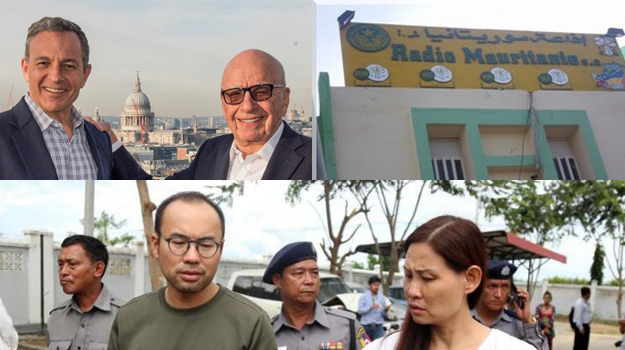
Making the greatest number of headlines in the media trade press and in the global consumer press is undoubtedly the news that 21st Century Fox has agreed to sell its entertainment business to Walt Disney. It’s an immensely expensive deal, with US$66.1bn in play for the Fox assets, assuming that the deal is cleared by regulators.

It is fitting that the deal was announced in the week of the premiere of the latest Star Wars movie. If the deal completes, Disney will become the largest media company in the world – with an empire that stretches from ABC, ESPN and A+E to Mickey Mouse and out into a galaxy far, far away.

Murdoch will continue to own the US Fox News and Sport assets; Sky in the UK – which produces Sky News – will become part of Disney. Star, serving audiences in the growth markets of Asia, will also be part of Disney enabling them to become a prime supplier of entertainment and sport to what will become increasingly valuable – and populous – markets.

Media observers have been discussing the future of reportedly loss-making UK-based Sky News after the Disney acquisition. Whilst Disney is most likely to be interested in access to sports fans via Sky Sports, and Sky’s movie channels and services, Sky News could be an interesting addition. It has the potential to extend ABC News’ international newsgathering capabilities, helping to bolster its output in the USA against rivals including, of course, Fox News which will remain a Murdoch operation.

Disney has made no secret of its intention to launch a rival to Netflix in 2019. It will gain a 30% stake in Hulu through the deal, which it could integrate into its planned OTT service. Disney’s movie portfolio will cease to be carried on Netflix – and presumably other streaming services – when its own service launches. This new deal provides immense marketing opportunities for Disney that could enable it to eclipse Netflix and other operators providing streaming services.

We believe that there will be many episodes to this story, so it could be a good time to order lots of popcorn.

TVN fine


A high value fine was imposed on Poland’s TVN this month. The Polish media regulator, KRRIT, fined TVN24 €350,000 for allegedly violating the country’s Radio and Television Act. The regulator said that TVN24’s coverage of anti-government protests in Warsaw at the end of last year promoted “illegal behaviour that posed a threat to public security”.

TVN, which was founded in 1997, has protested that the fine is unwarranted and says that it will appeal. TVN is owned by USA-based Scripps Networks Interactive.

TVN has been joined in protests against the regulator’s decision by the European Parliament and the US State Department, as well as local media in Poland. Gazeta Wyborcza, a daily newspaper, described the fine as “giant” and “unprecedentedly high”. The US State Department said: “The United States is concerned by Poland’s decision to fine the private TV broadcaster TVN for alleged biased reporting of demonstrations outside parliament last December. This decision appears to undermine media freedom in Poland, a close ally and fellow democracy. Free and independent media are essential to a strong democracy.”

The fine comes at a time when Poland is slipping down the list of countries that have free media. It is now described as only partially free by Freedom House, while Reporters Without Borders’ global ranking of press freedom has seen Poland has fall to 54th from 18th in 2015.

It’s perhaps worth noting that Poland has been pressing in European debates to change the Audiovisual Media Services Directive to allow regulation of channels in the country of reception, rather than country of origin. The Country of Origin rule is one of the cornerstones of European media regulation.

The issue of media freedom is one that will be discussed in a high-level conference that the AIB is planning for late February 2018. More details will appear on the AIB website shortly.

Mauritania


It’s a country twice the size of France, yet has a population of just 4.5m. It’s mainly desert, and is on some governments’ lists of “only travel there if essential” destinations. And now it’s in the media news as the head of state-run Radio Mauritanie has been dismissed for fraud.

In a country where the average household income is well under US$500, general manager Abdallahi O. Hormetalla has been dismissed for allegedly making fraudulent payments totalling 33m Mauritanian Ouguiya – around GBP70,000, mostly to relatives and fictitious companies likely controlled by relations. The annual budget of Radio Mauritanie is understood to be around GBP1.77m. Hormetalla, who had been appointed in 2016, has been replaced by presidential adviser Abdallahi O. Ahmed Damou.

Journalists under pressure


Journalists trying to cover stories in Bahrain and Kyrgyzstan have been barred from entering the countries over the past few weeks, while in Myanmar, they’ve been sentenced for illegal filming.

A Tel Aviv-based US journalist working for Al Jazeera has been accused of trying to enter Bahrain illegally, the country’s Ministry of Information Affairs said in the first week of December. The journalist, a correspondent for Al Jazeera in Iraq and Israel, arrived in Bahrain without, it is claimed, having applied for a media visa and without possessing an invitation from the organisers of the event he was reportedly planning to cover, the Ministry said.

The Kyrgyzstan government used similar tactics against AFP journalist Chris Rickleton (pictured). He reportedly has been barred from the country for “breaking the visa regime”. Rickleton has lived in the Kyrgyz capital Bishkek with his wife and daughter, who have Kyrgyz citizenship, since 2010. Rickleton has appealed to President Jeenbekov to lift the ban on his entering the country.

In Myanmar, two journalists working for TRT WORLD have been jailed for two months for allegedly contravening the country’s Aircraft Act. Singaporean Lau Hon Meng Malaysian Mok Choy Lin, as well as their local interpreter Aung Naing Soe and driver Hla Tin, were detained on October 27 while filming a programme for TRT WORLD. They were accused of trying to use a drone to record video images of the Hluttaw, or House of Representatives building, in the Myanmar capital allegedly without permission.

According to TRT WORLD, Lau and Mok had entered Myanmar on journalist visas on October 21. They were filming a documentary and had “shot in various locations with conventional cameras as well as with a drone, up until October 27”.

“The Myanmar Information Ministry was previously informed about all filming activities and the filming schedule,” TRT World said.

“According to information TRT World has gathered from local journalists who are in touch with Myanmar security officials and our team, our crew wanted to film the Parliament building in the capital with a drone after conducting an interview with a member of Parliament. They were detained by security officials before flying the drone.”


BBC Burmese programmes to run on Myanmar Radio

For the first time ever, BBC Burmese radio programmes will be rebroadcast by Myanmar’s state broadcaster, Myanmar Athan (Myanmar Radio) expanding the BBC Burmese service’s footprint in Myanmar further.  Three programmes – the BBC Burmese youth show, Mobigeno, the technology and digital innovations programme, Cool Tech, and the programme introducing innovative farming methods, San Thit Tehtwin Lai Myay Ta Kwin, are now part of the Myanmar Athan programming aired on FM, medium- and shortwave.


Collaboration with Myanmar Athan further expands BBC Burmese availability in Myanmar. BBC Burmese is currently broadcast through major local broadcasters, on TV and radio.  Its audio news bulletins are available on mobile phones in the country.


BBC Burmese Editor, Tin Htar Swe, commented:  “Our collaboration with Myanmar Athan means that now, for the first time for BBC Burmese in Myanmar, our content will be available via a state broadcaster.  In addition to medium- and shortwave availability, airing these programmes on FM will help us capture a new radio audience which will include a lot of young people who listen to FM on their mobile phones.  This is great news for the BBC in Myanmar, further reinforcing our multiplatform presence in Myanmar.”


MRTV Director-General, U Myint Htwe, said: “In such a good time of openness, Myanmar Athan will be carrying BBC content for the first time, and I am really proud of it. By adding the BBC’s high-quality radio programmes to the schedule of Myanmar Athan, we are further diversifying our radio offer.  I am looking forward to continuing MRTV’s cooperation with the BBC.”


The BBC Burmese 10-minute bi-weekly programmes will be re-broadcast by Myanmar Athan and repeated the following week at these times:


Mobigeno (Mobile Generation) – 15.15 Myanmar Time on Monday

Cool Tech – 14.20 on Tuesday

San Thit Tethwin Lai Myay Ta Kwin (Innovative Methods of Farming) – 11.45 on Thursday


The BBC Burmese radio programming is broadcast from London on shortwave and on Asiasat5 satellite television channel and streamed online via bbcburmese.com.  In addition to availability on MNTV, BBC Burmese TV news bulletins are streamed live on the website bbcburmese.com at 20.45 local time (14.15 GMT) Monday to Friday.  The BBC Burmese Facebook page has around 6.5 million fans while the BBC Burmese channel on Viber has around 200,000 followers (August 2016). BBC Burmese also connects with its audiences on Twitter.


BBC Burmese is part of BBC World Service. (Source: BBC press release)


BBC Burmese news bulletins come to MNTV in Myanmar

In another landmark development for the BBC’s presence in Burma (also known as Myanmar), BBC Burmese has launched its TV news bulletin on the national TV channel, Myanmar National Television (MNTV). BBC Burmese service’s 10-minute programme brings the BBC’s coverage of regional and international news to viewers of MNTV, live, at 20.45 Burmese Time (14.15 GMT) Monday to Friday.  The programme will also be streamed live on the website bbcburmese.com.

The launch of the new BBC Burmese TV news programming is part of the continued move of the BBC’s international news services towards digital platforms. BBC Burmese Editor, Tin Htar Swe, says:  “We have enjoyed mass listenership in Burma, where the BBC’s balanced, trustworthy radio programming has been in demand for decades.  Thanks to this milestone partnership with MNTV, viewers across the country will now have access to BBC news on prime time TV.  We are looking forward to this exciting new collaboration which will benefit those who want to keep abreast of the regional and world developments.”

Nan Mouk Laung Saing, President of MNTV and Managing Director of Shwe Than Lwin Media Co, Ltd, adds:  “We are delighted to form a partnership with the BBC. As a private media company, we are particularly proud to collaborate with the BBC and we look forward to a long-term partnership.  Shwe Than Lwin Media’s core objective is to entertain and inform Myanmar people, and the broadcast of BBC international TV news in Burmese language on MNTV channel will benefit our audience greatly.”

The launch of the BBC Burmese TV news bulletins on MNTV follows the recent expansion of the BBC presence on Myanmar’s media scene which saw the inclusion of selected BBC radio programming to the schedules of some of the country’s nationwide FM networks.  In another first for Burma, BBC Burmese audio news bulletins were made available to the country’s mobile-phone users.

The BBC Burmese radio programming is broadcast on shortwave and on PAS10 and Palapa satellite television channels and streamed online via bbcburmese.com. In addition to providing the latest news and current affairs, BBC Burmese offers its audiences a variety of programmes on education, sport, health, technology as well as weekly debates on topical issues.

BBC Burmese is part of BBC World Service. (Source: Press release)

Channel NewsAsia opens Myanmar news bureau and holds Business Insights Seminar

Regional broadcaster, Channel NewsAsia, celebrates the official opening today of its news bureau in Yangon, Myanmar, making it the channel’s 13th dedicated bureau in Southeast and East Asia. The office in Yangon follows on the heels of the launch of the Mumbai bureau in January 2013 in India.

The channel’s correspondent, May Wong, based in Yangon, will report from the ground with credibility and authenticity, to capture the developments in Myanmar as it opens up after half a century of isolation. This is also a significant year as the country assumes the ASEAN Chair for the first time. A broadcast journalist with 17 years of experience, May Wong has been filing stories from Myanmar since a year ago. In the more recent events, the channel was able to give regional viewers a close up on the astounding Southeast Asian Games in Myanmar and the just-concluded ASEAN Ministerial Meeting. On the business front, she provided insights on plans to set up the country’s first stock exchange, and its strategies to grow the aviation sector and to build a new airport to meet rising air passenger traffic.

Supporting these reports, the channel has, over the past few years, had several exclusive interviews about Myanmar. This included President Thein Sein’s first international television interview in July 2012, and when Speaker of Parliament, Thura U Shwe Mann, was in Singapore in September that year. It produced a 6 part series called “The New Myanmar” last year, and several other documentaries on the developments in the country.

Ms Debra Soon, Managing Director of Channel NewsAsia comments, “We have stepped up not only our news coverage, but our documentaries and programmes on Myanmar in the past few years. Today, we are adding another thrust to our engagement with Myanmar with a regional business seminar. This provides a platform for political and business leaders to understand more about the changing face of Myanmar. It’s a formula which we are replicating across Asia, improving our coverage within the region through news and current affairs, and making connections to the movers and shakers across Asia.”

Just a year ago in January 2013, the channel increased its broadcast time, reporting “live” for 24 hours. It opened a satellite studio in Singapore’s new upmarket Marina Bay Financial Centre that signalled its increased business programming, whilst it improved its Asian overnight coverage of financial markets in the United States and Europe. Its focus to deliver high end documentaries and content on Asia will tell the story of the region’s progress, dynamism and challenges.

As a continuing commitment to bring better understanding of Asia, Channel NewsAsia has brought its series of regional seminars for today’s official opening. The seminar, Business Insights – Understanding the Changing Myanmar, gathers think tanks, captains of industries and government leaders to discuss how business communities can achieve success and contribute to sustainable development and to deliver value to the people. The event is held at the Sedona Hotel in Yangon with official venue partner, Keppel Land.

The panel discussion will be facilitated by Channel NewsAsia’s award-winning Presenter, Teymoor Nabili. It includes Dr Muang Muang Lay, Vice President of the Republic of the Union of Myanmar Federation of Chambers of Commerce and Industry (UMFCCI), Mr Kanthan Shankar, Country Manager, East Asia & Pacific of The World Bank Group, Mr Melvyn Pun, CEO, Serge Pun & Associates (Myanmar) or SPA (Myanmar), Associate Professor Simon Tay, Chairman of Singapore Institute of International Affairs, and Mr William Greenlee, Jr., Partner/Deputy Managing Director, DFDL, Myanmar.