UK media regulator revokes CGTN broadcasting licence

UK media regulator revokes CGTN broadcasting licence

UK media regulator revokes CGTN broadcasting licence

UK media regulator Ofcom announced on 4 February that it has withdrawn the licence for CGTN to broadcast in the UK. The regulator gave details of its decision, stating that “…after its investigation concluded that the licence is wrongfully held by Star China Media Limited.”

Ofcom’s statement on the affair said:

“China Global Television Network (CGTN) is an international English-language satellite news channel.

In the UK, broadcasting laws made by Parliament state that broadcast licensees must have control over the licensed service – including editorial oversight over the programmes they show. In addition, under these laws, licence holders cannot be controlled by political bodies.[1]

Our investigation concluded that Star China Media Limited (SCML), the licence-holder for the CGTN service, did not have editorial responsibility for CGTN’s output. As such, SCML does not meet the legal requirement of having control over the licensed service, and so is not a lawful broadcast licensee.

In addition, we have been unable to grant an application to transfer the licence to an entity called China Global Television Network Corporation (CGTNC). This is because crucial information was missing from the application, and because we consider that CGTNC would be disqualified from holding a licence, as it is controlled by a body which is ultimately controlled by the Chinese Communist Party.

We have given CGTN significant time to come into compliance with the statutory rules. Those efforts have now been exhausted.

Following careful consideration, taking account of all the facts and the broadcaster’s and audience’s rights to freedom of expression, we have decided it is appropriate to revoke the licence for CGTN to broadcast in the UK.

We expect to conclude separate sanctions proceedings against CGTN for due impartiality and fairness and privacy breaches shortly.

Ofcom’s investigation

Our investigation found that SCML does not have editorial responsibility for selecting or compiling CGTN’s programme schedule. It is the distributor of the CGTN service in the UK, rather than “the provider” of the service.[2]

In addition, none of the employees involved in CGTN’s decision-making, or day-to-day running of the channel, appear to be employed by SCML. CGTNC confirmed that its Global Editorial Board is the ultimate decision maker over the selection and organisation of programmes for the CGTN service and exercises editorial control.

CGTN’s licence transfer application

In response to our enquiries, CGTN accepted that SCML did not control the channel and should no longer hold the licence. But it confirmed its intention to restructure to separate the CGTN division from China Central Television (CCTV) – which is ultimately controlled by the Chinese Communist Party and so disqualified from holding a UK broadcast licence[3] – and apply to transfer the licence to an entity which did control the channel.

Given the revocation of a broadcast licence is a significant interference with a broadcaster’s right to freedom of expression, we considered it appropriate to allow CGTN a reasonable period of time to come into compliance.

An application to transfer the licence to CGTNC was submitted in September 2020. However, we were unable to properly assess it. Crucial information was missing from the application, while the restructure that CGTN had signalled had not, and still has not, taken place.

CGTN has since repeatedly failed to respond to important questions necessary to our assessment of its application to transfer the licence, or to offer any update on progress with its restructure.

Links between CGTNC and CCTV

Having considered the available evidence, we have decided we are unable to grant the application to transfer the licence from SCML to CGTNC.

Correspondence from CGTN submitted during the course of our investigation makes clear that CGTNC is controlled by CCTV, which is also the sole shareholder of CGTNC.

Given CGTNC is controlled by CCTV – which, as part of the China Media Group, is controlled by the Chinese Communist Party and therefore disqualified from holding a broadcast licence under UK broadcasting laws – we consider that CGTNC would be disqualified from holding a licence.

An Ofcom spokesperson said: “Our investigation showed that the licence for China Global Television Network is held by an entity which has no editorial control over its programmes. We are unable to approve the application to transfer the licence to China Global Television Network Corporation because it is ultimately controlled by the Chinese Communist Party, which is not permitted under UK broadcasting law.

“We’ve provided CGTN with numerous opportunities to come into compliance, but it has not done so. We now consider it appropriate to withdraw the licence for CGTN to broadcast in the UK.”

Other CGTN cases

In 2020 we found CGTN in breach of the Ofcom Broadcasting Code for failing to preserve due impartiality in its coverage of the Hong Kong protests, and also found a serious breach of our fairness and privacy rules.[4]

Due to the seriousness of these breaches, we told CGTN that we would consider imposing sanctions.

Today’s decision does not affect these sanctions proceedings against CGTN, and we expect to reach our decisions shortly.

We have three other fairness and privacy investigations about content on the CGTN service which also remain ongoing, pending further consideration.”

CGTN has been monitored still broadcasting to the UK via the Freesat platform at the headquarters of the AIB at 1530GMT on 4 February.

UPDATE: The service ceased on Freesat at 1638GMT. 
Beijing consolidates national broadcasters

Beijing consolidates national broadcasters

According to a report in the South China Morning Post, China is planning to merge its state television and radio networks into one mega broadcaster in an overhaul that, the report says, is designed to tighten the Communist Party’s grip on public opinion and burnish the country’s global image.

China Central Television (CCTV), China National Radio (CNR) and China Radio International (CRI) will be consolidated into a new broadcaster that is to be called Voice of China – a name that is reminiscent of international broadcasters at the height of the Cold War.

“Our senior editors are convening meetings to convey the news this afternoon,” said a source who talked to SCMP and who requested anonymity. Another source at CCTV also confirmed the merger to the newspaper.

A document introducing the changes began circulating on social media on Tuesday. It says the consolidated group will sit directly under the State Council, China’s cabinet, and will be led by the party’s Central Publicity Department.

It also outlines changes to the propaganda unit and the Central Organisation Department – two already powerful agencies that will have even more heft after the revamp.

The propaganda department will absorb the country’s top media watchdog – the State Administration of Press, Publication, Radio, Film and Television – taking over its regulatory power on news, publications and film.

According to the document, Voice of China’s main duties will be to “promote the party’s theories, principles and policies”, “coordinate and organise major propaganda coverage”, “strengthen the ability to shape public opinion”, “improve its global communication capabilities”, and “tell the China story well”.

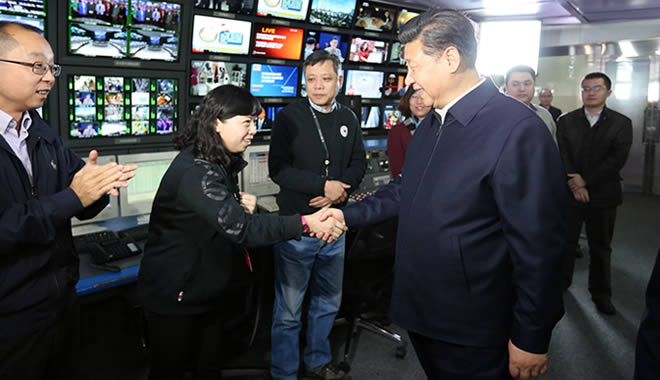
Under President Xi (seen above visiting CCTV headquarters), Beijing has also grown increasingly eager to be heard in a world it sees as dominated by Western narratives that are unfair and biased against China.

CCTV rebranded its international English-language news channel as CGTN in a move some observers say is to distance itself from Chinese state media.

New head for CCTV

New head for CCTV

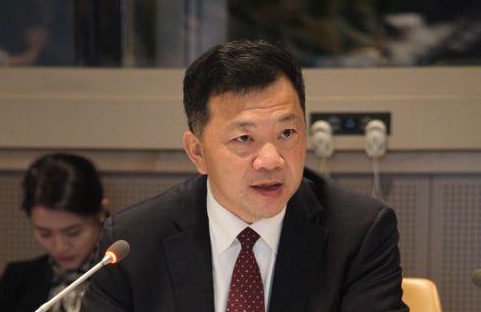
Shen Haixiong has been appointed as the new head of China Central Television (CCTV), the 12th director of the state television broadcaster.

The 50-year-old worked for 26 years at Xinhua News Agency and later served as a member of the Standing Committee of the CPC Guangdong Provincial Committee and Head of the Guangdong Publicity Department from 2015.

Shen succeeds Nie Chenxi, who has been CCTV head since 2015.

Eutelsat hits new milestone of 1,000 HD channels

  • HD pace accelerates across Eutelsat video neighbourhoods
  • 240 new channels in 2016 represents ↗30% growth

High Definition TV continues to gain ground across the broadcast satellites operated by Eutelsat Communications (NYSE Euronext Paris: ETL) with the 240 HD channels launched in 2016 equalling the total number launched during the previous two years.

The symbolic landmark of 1,000 channels was crossed this month with the launch at Eutelsat’s HOTBIRD neighbourhood of CGTN HD, the news and current affairs channel of China’s CCTV media organisation, marking its first foray into HDTV in Europe.

Eutelsat’s key video neighbourhoods all saw HD growth in 2016, with three distinguished for exclusive content and market leadership.

Accelerating HD growth at the HOTBIRD neighbourhood

The upwards curve of HD take-up was particularly strong at Eutelsat’s flagship HOTBIRD position where HD channels increased by 25% to 250, now accounting for almost one in four channels in the HOTBIRD line-up. This dynamic is driven by three key trends:

  • Progressive HD adoption by public broadcasters including RAI that has transitioned nine channels to HD and CCTV that launched three channels
  • New premium pay-TV content in flagship platforms including Sky Italia, Polsat, nc+ and Nova
  • A wave of new free-to-air channels that include Euronews HD and Al Jazeera English

Eutelsat 7/8° West position sets the trend in Middle East, North Africa and features exclusive HD channels

With almost 150 HD channels (up 40% in one year), of which 100 are exclusive, the 7/8° West position hosted by Eutelsat and Nilesat satellites leads the transition to HD in the Middle East and North Africa. Free-to-air channels in HD now outnumber pay, with strong brands launched exclusively at this neighbourhood including five channels launched by Kuwait TV and Echourouk News HD, the 24/7 Algerian news channel.

Eutelsat 36° East neighbourhood hits new high spot in Russia and Africa

Eutelsat satellites at 36° East that serve Russian and African markets clocked 14 additional HD channels over the last 12 months, rising to 114 HD channels. Russia’s leading NTV+ and Tricolor platforms each broadcast around 40 channels, to which can be added 32 HD channels broadcast to homes in Siberia from 56° East. In Africa, MultiChoice Africa and Zap are in the vanguard of HD, broadcasting 16 and 17 channels respectively and underscoring the trend towards higher resolution in Africa’s TV market.

Michel Azibert, Commercial and Development Director at Eutelsat, said: “2016 marked a tipping point for High Definition TV across our portfolio of video neighbourhoods, culminating in a new landmarkof 1,000 channels, many of which are exclusive to Eutelsat. We are fully equipped to accommodate this accelerating pace and to work closely with broadcasters as they transition to an enhanced viewing experience.”

(Source: Eutelsat press release)

CCTV rebrands in new global push

CCTV has disappeared as a brand from China’s consumer-facing international TV channels, replaced by a new name: China Global Television Network (CGTN). Overnight on 30 December, CCTV’s English, Arabic, Spanish, Russian and French channels were rebranded under the CGTN umbrella, while new mobile apps were launched.

According to the South China Morning Post, CCTV carried out the rebranding to “integrate resources and to adapt to the trend of media convergence”, with foreign language channels, video content and digital media falling under the new group.

This rebranding – and the new apps – are part of a continuing effort by China to project its soft power internationally. It is widely reported that billions of dollars are spent each year on China’s international television channels and on its cultural initiatives in markets globally.

Watch the CGTN promotion here: