The Winners of the 2009 AIBs

The Association for International Broadcasting announced the winners of its annual global media excellence awards at a gala event in London on 4 November 2009. The AIBs recognise creativity and innovation in global broadcasting across TV, radio, cross-media, marketing and technology.
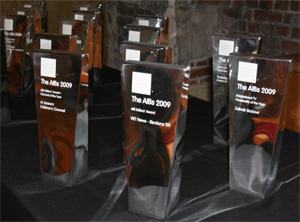
The AIBs are unique in broadcasting because of their independence from commercial interests – an independent panel of judges consisting of respected professionals from the broadcasting and wider industries selected the winners among more than 200 entries initially submitted from 26 countries as diverse as Argentina, France, India, UAE, USA, to name but a few.

Categories covered by the ‘AIBs’ include separate awards for radio and television, in current affairs, coverage of a single news event, creative features, and personality of the year, as well as awards for innovation in marketing, use of technology and cross-media productions.

The Awards event was sponsored by Bloomberg TV and hosted by Bloomberg anchor Francine Lacqua and attended by senior executives, producers and journalists from media organisations around the world.

The AIB International Media Excellence Award winners were:

Clearest coverage of a single news event – television

Winner

BBC Persian TV (UK) for The elections that shook Iran

—“a young channel mastering a huge challenge given the reporting restrictions and the vilification of the channel by the Iranian press”—

Highly commended

TV2 (Norway) for Children of Gaza

—“painful and touching”—

VRT (Belgium) for Villa Politica

—” mesmerising political drama unfolding on your screen”—

Clearest coverage of a single news event – radio

Winner

RFE/RL (Czech Republic) for Special coverage of the Azeri referendum

—“facing some tough hurdles in trying to reach into countries where the press is not as free as it should be”—

Highly commended

Voice of America for Coverage of the war in Sri Lanka

—“reporting that’s thoroughly useful to audiences, and
creates a deeper insight into the conflict”—

Most creative specialist genre – television

Winner

Pyramedia (UAE) for The Prince of Poets

—“astounding”— —“fantastic”—

Highly commended

Luxe TV (Luxembourg) for Lifestyle

—“stylish presentation”—

VTV (Ghana) for Make me a success – enterprise challenge

—“entertainment cleverly combined with education”

Most creative specialist genre – radio

Winner

Deutsche Welle (Germany) for Family affairs – how to become a political player

—“true creativity”—

Highly commended

Voice of Nigeria (Nigeria) for Kiddies’ voices – Africa fit for the child

—“passionate, unique and engaging, with creative use of poetry and dialogue”—

BBC World Service (UK) for The trouble with money

—“highly informative and strong editing helps to convey complex issues”—

Best creative feature – television

Winner

Rockhopper TV (UK) for Love in a time of HIV – I love NY

—“sensitive treatment of a difficult subject”—

Highly commended

CBC Radio-Canada (Canada) for Sunday with Darwin

—“informative dramatisation with excellent editing”—

Deutsche Welle TV (Germany) for Walled in – Germany’s inner borders

—“excellent animation”—

Best creative feature – radio

Winner

Tinderbox Productions (UK) for The counterfeiter’s tale

—“an astonishing story – one that needs to be told”—

Highly commended

Deutsche Welle (Germany) for On skis to the North Pole

—“great use of sound to tell an incredible journey”—

Radio Netherlands Worldwide (Netherlands) for The face of forgiveness

—“great story about redemption”—

Most innovative technology – sponsored by Bloomberg TV

Winner

France 24 (France) for World pioneer on the iPhone

—“brilliant use of a particular technology to expand the channel’s audience”—

Highly commended

E4 (UK) for Skins Messenger

—“brilliant and innovative support for the programme”—

NDTV (India) for Yoda – Multi-production in a laptop

—“highly adaptable to others in the industry”—

Best mobile or cross-media production

Winner

RTHK (Hong Kong) for Deconstructing Hong Kong

—“captivating story-telling that genuinely uses multiple media platforms

in their best functions”—

Highly commended

BBC World Service Trust (UK) for Condom Condom

—“a naturally seamless production”—

Most creative marketing strategy

Winner

ABC Radio Australia (Australia) for Pacific break

—“an original campaign that delivered a small idea on a very big scale

across a huge region of the world with a compelling final destination”—

Highly commended

BBC (UK) for India election train

—“energetic and engaging campaign”—

Channel 4 (UK) for E4

—“brilliantly executed campaign”—

Best current affairs documentary – television

Winners

CBC Radio-Canada (Canada) for Baby boomers take on Mount Mera

—“simply inspiring”—

Channel 4 (UK) for Dispatches – Pakistan’s Taliban generation

—“powerful, risky and passionate”—

Highly commended

Arte (France) for Tibetan el Dorado

—“visually stunning, a great story about herbal medicines”—

United Nations for 21st century – Central African Republic: the forgotten crisis

—“an extremely engaging production”—

Channel 4 (UK) for Dispatches – Orphans of the Burma cyclone

—“a risky undertaking and very moving”—

Best current affairs documentary – radio

Winner

Tinderbox Productions (UK) for Children of God

—“a fascinating and frightening documentary about young preachers

that engages the listener from the outset”—

Highly commended

ABC (Australia) for Losing Erin

—“a well-produced insight into a much misunderstood area of mental illness”—

BBC (UK) for Lost voices of Tiananmen

—” giving a deeper understanding of events in China 20 years ago”—

Best historical documentary – television

Winner

WDR (Germany) for Tiananmen

—“informative and compelling production”—

Best investigative documentary – television

Winner

BBC World News (UK) for Korea, out of the North

—“compelling account of unfolding human tragedy”—

Highly commended

Hessischer Rundfunk (Germany) for The child, the death and the truth

—“well-crafted and well thought out – opens the debate

on one of the searing images of our time”—

RTE (Ireland) for Prime time investigates: Travellers on the edge

—“fascinating account of a culture rarely highlighted”—

Best investigative documentary – radio

Winner

Ruth Evans Productions (UK) for The new scramble for Africa

— “reminding listeners how the political and economic landscape

in Africa is changing”—

Highly commended

Radio Romania (Romania) for The poisonous water

—“a well-produced, ‘old school’ documentary”—

International TV personality of the year

Winner

Zeinab Badawi – BBC World News (UK)

—“a clear winner”—

AIB Editors’ Awards

Al Jazeera Children’s Channel (Qatar) – JCC, the first Pan-Arab ‘edutainment’ channel for 7 to 15 year olds received the AIB Editors’ Award in recognition of the channel’s innovative and inspirational approach to providing fun education television to a region of the world where children are underserved.

VRT News (Belgium) – VRT News has offered its viewers ground-breaking coverage of elections in Belgium. During the 2009 election coverage, barriers between presenters, politicians and voters were torn down, thanks to innovative and engaging presentation. For this reason, AIB decided that one of its prestigious and exclusive Editors’ Awards should go to the VRT News team.

The judges for the AIBs 2009 have a vast range of experience in different aspects of broadcasting and are drawn from all over the world. The full list is: Amir Jahangir, CEO, SAMAA TV, Pakistan; Danforth Austin, Director, Voice of America and Acting Director, International Broadcasting Bureau, US; Michael Joseph, CEO, Safaricom, Kenya; Billy Wright, Global Head Media & Games Partnerships, Nokia, UK; Hanh Tran, Chief Executive, Radio Australia, Australia; Nahida Nakad, Deputy Director, Arabic Service, France 24, France; Darby Sanchez, CEO, Globecast Asia, Singapore; Matteo Berlucchi, CEO, Livestation, UK; Alla Salehian, Director, Global Media Services – Associated Press Television, UK; Torsti Tenhunen, CEO, Hasan & Partners Oy, Finland; Dirk Beusch, Senior Project Manager, Deutsche Welle TV, Germany; Dr Nabil Khatib, Executive Editor, Alarabiya News Channel, UAE; Natasha Elkington, AlertNet Correspondent/Humanitarian Crisis Reporter & Online Editor, Thomson Reuters, London; Russell Grute, Director of Marketing, Pharos, UK; Marcus Metzner, Head of Marketing & Communications, S4M, Germany; William Bird, Director, Media Monitoring Africa, South Africa; Corne Bouman, Managing Director, ProSkope, The Netherlands; Lem van Eupen, Head of Strategy, Radio Nederland Wereldomroep, The Netherlands; Julian Clover, Editorial Director, Broadband TV News, UK; Samuel Attah-Mensah, General Manager, CitiFM, Ghana; Simon Spanswick, CEO, AIB, UK.

RFI on mobile phones now in 11 US cities

RFI has just signed an agreement with AudioNow to broadcast its French programs on the telephone network, 24 hours a day, in 11 American cities: Boston, Chicago, San Francisco, Miami, New York City, Lafayette, New Orleans, Dallas, Seattle, LOS ANGELES and ATLANTA.

You can now listen to RFI by calling the following phone numbers (only local charges will apply):

– 617.963.1545 in Boston;

– 312.646.7684 in Chicago;

– 415.200.0603 in San Francisco;

– 786.228.5543 in Miami;

– 212.401.4554 in New York;

– 337.606.4013 in Lafayette;

– 504.218.0121 in New Orleans;

– 281.661.3512 in Dallas;

– 206.494.5388 in Seattle;

– 310.734.2092 in Los Angeles;

– 404.260.7375 in Atlanta;

This form of broadcasting is especially adapted to cell phone users who wish to stay tuned to their favorite shows.

About RFI

Radio France International is the leading French world news radio with international news round-the-clock. It broadcasts 24 hours a day on FM, shortwave, as well as on cable, satellite, the internet and mobile phone. A team of journalists broadcasting from its Paris studios along with 600 correspondents worldwide offer listeners a complete range of the latest international news and features and gives them a global outlook. All day long and every hour, a 10-minute news program and a 3-minute newsflash keep listeners updated on the international news.

About AudioNow

AudioNowTM is the leading provider of mobile phone broadcast radio distribution in the United States using its proprietary patent pending technology which allows any fixed or mobile phone to access live audio programming without any downloads or data networks. AudioNow works exclusively with leading radio broadcasters around the world to provide the most robust and reliable network connecting their content with listeners on the go. The company is the largest and fastest growing platform for radio broadcasters on any mobile phone. For the most recent month, Audionow registered more than 8 million listener minute and is adding 1 million listener minutes monthly.”

Despite threats to press freedom BBG broadcasts attract large audiences

U.S. international broadcasting attracted wide audiences worldwide in 2009, particularly in key countries including Iraq, Afghanistan and Iran, despite declines in press freedom and the targeting of journalists in some countries, the Broadcasting Board of Governors (BBG) announced today.

More than 171 million people worldwide turn to U.S. international broadcasts across media platforms every week for reliable news and information, according to the BBG’s independent research. This figure is statistically unchanged from the BBG’s global audience estimate of 175 million reported in June 2008 and represents an increase of more than 70 percent over the 100 million listeners and viewers in 2002.

BBG broadcasters — the Voice of America, Radio Free Europe/Radio Liberty, Radio and TV Marti, Radio Free Asia and the Middle East Broadcasting Networks (Alhurra TV and Radio Sawa) — are bringing reliable news and information to places where it is needed most. For example, U.S. international broadcasting reaches over 56 percent of the population in Afghanistan and more than 30 percent in Iran each week.

Freedom House marked 2009 as the seventh straight year of decline in global media freedom while the Committee to Protect Journalists documented increasing dangers bloggers face including harassment and imprisonment.

Countries with the highest percentage of audience reach include Iraq (72 percent), Rwanda (72 percent), Kosovo (64 percent), Afghanistan (56 percent) and Haiti (50 percent). Audiences increased to a record 43 percent in Armenia and to 16 percent in Zimbabwe.

The largest audiences for U.S. international broadcasting include Nigeria (22 million), Indonesia (16 million), Iran (14.5 million), and Iraq (11.7 million). The BBG?s first-ever survey of Niger found an audience of nearly 3 million in that country, while the first nationwide survey of Haiti found 1.4 million listeners. The audience also increased by 1.4 million in Egypt.

In order to reach key audiences on preferred media, the BBG has taken a number of strategic steps including continuing to increase TV offerings, expanding local FM presence where possible, and maximizing online content. Audience engagement through call-in shows and social networking is another priority effort.

U.S. international broadcasting has been able to attract high audience levels through sustained journalistic excellence, program innovations and diversification of media platforms. Harassment and threats to journalists in Pakistan, Iraq, Azerbaijan, Turkmenistan, and Cambodia along with persistent censorship in many countries including China, Iran and Cuba are ongoing challenges. Government crackdowns, most notably in Kyrgyzstan and Azerbaijan, prevented local radio and TV affiliates from carrying programming and caused declines in audience estimates. In addition, some radio audience declines were observed due to increased local competition, crowded FM markets and increased popularity of satellite TV.

At the same time, the BBG is delivering a significant amount of news on the Internet, via SMS text messaging and other new media platforms. The largest BBG Internet audiences are in Iraq, Oman, Kosovo, Morocco, and the UAE.

The BBG’s audience and market research is done independently via local market research firms around the world through a contract with the InterMedia Survey Institute. The standard measure of audience reach for the BBG and other international broadcasters is the number of adults (age 15and above) who “listened or viewed last week.” The audience estimate includes research conducted over a three year period in 70 countries, including 39 in Fiscal Year 2009.

Audience reach is one criterion the BBG uses to assess effectiveness. Broadcasting impact on the target audience, audience perception of the broadcasters’ credibility and improved understanding of the United States and current events are also key indicators of effectiveness.

In many countries, audience samples are extremely limited and require audience members to acknowledge illegal listening and/or viewing, activities that result in severe penalties. Numbers for these hard to reach countries and regions such as Somalia, North Korea, Tibet, and the Xinjiang Uyghur Autonomous Region are not included in our overall estimate. Such restrictive environments may make survey participants reluctant to reveal media habits that include banned international broadcasts.

The BBG is announcing its global audience estimate in conjunction with the release of the Fiscal Year 2009 Performance and Accountability Report.

World Electronic Media Forum calls for concrete action on murders of journalists

Broadcasters attending the fourth World Electronic Media Forum (WEMF 4) have called for sustained and concrete international action to address the murder of journalists in peacetime and in war.

“Most journalists are killed not in war zones but in their own countries as they try to shine the light of the truth into the darkest recesses of their societies,” they said in in a declaration adopted unanimously at the end of a two-day meeting in Mexico City.

The declaration, which will be put before the UN Secretary General, the President of the UN Security Council, the UN High Commissioner for Human Rights and UNESCO, was drawn up after a presentation of the global situation by the Director of the International News Safety Institute, Rodney Pinder.

He recalled that more than 350 men and women in the news media had died trying to tell the story since WEMF 3 two called on UN member states to respect “in letter and spirit” the terms of Security Council Resolution 1738 of 2006 on the safety of journalists in conflict. That resolution also urged nations to end the culture of impunity which so often shields the killers of journalists.

More journalists have been killed in Mexico this year than in any other country in the Western hemisphere, many of them for reporting on drug trafficking and related corruption.

“Governments are primarily responsible for the safety of all their citizens, including those in the news media,” the declaration said. “They have a responsibility to protect those citizens, pursue their killers and ensure freedom of expression.”

The safety session at the conference also heard dramatic accounts of the plight of many journalists in Mexico and Latin America from Dario Ramirez, regional director of the press freedom organisation Article 19 and Argentine journalist and writer Olga Wornat.

Like its three predecessors – in Geneva (2003), Tunis (2005) and Kuala Lumpur (2007) – WEMF 4 was organized by the world’s eight regional broadcasting unions. (Source: INSI press release)

GlobeCast’s platform on Astra 4A adds Canal 3 Benin to community of African content

GlobeCast announced today that Canal 3 Benin has joined its platform on Astra 4A (Sirius 4) at 5ºE. This privately-owned channel joins other key regional and international broadcasters on the platform, such as Vox Africa, Canal 2 International, LMTV and Waladjiri.

GlobeCast receives Canal 3’s signal via satellite in C band at its Paris technical operations center. The feed is then uplinked to GlobeCast’s sub-Saharan Africa distribution platform on the Astra 4A satellite. Once on the satellite, the channel can be received in Ku-Band direct to millions of homes in over 30 countries, with antennas as small as 90cm. GlobeCast also offers the channel a web streaming service for its internet site.

For Canal 3 Benin, the international distribution of its channel provides an opportunity to share its country with the rest of the world, including its socioeconomic, artistic and economic realities as well as tourism information. It also allows the channel to foster and build business relationships.

For GlobeCast, the addition of Canal 3 to its platform is the latest proof of the growth of this dynamic community of regional and international broadcasters – a community that is increasingly diverse in terms of the number of channels and diversity of content offered on the platform.

Al Jazeera English launches on Austar expanding its distribution reach to over 180 m households

Al Jazeera Network announces the launch of its English language global news service on the Austar Pay TV platform in Australia which will begin on the 15th of November, 2009, expanding Al Jazeera English’s distribution reach to over 180 million households globally.

Al Jazeera English is joining 40+ other channels available in the Austar Starter Package which has a subscriber base currently of 739,000 throughout regional Australia. It can be watched on channel 651.

Phil Lawrie, Director of Global Distribution, Al Jazeera said “We are delighted to be celebrating today’s launch of Al Jazeera English on Austar and to be able to provide AJE to a sizeable new audience in this important market. Furthermore, we’re excited at the fact that this launch helps carry AJE to a global distribution reach of over 180 million households – a particularly notable statistic in that we have now added 100 million homes to AJE’s distribution in the three years since the channel’s launch”.

John Porter, CEO of Austar said “With the addition of Al Jazeera English to our Starter Package, now Regional Australians will be able to enjoy a wide and diverse range of international news viewpoints and discourse”.