7 September 2004
The European Broadcasting Union today called on the European Union’s 25 Member States to support the EU’s Lisbon Strategy by ensuring that public broadcasters have a clear mandate and sufficient funding to offer a full and evolving range of services in the new media.
Senior officials of the EBU, the professional association of Europe’s public service broadcasters, were attending a conference organized by the Dutch government – current holder of the EU Presidency entitled The key role of public service broadcasting in the 21st century (www.omroep.nl/eu2004).
The Lisbon Strategy sees a decisive role for the audiovisual sector in making Europe the most competitive and dynamic knowledge-based economy in the world by 2010.
EBU President Arne Wessberg, who is director general of the Finnish Broadcasting Corporation YLE, said it was the responsibility of public broadcasters to serve the diversity of publics and cultures within their country, through the new electronic media as well as on television and radio. “Public service broadcasters must be given proper possibilities, by the societies in which they operate, to serve citizens with all media technologies they choose to use, and under adequate and predictable economic conditions,” he said.
The EBU submitted a substantial written contribution to the conference which called on Member States (which are primarily competent in the area) and on the European Union, within its areas of responsibility, to take a series of actions to enable public service broadcasting to plays its key role in European society in the 21st century. Among the actions sought, was to “ensure that the remit of public broadcasting, as referred to in the Amsterdam Protocol, is dynamic and evolutionary, particularly in view of new digital platforms which provide additional means for distributing electronic media content”.
Ruth Hieronymi, a German MEP who gave the conference’s keynote speech, said MEPs would fight for the dual public-private system of broadcasting “We don’t want the US system” – but that to do so effectively, they needed governments to establish clear remits for public broadcasters.
The Geneva-based EBU is the largest professional association of national broadcasters in the world. It serves 72 active members in 52 countries in Europe, North Africa and the Middle East and 50 associate members in 30 countries further afield. On behalf of its members the EBU negotiates broadcasting rights for major sports events, owns and operates the Eurovision and Euroradio networks, organizes programme exchanges, is the centre for coproductions and acquisitions, and provides a full range of other operational, commercial, technical, legal and strategic services.
3 September 2004
The Managing Director of the ABC, Russell Balding, has restructured the senior management levels of the Corporation to sharpen its focus on content and better position it strategically in the changing media landscape.
Mr Balding said that this restructure was a confident move, undertaken within a climate of success and strength, to give the Corporation an even more effective road-map for the next decade.
The ABC Executive, the principal decision making body of management, has been reduced in size from 12 to 7. The Executive will now be made up of the Managing Director, the Directors of Television, Radio, New Media and Digital Services, and News and Current Affairs, as well as two new positions covering operational areas and strategy.
David Pendleton (currently Director Business Services) has been appointed to the new position of Chief Operating Officer (COO). It has been created to oversee and coordinate operational support areas: Business Services, Human Resources, Production Resources and Technology and Distribution. These support areas were formally represented individually on the ABC Executive. The COO will also be the ABC’s Chief Financial Officer.
Geoff Crawford (currently Director Corporate Affairs) has been appointed to the position of Director of Strategy and Communications. This is a redesigned role to reflect a broadening of the Corporate Affairs function increasing the emphasis on strategically positioning the Corporation.
International Broadcasting and Enterprises Divisions will continue to report to the Managing Director.
“This restructure will reposition ABC management to focus on its primary objective, the creation and broadcast of programs, and to ensure that those programs are supported in an efficient and cost effective manner,” Mr Balding said. “The ABC has successfully navigated beyond the turmoil of the past to a point where it is now achieving historically high audiences and is in a position to capitalise on emerging opportunities. Standing still is not an option. To confront the challenges of the digital media future the ABC must order its priorities towards content creation. That is why I have formed a new leaner content-driven executive team to concentrate on creativity and program output,” Mr Balding said.
3 September 2004
The BBC’s commercially funded 24-hour news and information channel, BBC World, is set to more than double its reach across Germany as part of the country’s new national digital basic cable TV system.
BBC World is the first international television channel to be included in the main 24-channel package, available from September via Kabel Deutschland GmbH (KDG). This extends the reach of BBC World from around 11m cable homes to a potential 23m cable homes, giving Rhineland-Pfalz and Sachsen-Anhalt access to the channel for the first time, and considerably increasing the channel’s reach in Bavaria, Mecklenburg-Vorpommern and Saxonia.
“This is an incredibly exciting development, potentially giving all television viewers in Germany access to BBC World’s highly-regarded programmes for the first time,” says Gerry Ritchie, Head of Network Development, BBC World. “The channel is fast becoming a digital ‘must-have’ across Europe – we have a digital terrestrial frequency in Berlin/Brandenburg, and in Italy, Sweden and The Netherlands, with even more to come.”
KDG’s free digital offer, available free upon purchase of a digital decoder, is intended to be at the forefront of Germany’s strategy to transfer TV consumers to digital, in anticipation of analogue switch-off in 2010. The new channel bouquet includes the 24 channels with the strongest reach, in addition to public broadcasters ARD and ZDF.
“With BBC World, we have the international channel with the highest increase in daily viewing in our free digital package,” says Dr. Manuel Cubero, Director Cable TV at KDG, citing data from the European Media and Marketing Survey [EMS] 2004.
1 September 2004
SES ASTRA and GlobeCast have announced an agreement to offer access to the ASTRA Satellite System at 19.2° East to multicultural TV channels, targeting Spain and France. The GlobeCast satellite multiplex located in Madrid and linked to Globecasts worldwide ATM fiber ring will ensure secured access to the ASTRA platform.
This agreement will notably enable additional ethnic channels to join the roster of digital free-to-air channels on ASTRA. ASTRA currently broadcasts over 130 digital TV channels plus another 100 digital radio stations that can be received free-to-air with a simple dish antenna pointed at ASTRA 19.2° East and a simple, affordable digital satellite receiver.
This agreement provides a great opportunity for television channels to be accessed by more than 10 million European households receiving digital TV through ASTRA, of which 1.34 million are in Spain, and 2.99 million in France.
GlobeCast will deliver channels to the platform over its global transmission network that includes 15 teleports and technical operations centers on five continents, as well as via a global ATM fiber ring that interconnects GlobeCasts facilities worldwide to the multiplex gateway in Spain. Our partnership will benefit broadcasters by offering a one-hop global package to reach ASTRA viewers in Spain and in France from anywhere in the world. GlobeCasts worldwide fiber and satellite contribution network will feed channels to our ASTRA gateway in Madrid, states Christian Pinon, President and CEO of GlobeCast.
www.ses-astra.com
www.globecast.com
31 August 2004
The Federal Government of Nigeria has appointed an Acting Director-General for Voice of Nigeria (VON). He is Mallam Abubakar Jijiwa, who has been the Corporations Director, Administration and Finance.
Mallam Abubakar Jijiwa succeeds Mr. Taiwo Allimi whose five year term expired on 29 July 29. Mallam Jijiwa will also act as the Chairman, Broadcasting Organisations of Nigeria (BON).
The new acting Director-General assures that VON will continue to respect all its obligations and commitments to all its partners across the world.
Mallam Jijiwa can be reached on: abubakarjijiwa@yahoo.com
Telephone Numbers: 234-9-2346972 or 234-803-4700001
30 August 2004
The AIB has protested the closure of the Baghdad bureau of Aljazeera on Saturday 7 August 2004 by the Iraqi government.
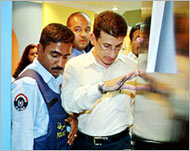
Above: An Aljazeera reporter being
escorted out of the office
The closure will do nothing to aid the establishment of democracy and civil society within Iraq, nor will it assist the free and fair reporting of events in the country to the Middle East. There is no credible evidence that the channel, a member – along with many other international radio and television broadcasters – of this Association, has encouraged criminals in Iraq or advocated or incited hatred and racial tension as the Iraqi authorities suggest.
Aljazeera, with a regular audience of well over 35 million people in the Arab-speaking world, is the only pan-Arab broadcaster to openly embrace and promote a code of ethics similar to that which journalists in international television and radio broadcasters worldwide work to. It is the only pan-Arab network that has engaged multiple trainers from western broadcasters and media training institutes to ensure that its rapidly growing staff are taught the need to be impartial, fair and accurate in their reporting and editing.
“The restrictions placed on Aljazeeras team working in Iraq may provide obstacles to the channels ability to report directly from the scene,” says Simon Spanswick, Chief Executive of the AIB. “However, the Iraqi government fails to understand the way in which modern television newsgathering operations function as Aljazeera will have continued access to video footage and correspondents reports from the country thanks to its long-standing arrangements with the mainstream news agencies and with other broadcasters.”
“This closure damages the Arab worlds perception of the fledgling Iraqi government,” Spanswick continues. “It suppresses factual news and information from high-quality journalists and harms the first freedom – that of free expression. We call on the Iraqi government to reverse its decision and allow Aljazeera to operate feely in the country.”
