27 January 2009
RRsat Global Communications Network Ltd. (NASDAQ: RRST), a rapidly growing provider of comprehensive content management and global distribution services to the television and radio broadcasting industries, announced today that it has been chosen to distribute two additional Russian-speaking channels, Smile of Child and Bridge TV, over Russia via Gascom’s Yamal 201 Satellite at 90° East.
RRsat has already started to distribute the channels from its teleport in Israel via Gascoms Yamal-201 Satellite, which will broadcast these channels over all of the CIS.
Smile of Child is an international, Russian-speaking channel broadcasting 24-7, targeting 4-12 year olds, which is currently viewed in 160 countries, and is retransmitted by over 450 cable networks in Russia alone. Bridge TV is a Russian satellite music channel presenting a modern and positive view on life and music. The channel targets young and active individuals.
These two channels join three additional Russian-speaking channels, CNL Siberia, CNL Europe and TBN, which are already distributed by RRsat via the Yamal-201 Satellite.
Gascom has always viewed its TV business sector to be of first priority: this is further visible by the fact that, despite the very high satellite utilization, we nevertheless managed to accommodate these two new channels, said Igor Kot, Deputy Director General of Gascom. We believe that our cooperation with such an advanced teleport such as RRSat, in itself increases Gascom’s ranking as a global satellite operator. We look forward to further developing this partnership over the future Yamal Satellites which optimally target the needs of a major client such as RRsat.
“Through our long standing working relationship with Gascom, and the Yamal-201 Satellite, we have been able to offer our customers access to almost the entire Russian territory, bringing the channels to millions of households through DBS and Cable headends,” commented Lior Rival, Deputy CEO and VP Sales & Marketing of RRsat. “RRsat, through its ever growing and expanding global network, is constantly seeking to enhance its offering to its customers, and we look forward to further strengthening our cooperation with Gascom through the future Yamal satellites.”
27 January 2009
Al Arabiya news channel, based in Dubai, has scooped the world with the first TV interview with President Barack Obama.
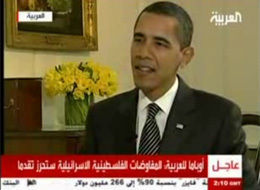
The interview was broadcast on 26 January and was carried out by the
channel’s Washington Bureau Chief, Hisham Melhem. With the the Map Room in the
White House as the backdrop, Obama talked about Al-Qaeda, living in Muslim
countries and the Palestine-Israel conflict.
Read the full the interview
here.
19 January 2009
WRN, the UK-based television and radio transmission company, is providing comprehensive satellite uplink and capacity and EPG services for Zee Radio, the newest radio station on the Sky Digital platform.
ZEE Radio is London’s all-Bollywood music station that will now be available nationally to all Sky viewers. The station, which is a part of ZEE Network UK, currently broadcasts in Greater London on 558AM (between 7am and 1pm) and on DAB digital radio and also across UK online at www.zeeradio.com.
Zee Radio will be available on Sky 0215 and WRN is also supplying EPG data compilation and submission services as part of the launch. ZEE Radio will join its TV family that consists of ZEE TV, ZEE Muzic, ZEE Cinema, ZEE Gujarati and Alpha ETC Punjabi, on the Sky platform.
Sangraam Marathe, Content Head, ZEE Radio said: “We are continuously reviewing our strategies to make ZEE Radio available to as many listeners as possible. After a fantastic first year on air in London, we now are going national by launching on Sky Digital, the home to our other ZEE TV channels.”
In February ZEE Radio celebrates its first broadcasting year on-air.
Sophie Wilson, Head of Sales and Business Development at WRN, says: “WRN is proud to have facilitated the launch of Zee Radio onto Sky Digital and we look forward to continuing to help them expand their reach across multiple digital platforms.”
WRN is able to supply satellite uplink and capacity and EPG services for Sky and guide clients through the entire process of launching on the platform.
19 January 2009
The Interactive Group, one of Italys leading post production companies, has purchased two eQ systems from Quantel.
When time is of the essence and the project demands the highest quality and reliability, then the only solution is Quantel, explains Interactive Romas Art Director, Elena Chiesa.
The eQs are an important step forward in speeding up all our post production processes. Since we opened for business in 2000, we have built our reputation on creativity and quality while offering a level of client service that is second to none, Chiesa continues.
Using other approaches, you waste a lot of time (and we all know time is money!) bouncing the media between several suites to carry out different parts of the post production process, both within and outside of the facility, explains Chiesa.
With the eQ, its perfectly viable to create the whole job on the system, from online editing to imported vfx, integrating titles, color correction, conforming, finishing and multi-format deliverables for every conceivable need. This multiple capability, combined with its incredible speed, means we can carry out the whole project in front of the client and make any required changes instantly as the job progresses, all without the use of any proxies.
It also means the client doesnt get any nasty surprises in the finishing sessions! eQ is the ultimate one-stop shop for all our post production requirements, Chiesa concludes.
19 January 2009
Darby Sanchez has been named CEO of GlobeCast Asia, based in Singapore.
Based in Singapore, Darby is responsible for all of the GlobeCast Groups activities in Asia, a role which she previously occupied from 2003 to 2006.
She replaces David Justin, who, following the successful growth of the company’s Asian business, has been called back to corporate headquarters in Paris to work with CEO Christian Pinon on GlobeCast’s worldwide strategy.
Darby Sanchez has been with GlobeCast for a decade, serving most recently as Senior Vice President of Sales at GlobeCast Europe in Paris as well as Vice President, Latin American Sales at GlobeCast America. Prior to joining GlobeCast, Darby was with L3 Communications and General Instrument Corporation.
12 January 2009
The International News Safety Institute has appealed to all parties involved in war and other conflicts to respect the independence and safety of journalists as the new year got off to one of its bloodiest beginnings ever for the world’s news media.
Warfare and other unrest claimed the lives of five journalists in the first eight days of 2009, the worst start to a new year since INSI began keeping records in 2003. More than 100 news media staff died in 2008.
There was significant evidence of journalists being targeted to silence their work.
“This is a dismaying start to the new year,” said INSI Director Rodney Pinder. “The deliberate targeting of journalists in war or peacetime is a crime and the perpetrators must be brought to justice.
“Free societies cannot exist without press freedom and there is no press freedom where journalists are being killed because of their work.”
The first victim, a Somali radio reporter, fell on 1 January. Radio Shabelle correspondent Hassan Mayow Hassan was shot by a member of a pro-government militia in Afgooye, 30 km south of Mogadishu.
Hassan was with other journalists covering clashes between Islamist militants and armed groups that support the federal transitional government. When Hassan identified himself as a journalist a militant shot him twice in the head.
The most recent victim, on 8 January, was Sri Lankan journalist Lasantha Wickramatunga, editor in chief of the Sunday Leader and one of South Asia’s most prominent press freedom campaigners.
Gunmen ambushed his car as he drove to work, used crowbars to smash the windows and opened fire at close range.
Lasantha was the 16th member of the news media slain in Sri Lanka over the past three years as war rages between the government an the Liberation Tigers of Tamil Eelam (LTTE).
A delegation to Sri Lanka from the International Press Freedom and Freedom of Expression Mission, which included INSI, reported that press freedom had deteriorated sharply over the previous year, marked by murders, attacks, abductions, intimidation and harassment of journalists.
It noted the authorities had taken little or no action over the killings even where there was evidence of identity of the perpetrators.
On 4 January, a suicide bomber in Pakistan killed at least seven people, including two journalists, Mohammad Imran and Tahir Awan of local dailies Eitedal and Apna Akhbar. The bomber struck when police, observed by journalists, were examining evidence of an earlier small explosion.
Two days later, a Palestinian cameraman, Basel Faraj, died of his wounds after being hit in an Israeli air strike in Gaza. Faraj, who worked for the Algerian TV network ENTV and the Palestine Broadcast Production Company, was filming with two reporters and another cameraman who were wounded.
The Palestine Journalists Syndicate (PJS) says Israeli forces have targeted vehicles and journalists clearly identified as such with “Press” or “TV” markings.
Two leading journalist support groups, The International Federation of Journalists and the Committee to Protect Journalists, both INSI members, have accused the Israeli military of targeting Palestinian news media in the Gaza Strip while maintaining a ban on foreign journalists from entering the territory.
The
CPJ, quoting regional news agencies, said Israeli forces on Monday fired two missiles into the offices of the Hamas-affiliated Al-Risala news weekly and a few minutes later bombed al-Rantisi printers, a commercial firm which publishes Al-Risala.
The IFJ said each day brought “more cynical violations of press freedom and the rights of journalists trying desperately to cover events unfolding in Gaza”.
INSI urges all warring parties to respect in letter and spirit UN Security Council Resolution 1738 of 2006 which demands an end to attacks on journalists in armed conflict.
“All parties in situations of armed conflict were urged to respect the professional independence and rights of journalists, media professionals and associated personnel as civilians,” the resolution says.
INSI’s Killing The Messenger tracker of news media casualties around the world counts at least 1,375 dead in the 12 years since 1996.
