21 May 2013
Intelsat S.A. [NYSE: I], the world’s leading provider of satellite services, today announced that its subsidiary, Intelsat Jackson Holdings S.A. (“Intelsat Jackson”), intends to offer $2,000,000,000 aggregate principal amount of senior notes due 2023 (the “2023 notes”). Intelsat Jackson’s obligations under the notes will be guaranteed by certain of its parent and subsidiary companies.
In addition, Intelsat Jackson intends to offer $635,000,000 aggregate principal amount of its 65/8% Senior Notes due 2022 (the “2022 notes” and together with the 2023 notes, the “notes”). The 2022 notes will be issued under the same indenture as Intelsat Jackson’s existing 65/8% Senior Notes due 2022. Intelsat Jackson’s obligations under the 2022 notes will be guaranteed by certain of its parent companies. The 2022 notes will not be guaranteed by Intelsat Jackson’s subsidiaries.
The net proceeds from the sale of the notes, together with other available cash, are expected to be used by Intelsat Jackson to repay all amounts outstanding (approximately $868 million principal amount) under its two senior unsecured credit agreements.
In addition, Intelsat Jackson expects to make a dividend to Intelsat (Luxembourg) S.A., which will use such funds and other available cash to redeem all of its 11¼% Senior Notes due 2017 in its previously announced redemption on June 12, 2013. The remaining net proceeds are expected to be used to pay related fees and expenses and for general corporate purposes.
The notes referred to above will be offered and sold to qualified institutional buyers in accordance with Rule 144A under the Securities Act of 1933, as amended (the “Securities Act”), and to persons outside the United States in accordance with Regulation S under the Securities Act and applicable exemptions from registration, prospectus or like requirements under the laws and regulations of the relevant jurisdictions outside the United States.
About Intelsat
Intelsat [NYSE: I] is the leading provider of satellite services worldwide. For almost 50 years, Intelsat has been delivering information and entertainment for many of the world’s leading media and network companies, multinational corporations, Internet Service Providers and governmental agencies. Intelsat’s satellite, teleport and fiber infrastructure is unmatched in the industry, setting the standard for transmissions of video, data and voice services. From the globalization of content and the proliferation of HD, to the expansion of cellular networks and broadband access, with Intelsat, advanced communications anywhere in the world are closer, by far. www.intelsat.com
20 May 2013
WRN Broadcast has today announced the appointment of Nick Thompson to the position of Non-Executive Director.
Thompson, who was Managing Director of Arqiva’s Broadcast & Media division until 2011, has a wealth of experience in creating and building international businesses, specifically in the broadcast and media sectors. The appointment will see Thompson work with WRN Broadcast’s board and executive management team to inform the company’s strategic development plan and further progress the rapid growth the company has experienced in the last few years in the ever-changing international broadcast marketplace.
Tim Ashburner, Chairman, WRN Broadcast, said: “We’re delighted to appoint Nick Thompson as a Non-Executive Director. With our recent investment into key emerging areas and with several significant customer wins Nick joins us at a very exciting time for the company. We welcome the wealth of experience Nick brings and we are excited to have his guidance and support. By continuing to strengthen our board, we are confident that we can continue to develop our provision of first-class international broadcast and media services.”
At Arqiva, Thompson was responsible for establishing one of the world’s largest satellite and broadcast services companies. Prior to this, he had significant success as President, EMEA division, at Loral CyberStar; Managing Director, Satellite division at Kingston Communications; and CEO of Inmedia Communications – before leading the sale of Inmedia to Arqiva in 2005.
Nick Thompson said: “I’m delighted to be joining WRN Broadcast as a Non-Executive Director. The company has made tremendous progress over the last few years and I’m confident my recent experience of creating and leading one of the world’s largest satellite and broadcast services companies will allow me to assist the senior management team in driving WRN Broadcast to become one of the pre-eminent providers of digital broadcast and media playout services, globally.”
Under the leadership of CEO, David Treadway, WRN Broadcast continues to provide multi-channel playout, content management and distribution services for some of the world’s greatest networks including Viacom, Top Up TV and Zuku.
17 May 2013
- arvato at influential ‘Media Finance Focus 2013’ conference inNew Orleans
- arvato Systems’ comprehensive solutions suite supports the latest trends in the media industry, including cross-media, on-demand, and non-linear services
arvato Systems is set to participate in the annual MFM & BCCA conference for the fourth time. Visitors to the well-established event in the U.S. media industry can learn more about arvato Systems’ advanced software solutions for broadcast and new media, all of which deliver the latest features such as cross-media marketing, integrated rights management, and ad slot optimization.
Media Finance Focus 2013 is an exclusive event established in theU.S.media industry many years ago. It is primarily geared toward business managers at media companies. Over 150 participants will gather at The Roosevelt Hotel inNew Orleansfrom 20 to 22 May 2013 to hear the latest on topics such as finance, accounting, taxes, human resources, and technologies as these relate to TV, radio, print, and the Internet.
arvato Systems will present IT solutions that support and simplify highly complex, cross-media advertising strategies at Booth 118. The sales software ensures optimal management and the perfect placement of commercials and banner advertisements, with maximum flexibility in terms of the type of customer, campaign, or media. This way, the solutions provide an integrated workflow that incorporates the latest media technologies to help unlock the full potential of advertising.
Eivind Sandstrand, Corporate Business Manager North America at arvato Systems S4M GmbH inCologne, will deliver a presentation focusing on the central web-based media sales platform AdStore and the S4AdOpt optimization tool, as well as the benefits of Avatega, the modular, all-in-one solution. “There are many benefits for users from the media industry such as optimized profits in cross-media sales,” says the long-time industry expert.
www.s4m.arvato-systems.de.
16 May 2013
AP reports that a Vietnamese satellite TV platform has dropped BBC World News and CNN from its channel line-up on Thursday 16 May. K+, a joint venture between a Vietnamese company and Canal Overseas, part of the Canal+ Group, appears to be interpreting the “Decision 20” regulation – which places onerous conditions on foreign TV channels – in a particular way, in direct contrast to a majority of other Vietnam-based platforms.
AIB has been lobbying on the issue over the past few months and is now seeking further clarification both from K+ and the Vietnamese Ministry of Information and Communication.
“We are disappointed that Vietnamese audiences are having their choice of international TV channels restricted,” said Simon Spanswick, AIB chief executive. “There is still uncertainty around the proposed pay-TV regulations promulgated in Vietnam. K+ appears to be out of step with the Vietnamese market and the latest interpretation of Decision 20. We look forward to the channels that have been taken off air being restored very quickly.”
As of the European afternoon on 16 May, the K+ website was still showing BBC World News and CNN as channels available to the platform’s subscribers.
14 May 2013
One of Asia’s leading sports executives and a football guru for the “beautiful game”, has joined the Association for International Broadcasting [AIB] as an adviser.
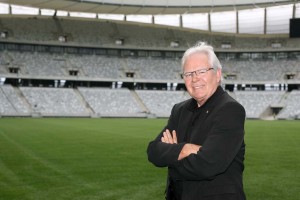 Les Murray (right) is known in his adopted homeland – Australia – as “Mr. Football”. He will provide a wide range of skills for the AIB as it develops its new Asian base.
In a rapidly expanding Asian market for sport, Murray’s experience in football will be vital to expanding the interests of the AIB, said its Chief Executive Simon Spanswick.
“Les will play a crucial role in our plans for Asia, especially with football properties. We intend to be an aggressive player in the market,” Spanswick said from London.
Mr. Murray was until recently the chair of the Asia Pacific Broadcasting Union’s Sports Group (ABU), a position from which he retired after 12 years.
Mr. Murray, a Fifa Ethics Commissioner, is something of a legend in Asia, having covered football there for 30 years.
“We are delighted to have Les on board our new broadcast vehicle ,” said Spanswick. “He will add a tremendous amount of value to our brand, as well as our ability to attract new business,” he added.
Les Murray’s interest in sports broadcasting has roots in his boyhood love for football in his birthplace of Hungary.
After immigrating to Australia as a child refugee in 1957, he continued his passion for his beloved game and made it a life mission to convert Australians to the world’s favourite sport.
Ultimately, after he stepped into broadcasting in the late 1970s as commentator and sports presenter, the mission met with success through the exposure he brought to football on Australian television. Murray is now largely credited with football’s vast growth in awareness and popularity in his adopted country over the past 30 years.
In 1996 Murray was appointed head of sport at Australia’s multicultural broadcaster, SBS, and continued in that role for ten years. During that period he negotiated many major sports rights deals, including three FIFA World Cup contracts, the UEFA Champions League, the Tour de France and international athletics with the IAAF.
Murray has spoken at many international forums, including the United Nations, and in 2006 was awarded the Order of Australia for his services to football and sports journalism. In 2009 he was given the Australian Sports Commission’s Lifetime Achievement Award.
Said Murray: “I am delighted to accept this invitation by the AIB and be given the opportunity to work with broadcasters in Asia.
“Sport and, in particular, sports broadcasting are fabulous catalysts for advancing and enriching national cultures and for empowering cultural identities.
“I am thrilled to be able to assist Asian broadcasters in achieving these goals.”
13 May 2013
The Association for International Broadcasting (AIB) has launched its 9th annual international awards covering all that is best in information media, with a call for entries in any language from every country to be submitted by 5 July.
CRANBROOK, UK 13 MAY 2013 –For the ninth successive year the Association for International Broadcasting (AIB) is shining the spotlight on the best of factual broadcasting, whether it is on radio, on TV or on transmedia platforms. Entries for the 2013 AIBs are invited from all over the world and can be in any language.
The AIBs have a history of attracting the very best content, with programmes entered by broadcasters, independent producers and journalists from countries on every continent. The awards are independent of commercial interest and judged by a panel of independent highly respected media professionals.
“Winners have told us how much it means to be presented with an AIB Award,” says Simon Spanswick, CEO of the AIB. “It is a recognition of fantastic effort and skill given by their peers in the broadcasting industry. Being selected for the shortlist has also helped programmes to gain commercial success and programme-makers to develop their careers. Broadcasters have bought featured programmes and producers have spotted rising talent. We’re proud to have helped talented people further their careers over the last eight years.”
As well as live journalism and documentaries that inform debate, the AIB is also searching for the best in science programming, and the best children’s factual programme or series. For the second year there is an award for the best short documentary, feature or report – factual story-telling in under ten minutes; this will represent this growing genre which is available not just from traditional broadcasters but also from online platforms such as YouTube and increasingly on the websites of newspapers and online news publishers.
Online upload and viewing capability will make the AIBs greener than in previous years. It will save entrants having to ship tapes and the judges, who are based all over the globe, will have easy access to the entries.
Entries must be submitted to the AIB by Friday 5 July 2013. Full details of the awards and how to enter are contained in the “AIBs 2013 Entry Booklet” which can be viewed and downloaded from the AIB website at www.aib.org.uk.
The winners will announced at the AIB awards gala in London on Wednesday 6th November 2013 which will be held in the stunning surroundings of LSO St Luke’s, the education and training centre of the London Symphony Orchestra, in the company of guests from around the world.
The AIBs also include awards for best TV and radio personality and for innovative production technology. The full list of categories is:
TV AWARDS
- Live journalism
- International current affairs documentary
- Domestic current affairs documentary
- Investigative documentary
- Children’s factual programme/series (sponsored by RTG TV)
- Science programme or scientific coverage
- Specialist genre programme or series
- Live sports coverage
- Short documentary or report
RADIO AWARDS
- Live journalism
- Current affairs documentary
- Investigative documentary
- Creative feature
ON-AIR TALENT
- International TV personality
- International radio personality
TRANSMEDIA
TECHNOLOGY
- Most innovative production technology
E N D S
About RTG TV
Russian Travel Guide TV is sponsoring this year’s “Children’s factual programme/series” award. RTG TV is an international documentary TV channel focused on the cultural and geographical variety of the world’s largest country. It covers a wide range of topics from history to culture, cuisine, nature programmes, active holidays, andRussia’s ethnic mix.
About the AIB
Established in 1993, the AIB is the international not-for-profit, non-governmental industry association and global knowledge network for the international broadcasting industry – cross-media, cross-border, cross-cultural. With a reach of over 25,000 communicators and media professionals, AIB is a unique centre of information about international broadcasting, covering TV, radio, online and mobile. AIB researches regular market intelligence briefings for its members and provides client-specific consultancy and project support. Members receive an extensive package of services throughout the year. AIB publishes the comprehensive Global Broadcasting Sourcebook and the international media magazine, The Channel. AIB hosts the annual AIB International Media Excellence Awards – the “AIBs”. For more information, visit www.aib.org.uk and theaibs.tv or call +44 (0) 20 7993 2557
Media Contact
For further information please contact Roger Stone at the AIB
AIB |PO Box141|Cranbrook| TN17 9AJ |United Kingdom
T +44 20 7993 2557
F +44 20 7993 8043
www.aib.org.uk
