1 August 2014
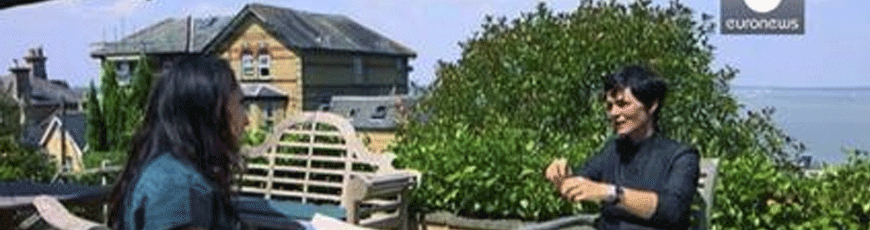
Euronews’ Isabelle Kumar spoke to Ellen MacArthur in The Global Conversation first aired 31 July 2014. After battling towering waves alone at sea, she broke the world record for the fastest circumnavigation of the globe in 2005, Ellen MacArthur returns with a new challenge: accelerate the transition to an eco-friendly circular economy.
During the interview, Ellen MacArthur also engages with Euronews’ online audience by answering questions submitted via #AskMacArthur.
On the circular economy:
“I think one of the most interesting elements of the European Commission’s work around the circular economy, is that they are looking at taking, for example, the eco-design directive, which is very much focused on the energy consumption of products, and saying how do we take that further to look at what sits within products, the recyclability of products of course, but actually that lies within the fact that the products are designed to be recycled, they’re designed to be regenerated, they are designed to be remanufactured, so its opening up much more to look at the whole system, rather than just the energy element.”
About the adrenalin:
“There’s a lot of adrenalin in both worlds. How does that adrenalin compare? When you sail around the world there is massive adrenalin, you fear for your life, but ultimately, it does not matter. If it all goes wrong, it’s just you, it’s your family, the implications on your family and friends, but ultimately it’s just you, it doesn’t really matter, and you do it for you because that’s your goal. This isn’t for me, this is something much larger, this is a massive challenge for all of us moving forwards. If there is a reason for adrenalin to be higher in this, well its because actually, this matters, our global economy really matters.”
1 August 2014
The Stalwarts share their journey to excellence
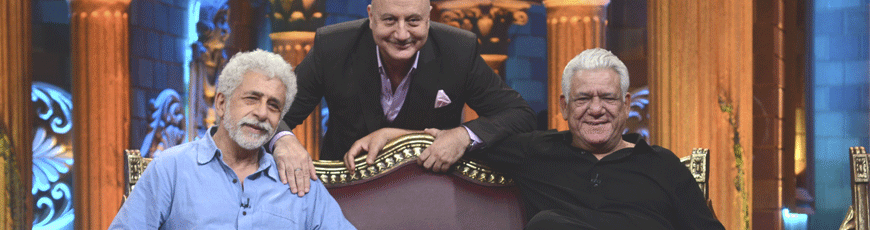
It’s rare enough to see Naseeruddin Shah or Om Puri bare their hearts. But the first episode in August of The Anupam Kher Show – Kucch Bhi Ho Sakta Hai will bring together both these stalwarts as they recount their journey from being simpletons to the superstars that they are today.
For Naseeruddin Shah, it was always about literature and art. His interest in being on the stage peaked when in Std. 9 he got an opportunity to be a part of Shakespeare’s famous play, The Merchant of Venice. This first stint on stage made Naseeruddin Shah fall in love with acting while creating a sense of self-worth and belonging. As he ventured deeper into the world of theatre and entertainment, Naseeruddin Shah joined the National School of Drama – a phase which he claims was the happiest in his life. Along with a stipend of Rs.200, his experience at NSD earned him the friendship of Om Puri, a classmate whom he has known since 1970.
Om Puri’s tryst with entertainment began when he was offered Rs.150 to act in a play. Om says, “If Naseeruddin didn’t push me at NSD, I wouldn’t be sitting here on the couch today.” The two, collectively, as seniors to Anupam Kher at NSD, are also responsible for taking Bollywood to international waters.
In fact, when Om Puri received a National Award for his role in Arth Satya, Naseeruddin openly commented that he was envious of Om because he would never have been able to pull off the role. Elaborating further, Naseeruddin said, “Om was born with a wooden spoon. I’m proud to see him here today.”
If this intrigues you about the relationship between Bollywood’s most legendary actors and their life and times, all we can say the episode will surely blow you away!
The show airs every Sunday at 8 PM on AIB member COLORS.
2 July 2014
France 24 today launches a new version of its Android application, compatible with all devices equipped with the Google mobile operating system, available for free on Google Play.
Adapted to new practices in news consumption, this new trilingual application (French, English, Arabic) features streamlined design and very fast video loading for greater user comfort.
This version has been completely redesigned for navigation on tablets and all video content is now compatible with the Chromecast service.
In addition to free access to articles, reports and all France 24 programmes, mobile users can now personalize their navigation thanks to a new “Favourites” page that lets them create a catalogue of content and build up lists of articles using keywords. They can also use the “tweets” tab to follow the activity of France 24’s journalists and programmes in real time on Twitter.
Lastly, thanks to the dedicated tools, users can share the news items of their choice on the social networks. To follow breaking international news as it happens, users can also sign up for news alerts in the language of their choice.
A pioneer in mobile broadcasts, France 24 has been available on smartphones since February 2009. The international channel was the first in the world to broadcast its programmes live on these devices.
About France 24, a France Médias Monde channel (FRANCE24.COM)
France 24, the international news channel, broadcasts 24/7 to 250 million homes around the world in French, Arabic and English. The three versions have a combined weekly audience of 41.7 million TV viewers (calculation method used without extrapolation in 55 of the 177 countries where the channel is broadcast). From its newsroom in Paris, France 24 gives a French perspective on global affairs through a network of several hundred correspondents located in nearly every country. It is available via cable, satellite, DTT, ADSL, on mobile phones, tablets and connected TVs. FRANCE 24’s new media platforms, which are also available in three languages, attract 14 million visits, 7 million video views a month and 6.5 million followers on social networks.
1 July 2014
More than 180 million Indonesians will go to the polls on 9 July to elect the country’s seventh President. Who will succeed outgoing President Susilo Bambang Yudhoyono? Will it be the former governor of Jakarta, Joko Widodo, or ex-general Prabowo Subianto.
Channel NewsAsia programmes, Insight and Primetime Asia, will bring viewers exclusive specials on the election for the Indonesia President.
Insight – Indonesia’s Next President
One a political newcomer with small business credentials. The other a wealthy former Special Forces general and former son-in-law of Indonesia’s strongman Suharto. The hugely popular Joko Widodo or Jokowi, who comes across as a humble and approachable leader, will come up against Prabowo Subianto, who has been campaigning hard on his perceived attributes as a tough and decisive leader in a two-horse race.
Will Jokowi’s combined strength of 4 parties with 40% of the votes be able to take on Subianto, who has amassed a formidable coalition of 6 parties with a combined strength of 49% of the votes? Who will Indonesians pick as their next leader?
Insight goes to several provinces in Indonesia to meet several key political personalities from the respective parties, former military men, analysts, the kingmakers as well as citizens to understand the preferences of the Indonesian voters ahead of the polls on 9 July.
Insight – Indonesia’s Next Presidentwill be shown at the following times:
Thursday, 3 July 2014, 8pm (SIN/HK/MNL time)
Encore telecasts
Thursday, 3 July, 1am
Friday, 4 July, 6pm
Friday, 4 July, 5am
Saturday, 5 July, 1pm
Primetime Asia – Indonesia Votes
This 2-hour special edition of Primetime Asia will deliver an indepth analysis of the latest election results with expert analysis. Channel NewsAsia’s team of correspondents will report “live” from Indonesia, updating on the results as they come in.
Primetime Asia – Indonesia Votes will be shown:
Wednesday, 9 July 2014, 7pm (SIN/HK/MNL time)
Updates, news articles and videos pertaining to the Indonesian Presidential Elections are exclusively available on http://www.channelnewsasia.com/news/asiapacific/indonesiaelections
1 July 2014
France 24 has concluded a new distribution agreement in Thailand with major cable operator Chaoren.
Thanks to this agreement, France 24 English version is now available in 300,000 additional households across the country in the operator’s basic offer on channel 22.
Already available in Thailand on various cable, satellite and IPTV offers, this new agreement allows France 24 to reach 2,525,000 households 24/7, which represents a quarter of all digital households in the country.
In addition, The France 24 Debate*, one of the channel’s flagship programmes, isnow broadcast every day to 14 million homes on the national TV channel PSI Saradee.
*subtitled in Thai
About France 24, a France Médias Monde channel (FRANCE24.COM)
France 24, the international news channel, broadcasts 24/7 to 250 million homes around the world in French, Arabic and English. The three versions have a combined weekly audience of 41.7 million TV viewers (calculation method used without extrapolation in 55 of the 177 countries where the channel is broadcast). From its newsroom in Paris, France 24 gives a French perspective on global affairs through a network of several hundred correspondents located in nearly every country. It is available via cable, satellite, DTT, ADSL, on mobile phones, tablets and connected TVs. France 24’s new media platforms, which are also available in three languages, attract 14 million visits, 7 million video views a month and 6.5 million followers on social networks.
1 July 2014
In the age of big data, Google critics say online services come at the price of freedom. Opponents say old business models for journalism are being redefined by the Internet and the people who use it.
Mathias Döpfner, CEO of media publishing house Axel Springer SE and U.S. Internet expert Jeff Jarvis locked horns in the first main debate at the DW Global Media Forum in Bonn, Germany. Döpfner says that people pay for seemingly free online services with their freedom, while Jarvis says he’s glad “that Google knows where I live.”
The “Media summit” on the first day of conference focused on the future of journalism and the role of international broadcasters. Also participating in the debate were Salah Negm, Director of News at Al Jazeera’s English channel, Jawhar Sircar, CEO of Indian public broadcaster Prasar Bharati and Peter Limbourg, Director General of Germany’s international broadcaster, Deutsche Welle.
Jarvis accused Döpfner of calling for state funding to save the faltering business model of paid journalism, rather than concentrating on developing new ideas. In response, Döpfner said his publishing company had already changed radically, and that digital content generates two-thirds of the business’ profits. He said that Axel Springer SE wants to become a leading digital publisher. Speaking to an international audience that included many journalists, Jarvis pointed out that “It’s far too soon to know what the Internet is and that we should define it in analog of our ways in the past.”
In a keynote speech just prior to the panel discussion, Döpfner predicted that “a culture of paying for digital journalism will take root over the next few years. Content that is less valuable will continue to be free, content that is particularly relevant, exclusive or entertaining will be paid for.” He also said it was a misperception that people can access online content for free. “The services which are perceived to be free of charge have a much higher price than money. Those who pay with their behavior, pay in the end with their freedom.”
“My newspaper can’t do that”
According to Jarvis, anyone who wants to be successful online needs to be Google-oriented. Google isn’t a gatekeeper who decides what information reaches people, he said. “It is a platform that enables anyone and everyone to speak.” Jarvis also pointed out that Google has a strict service commitment to its users and the personalized online experience it is developing will be a big part of the future of journalism. “I am happy that Google knows where I live and where I work because I get relevant data back in return. My newspaper has no idea who I am and where I live and where I work and can’t give me relevance.”
Journalism is a mission, not a profession
Debate moderator Tim Sebastian pointed out that not only the business model of journalism faces insecurity, but that journalists themselves are too often in danger, citing the three Al Jazeera reporters sentenced to prison in Cairo without fair trial. On the topic of security for journalists, Salah Negm, called for more solidarity from the international journalism community. Negm said that for him, the future of journalism is less of a technical question. “The most important factor is trust,” he said, “and we have to earn that trust everyday and every minute. I would like to think of journalism not as a profession but as a mission.”
Peter Limbourg, Director General of Deutsche Welle agreed, adding that international broadcasters have a duty to stand up to their responsibility as information providers when national media outlets only show one side of a story. “I think it’s good that we have the Russians, the Chinese and the Gulf states in the market and they should come to us and they should bring their opinions,” he said, “but it’s a vice versa thing. Let me try to broadcast Deutsche Welle in Saudi Arabia. This would be a difficult thing. Let me try to go in and broadcast in China. Or let me go in and broadcast in Russia – everywhere with everything.”
International partners and co-hosts
DW’s national and international partners for the 2014 Global Media Forum include, among others, Amnesty International, Deutsche Telekom, the Grimme-Institut, NATO, the United Nations, the Vodafone Institute for Society and Communications and Voices of Africa.
The conference is co-hosted by the Foundation for International Dialogue of the Sparkasse Savings Bank in Bonn. Support is also provided by Germany’s Federal Foreign Office, the Federal Ministry for Economic Cooperation and Development and the City of Bonn. Cooperation partner is The Right Livelihood College Campus Bonn.
For more information about the conference, go to www.dwgmf.de
