20 January 2015
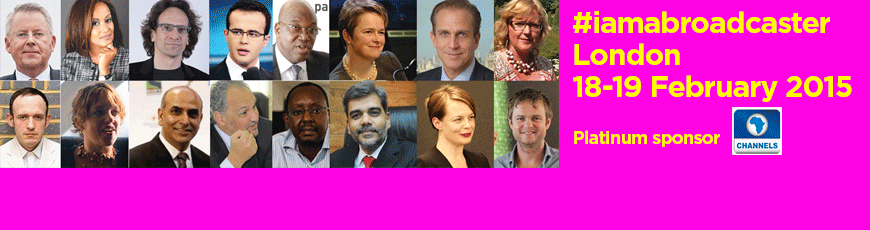
Join us for the #iamabroadcaster conference taking place in London on 18 and 19 February 2015

With speakers from across Europe, the Middle East and Africa, plus contributions from around the world via IP video connection, this two-day conference will provide a unique briefing about the state of the media industry in markets around the world.
The conference, on Wednesday 18 and Thursday 19 February, brings together a remarkable range of attendees who are travelling to London to share knowledge and ideas on media finance, audience engagement, future devices, TV news, telcos vs broadcasters, storytelling, connectivity, brands, and outsourcing.
See the latest agenda here.
The conference is run by AIB, the not-for-profit international industry association for TV, radio and online broadcasting. And since we’re not in the business of pleasing shareholders with this event, delegates will get two packed days of relevant, timely and useful information and networking.
You can reserve delegate places today – and to make sure that we make the conference as accessible as possible, we’re offering one-day passes for either the Wednesday or the Thursday to allow people who can’t spare the time to attend both days to take part in the conference for a shorter time.
Reserve delegate places through the AIB’s online booking service here.
Join us for the best briefing for the start of 2015 in London on 18 and 19 February.

19 January 2015

Komla Dumor received a posthumous AIB Founders award last year
The BBC has today launched the BBC World News Komla Dumor Award in honour of presenter Komla Dumor, who passed away a year ago, aged 41.
Komla was an exceptional Ghanaian broadcaster who in his short life made an extraordinary impact – in Ghana, in Africa and across the world – on Joy FM and at the BBC. He worked tirelessly to bring a more sophisticated African narrative to the world. In June 2012, he was named the presenter of Focus on Africa, the BBC’s first-ever dedicated daily TV news programme in English for African audiences, broadcast on BBC World News. He also interviewed a number of high-profile guests including Bill Clinton, Bill Gates, Kofi Annan, Tony Blair and Africa’s wealthiest businessman, Aliko Dangote. He anchored live coverage of major global events including the death of Nelson Mandela and the 2010 World Cup in South Africa. In 2013, the respected publication, New African, listed Dumor in its list of 100 most influential Africans.
Komla Dumor was the recipient of an AIB Founders award at the 2014 AIB Awards. The award was accepted by his widow, Kwansema Dumor at the AIB Awards ceremony in November of last year.
The BBC World News Komla Dumor Award is now open for applications and will be given to an outstanding individual living and working in Africa, who combines strong journalism skills and an exceptional talent in telling African stories, with the ambition and potential to become a star of the future.
The winner will be awarded the opportunity to gain skills and experience, working with teams across BBC News during a three month placement in London. They will have the chance to broadcast on TV, Radio and Online to the BBC’s audiences of 265 million across the world.
Solomon Mugera, BBC Africa Editor said: “Komla epitomised a new Africa; youthful, dynamic and enterprising. With his infectious enthusiasm, beaming smile and engaging personality he made the stories of a new Africa, good and bad, difficult to ignore. The BBC is committed to continuing Komla’s dedication to this continent with this award. We are searching for a rising star who displays exceptional talent, someone who embodies the spirit of Komla.”
Applications close on Monday 2nd February 2015 at 23.59GMT. For more information on how to apply, entry criteria, and terms and conditions visit bbc.com/komladumor.
The BBC World News Komla Dumor Award is supported by Standard Chartered.
16 January 2015
DW’s Chinese-language online content is now easier to access in China, despite state censorship. The cooperation between DW and Greatfire enables users to freely access DW’s website, blocked by Chinese authorities since 2008.
In this cooperative endeavor, Deusche Welle is counting on the innovative technology “Collateral Freedom” developed by the China-based organization Greatfire. The underlying principle for circumventing censorship is simple: Blocked content is distributed via the servers of large internet providers that cooperate with Greatfire.
“If these servers were blocked, a large number of popular web services in China would also fail. We can therefore assume that the state censors will refrain from actions with such wide-reaching consequences,” says DW’s Managing Director of Distribution, Marketing and Technology Guido Baumhauer.
What is currently a three-month collaboration with Greatfire offers DW effective access to the Chinese market through circumvention of state censorship, says Philipp Bilsky, head of DW’s Chinese service. “We want to reach a broad audience with our Chinese-language online content, and Greatfire, particularly because accessibility is made so easy, marks an important step in this direction.”
Baumhauer sees it as “a bit more freedom of information for those who either don’t want to or are unable to use specialized software to bypass internet censorship.” He also says that the software can be recommended for anyone who wants to access all of DW’s multilingual online content.
In China, users who are interested must now be made aware of the new possibilities available to them. To this end, DW is using Facebook, Twitter and email newsletters to disseminate the web addresses that provide access to the Chinese-language content. DW is also relying on Chinese living in exile to communicate the information.
“Although these services are also partly or intermittently blocked in China, this approach is promising because users have learned to find very creative ways to access the information anyway,” says Baumhauer.
In Iran, which practises strict internet censorship similar to that in China, DW has been actively circumventing censorship for the last two years with the help of a specifically developed software from Psiphon.
This enables for example the use of DW content via a smartphone app. As a consequence, the number of page views has steadily increased to over three million per month.
“However, success in circumventing censorship can’t just be measured by statistics,” says Baumhauer. “The availability of freely accessible information and the feeling that one can freely inform oneself alone constitutes an important step.”
DW Chinese: dw.de/chinese
15 January 2015
Research data from the Broadcasting Board of Governors and Gallup shows that the media market in Afghanistan is primarily split between radio and television. While Afghanistan remains one of the few media markets in which shortwave radio use is still in the double digits, presenters at a research briefing today showed that TV use is overtaking radio for the first time in the country.
“Viewership rates are particularly high in the northern part of Afghanistan, where the electricity supply is more reliable, and drop off in the south where we see more Taliban activity,” said Paul Tibbitts, director of market insight and evaluation at Radio Free Europe/Radio Liberty.
TV usage has nearly doubled since 2008, with current weekly viewership at 64% of the total population. Urban residents and non-Pashtuns are more likely to tune in, and TV viewing also increases with education level.
“Those with a post-secondary education are the most avid media users for news overall,” said Sonja Gloeckle, director of research for the International Broadcasting Bureau. Highly educated Afghans were more likely to use TV (72%), radio (51%), Internet (19%), SMS (15%), and social media (14%) on a daily basis for news than other segments of the population.
These findings indicate the best media avenues to reach Afghans during a particularly uncertain transition with continued NATO troop withdrawals. According to Gallup World Poll data, Afghans’ quality of life ratings are at the lowest in eight years. Based on self-reporting zero Afghans can be considered “thriving” within Gallup’s life evaluation scale.
“When you see life evaluation assessments as dismal as what we see in Afghanistan coupled with the anticipated withdrawal of NATO forces and a murky political roadmap, it is quite concerning for all of us following events in the country closely,” said Mohamed Younis, senior analyst and senior practice consultant with Gallup.
A research brief and presentation with further information about this data can be found here, and a video of the briefing will be added in the coming days. More information about the BBG’s media research series is available here.
14 January 2015
Discovery Communications today announced two new executive appointments that will further strengthen the company’s global sports expertise and strategy. Jean-Thierry Augustin has been named President, Sports Strategy & Development in a newly created position at Discovery Networks International, and Peter Hutton has been appointed Chief Executive Officer of Eurosport.
Augustin, who previously held the position of CEO at Eurosport, will report directly to JB Perrette, President of Discovery Networks International and continue to be based in Paris. Augustin will work closely with Discovery’s international leadership team and Peter Hutton to create a compelling sports business development strategy that utilizes sports as a game-changing asset and drives new growth globally.
Hutton joins Eurosport from MP & Silva Group, where he held the post of Co-Chief Executive Officer. As Chief Executive Officer of Eurosport, Hutton will oversee the negotiation of sports rights and lead Eurosport’s content strategy to bring renewed focus to programming, production, promotion and platforms. Hutton will take advantage of Discovery’s local infrastructure and global platforms to maximize Eurosport’s value across more than 70 countries and in 20 languages. Hutton also will report to Perrette and will be based in Paris, with a start date of March 1, 2015.
Perrette said, “As we approach the one year anniversary of Discovery’s acquisition of Eurosport in May, our focus is now on unlocking the full value of our must-have sports content for the entire Discovery Communications portfolio to benefit our advertisers, affiliates, audiences and shareholders around the world.”
Perrette continued, “Jean-Thierry has been at the helm of Eurosport for a number of years during which he has proved to be a tremendous commercial leader and this new role will harness his expertise to build Discovery’s global sports strategy and expertise. Similarly, Peter has excelled in the sports media business. With extensive experience in Europe, Asia and Middle East, and strong relationships with broadcasters and rights holders, he is the perfect executive to strengthen Eurosport’s position as a global leader in sports. I am excited to work with both Jean-Thierry and Peter as we take our business to an exciting new level.”
In May 2014, Discovery increased its interest in Eurosport International to 51% from 20% as part of a larger strategic partnership with TF1 Group that began in December 2012. TF1 Group continues to be the majority shareholder of Eurosport France, in which Discovery holds a 20% equity stake.
Jean-Thierry Augustin: Quote and Background
“It has been a privilege to lead Eurosport over the past several years. I look forward to applying my experience and working with JB and Peter to help utilize sports content to drive growth, and create long-term relationships with key partners throughout Discovery’s global business,” said Augustin.
Augustin joined Eurosport in 2001 as Regional Distribution Director and following various promotions was named Chief Executive Officer, Eurosport Group in June 2013. During this period, Augustin played a key role in the launch of Eurosport 2, which is available in 74 million homes in 51 countries and broadcasts 2,300 hours of live action every year. He also oversaw development of Europe’s number-one online sports destination, Eurosport.com which comprises 15 websites in 11 languages, and Eurosport Player, which provides live streaming of Eurosport and Eurosport 2 channels as well as catch-up TV around selected events in 35 markets.
Peter Hutton: Quote and Background
“After over 30 years in sports media, I can’t think of a better brand to lead than Eurosport,” commented Hutton. “I look forward to building on the great work of Jean-Thierry Augustin and his team to ensure that we further improve our line-up of world class sports relevant to our audiences throughout Europe and Asia. With the support of the Discovery teams around the world, we will deliver the best possible global and local events to our viewers and to our commercial partners.”
During his time at MP & Silva Group, Hutton oversaw a portfolio of rights that included the FIFA World Cup, UEFA European Championships, Formula 1, Grand Slam tennis and Serie A football. He helped launch joint venture channels with Be In Sports in Asia, and took the business into the sponsorship market and key local rights, such as Belgian and Polish football. Before joining MP & Silva Group, Hutton’s previous roles included Managing Director ESPN Star Sports, Senior Vice President Fox International Channels Sport, as well as COO and one of the founders of Middle East and Asian broadcaster Ten Sports.
Source: Eurosport press release
14 January 2015
BBC Indonesia has launched #TrenSosial (Social Trend) project which will involve the Indonesian audience in an exciting new approach to digital journalism.
Indonesia’s capital, Jakarta, is the city that tweets the most in the world, and the country, which ranks Facebook’s fourth largest market, is referred to as Asia’s social-media capital and one of the most “social” countries in the world. Around 70% of mobile social-media users in Indonesia are under 25. They spend more time on social media than watching TV, reading news websites, listening to the radio or reading a newspaper.*
The BBC Indonesia #TrenSosial teams in London and Jakarta engage with audiences via social channels to identify topics that matter to them, bring in experts to talk about the issues – and create more stories for the BBC Indonesia website, bbcindonesia.com. The project will bring at least one social media-sourced story a day to the site, to be shared across other BBC Asian outputs.
BBC Indonesia Editor, Karishma Vaswani, sees #TrenSosial as a way to reach young social audiences who like to talk about news: “With our new social-media product, #TrenSosial, we will engage with more young Indonesians, attracting them to our news content. #TrenSosial will energise both the BBC Indonesia content and our interaction with the Indonesian users. Users of social media, who are looking for accurate, engaging and informative news reportage online, will love #TrenSosial.”
David Cuen, Social Media Editor at BBC World Service, adds: “Social media is no longer a distribution channel or a marketing window. It’s a space for engagement and it’s a source of original journalism. Young people consume news and engage with news on social media, through mobile devices. If that’s where they are, that’s where we as a news broadcaster need to be. There’s a huge scope to do original journalism through social media. With #TrenSosial we will be able to use social media to source original Indonesian stories – and do that based on the same distinctive values of impartiality and accuracy that the BBC is known for.”
With #TrenSosial, BBC Indonesia adds to the BBC World Service languages output that builds around social audiences, adapted to regional media consumption habits: the BBC Turkce Sosyal Meydan, the BBC Brasil #SalaSocial, and BBC Thai – a social-only service delivered as a news stream on social media. BBC Trending (#BBCtrending; @BBCtrending) on BBC World Service explains the stories the world is sharing on social media – in a weekly radio programme and a regular blog.
BBC Indonesia is part of BBC World Service.
(Source: BBC press release)

