11 June 2015
Vietnamese youth are increasingly turning to online news sources over state TV, according to data issued today by the Broadcasting Board of Governors (BBG) and Gallup. When asked to name the three media outlets that are their most important sources of information, almost three-fourths (74.1%) of those age 35 and older include state-run VTV among their responses, while less than half of those age 15-34 (48.6%) do so. Young people, in turn, are more likely to name online sources – most commonly the popular Vietnamese news and information portals 24 Gio and Dantri.com, and the global social media giant Facebook.
“While television ownership remains almost ubiquitous, and frequency of TV and radio use has changed only slightly, the proportion of Vietnamese adults who use the Internet weekly or more continued to rise, from 26.3% in 2012 to 38.8% today,” explained Betsy Henderson, Director of Research, Training and Evaluation at Radio Free Asia. “Mobile ownership has grown by 10 per cent since 2012, and it is the growing availability in web-enabled phones that is a key factor in rising Internet use in Vietnam.”
Mobile phones have become the primary means of accessing the Internet in Vietnam, with eight in 10 weekly web users saying they used their mobiles to go online in the past seven days. By contrast, less than half (45.5%) say they have used a desktop computer to do so, and just over one-fourth (26.5%) have used a laptop.
Despite the country’s restrictive media environment, Vietnamese are extremely avid news consumers; almost nine in 10 adults (88.0%) say they access some type of news at least daily while almost all (96.8%) do so at least once a week. There is little difference among education or age categories in these results.
Unlike in China, which has a similarly restrictive media environment, Google and top-tier social media sites such as Facebook and YouTube are available to the public, and are accessed by more than one-fourth of all adults and a majority of those age 15-24 on a weekly basis.
Almost all Vietnamese are comfortable with the idea that media organizations should advocate national interests; 92.1% strongly or somewhat agree that Vietnamese media should present the country and its people in a positive way. However, most Vietnamese (58.2%) believe personal blogs are more believable than official news, pointing to an underlying distrust of state media, particularly among younger and better-educated adults.
9 June 2015
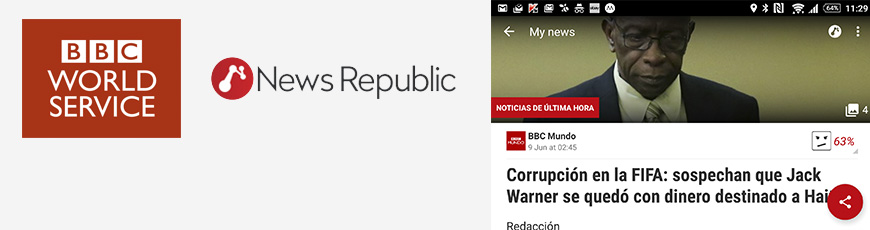
BBC World Service ’s content in four languages is now available to users of a leading global news app for smartphones, tablets and wearables, News Republic.
Thanks to a content syndication agreement between BBC World Service and News Republic, more than 12 million active users of the News Republic news app now can access the BBC World Service news content from BBC Chinese, BBC Hindi, BBC Mundo (in Spanish) and BBC Russian.
Head of Business Development, BBC World Service, Simon Kendall, says: “We are pleased to announce this exciting development with News Republic, which will contribute to BBC World Service’s substantial audience reach in the digital space. We look forward to reaching out to new audiences through this innovative digital platform and to providing our loyal World Service audience with a new way of consuming our multilingual content.”
Gilles Raymond, CEO of News Republic, adds: “BBC World Service has a superior reputation in the news business and we are pleased to contribute to their digital deployment by bringing their news to our rapidly growing user base. Mobile apps, such as News Republic, provide the innovation required to address mobile news consumers’ demands for easy to navigate, personalised, trusted and timely news on the go, and partnering with BBC World Service will considerably enhance the content offered.”
BBC World Service also offers its own news apps for several of its language services: BBC Arabic and BBC Chinese available on iOS, BBC Brasil (iOS and Android), BBC Hindi (Android), BBC Mundo (iOS and Android), BBC Russian (iOS and Android) and BBC Turkce (Android). There is also an app for BBC News (in English), available on iOS and Android.
News Republic is free to download from Google Play for Android smartphones and tablets, and for iPhone, iPad and iPod touch on the App Store.
8 June 2015
The international news channel is now available on Claro, the leading Colombian cable operator.
For the first time, Colombians will benefit from full-time access to Euronews. The news channel has just finalised an agreement with Claro, the largest telecommunications provider in Colombia, to air 24/7 its unique perspective on international news. Claro subscribers can find Euronews on the “TV Digital Avanzada” offer, in Spanish and in English.
After agreements with Claro Nicaragua and Claro Peru, this new deal enables the international news channel to improve its distribution in Colombia.
Arnaud Verlhac, Worldwide Distribution Director of Euronews said: “Since 2013, Euronews has been available part-time in Colombia. It is strategic to broadcast 24/7 the Spanish service to increase Euronews’ visibility in the country. Thanks to our agreement, Claro will bring Euronews’ view on world news to their subscribers. This is a new and important step for our development in Latin America”.
Celine Rodrigues, Regional Distribution Manager Latin America added: “This new contract is clearly an opportunity to increase our visibility. In addition, this agreement will strengthen our partnership with Claro in Latin America. We are proud to offer Euronews’ view on international affairs, in Colombia”.
Euronews covers more than 29.3 million households in Latin America.
About Claro
Claro Colombia is part of the leading telecom operator in Latin America, America Movil, and it is the preferred telecommunications operator throughout the country thanks to the widest coverage it offers in services such as TV, mobile telecommunications and broadband.
About Euronews
Euronews, the most-watched news channel in Europe, is an independent and multi-platform media hub. Euronews covers news worldwide, offering a unique perspective on events through factual analysis. Six hundred journalists, from more than 30 countries, report round-the-clock in 13 editions (Arabic, English, Persian, French, German, Greek, Hungarian, Italian, Portuguese, Russian, Spanish, Turkish and Ukrainian). Established in 1993 in Lyon, France, the channel is received by 420 million homes in 156 countries, and offers a complete range of products: websites, smart TV, radio, on-board technology (for cars), and portable technology (mobile apps, smartwatch).
In 2015 Euronews will launch Africanews, the first pan-African multilingual news channel.
Find Euronews in your country: click here
8 June 2015
SES S.A. (NYSE Euronext Paris and Luxembourg Stock Exchange: SESG) announced today that its subsidiary SES Platform Services, a leading technical service provider for the digital editing and broadcasting of audiovisual content, will unveil a new solution tomorrow at ANGA COM 2015 in Cologne, called FLUIDMedia. The service will allow companies that produce or distribute video content to convert their content easily and conveniently, and deliver it to internet or video-on-demand (VOD) platforms.
Users of this new service will be able to control technical aspects such as ingestion, transcoding in various formats, quality checks, packaging and delivery via a modern, browser-based interface on SES Platform Services’ content management infrastructure.
FLUIDMedia will also be able to easily manage and customize metadata such as information about license periods, images, trailers and brief descriptions. As users only have to prepare the content and its corresponding metadata once, they can deliver this content to many partners at the same time – saving considerably on time and money.
Users will also be able to access their media assets from any computers, and also from several workstations simultaneously.
“Alongside classic linear television, the distribution of on-demand content is becoming more and more important for broadcasters and production companies,” said Sophie Lersch, Chief Product Officer for Services at SES Platform Services. “The number of video-on-demand platforms is growing, and with it their technical complexity. Video is playing an increasingly important role in other sectors too – for example, publishing and automotive. FLUIDMedia is our solution to these developments. Our new service simplifies the entire technical-operational process of video-on-demand distribution and the use of internet video for customers: from the digital supply of content to all necessary editing processes right up to final delivery. With just a few clicks of the mouse, our customers can edit their content, deliver it to any video-on-demand portals, or use it on their own platforms.”
SES Platform Services will be presenting FLUIDMedia during ANGA COM 2015 at the shared stand of Astra Deutschland, HD PLUS and SES Platform Services: Hall 10.2, Stand E15.
8 June 2015
With ninety-seven percent of passengers carrying a phone, laptop or tablet when they travel, the demand for in-flight broadband communications and entertainment has never been greater. While passengers want expanded entertainment options, service providers and airlines are grappling with how to quickly integrate satellite technology to satisfy their customer’s burgeoning requirements, all while balancing operational budget realities.
Today, Intelsat S.A. (NYSE: I), the world’s leading provider of satellite services, introduced IntelsatOne Flex for distribution partners serving the commercial air transport market. IntelsatOne Flex aggregates Intelsat’s global and Intelsat EpicNG® high throughput satellite (HTS) fleet and the IntelsatOne terrestrial network into a simplified ecosystem that enables Intelsat’s distribution partners to easily and cost efficiently scale their service delivery capability to meet emerging in-flight demands.
An enterprise grade, customizable “Wholesale Mbps”, managed mobility service; IntelsatOne Flex allows Intelsat’s distribution partners and their aeronautical customers to access bandwidth when and where it is needed the most without the complexity of managing multiple beams and satellites. In addition, it provides tiered Committed Information Rate (CIR) plans that mean Intelsat distribution partners can offer unique and tailored services to the air transport sector.
Christopher Baugh, President, NSR stated, “With high throughput satellite technology forthcoming, the inflight-communications and entertainment market is poised to take off. We anticipate that the number of global aeronautical satcom units will increase from 47,500 units in 2014 to 95,500 units by the end of 2024. In order to capture this market growth, aeronautical service providers and airlines will benefit greatly from having this new technology in their networks.”
IntelsatOne Flex service will enable Intelsat aero distribution partners to:
- Maintain Control over their network by allowing them to continue to manage the customization, contention and prioritization of individual airborne terminals without the overhead of multiple network builds and inefficient use of bandwidth.
- Streamline the management of capacity for geographic expansion and surge, providing flexibility across multiple satellite beams and resulting in a more predictable cost structure directly matched to revenue generating activities.
- Leverage wide beams for broadcast applications to the plane and high throughput spot beams for high throughput data.
- Rapidly and cost effectively expand while retaining control over service differentiation, brand and visibility of end-user terminals.
- Customize the Quality of Service for “wholesale Mbps” procured on a region-by-region basis, bound by a Service Level Agreement (SLA) and underpinned by guaranteed CIRs.
- Minimize operational costs associated with network infrastructure, allowing service providers to focus on product differentiation, value added services and revenue growth.
- Lower Total Cost of Ownership through reduction in capital expenditure and elimination of unnecessary bandwidth overhead.
James Collett, Head of Mobility and Energy Services, Intelsat, said, “Inflight entertainment is no longer a nice to have element for airlines today. Passengers require the same level of connectivity that they would receive at home or in the office. This leaves many airlines and their distribution partners needing to rapidly invest in new technology to meet growing bandwidth demands, satisfy the needs of passengers and capture revenue growth. However, integrating new technology can be a complex process and choosing the wrong network, a costly mistake. With IntelsatOne Flex, aeronautical distribution partners have a new option that provides a flexible operational environment that easily scales to meet growing broadband requirements optimizes bandwidth allocations and aligns costs with revenue demands. Importantly, to take advantage of the power, accessibility and efficiency of Intelsat EpicNG, aeronautical distribution partners can easily integrate high throughput technology into existing networks with minimal capital expenditure and provide a platform that will support their technology requirements well into the future.”
With Intelsat’s global Ku-band satellite fleet and Intelsat EpicNG high throughput satellite platform, distribution partners using IntelsatOne Flex will benefit from a global network and coverage. Intelsat’s wide beams will enable the accommodation of broadcast applications and service to the most remote regions, while fully integrated spot beams will provide layers of high throughput capacity across the highest traffic routes.
IntelsatOne Flex uses iDirect Velocity®, a ground infrastructure platform designed for large-scale global HTS networks, which has been fully optimized for Intelsat EpicNG to provide scalability, performance and higher throughput. Leveraging iDirect Velocity, IntelsatOne Flex incorporates features that have been optimized to the Intelsat EpicNG environment including next-generation remote and hub processing capabilities that enable significantly higher throughput rates and global bandwidth management ensuring seamless connectivity across multiple spot-beams, and very fast beam switching features. IntelsatOne Flex is fully integrated with Velocity’s companion network management system, Pulse®, enabling Intelsat distribution partners to develop differentiated service offerings, create customized applications and system integration through open APIs and provide visibility for real-time monitoring, tracking and adjustment of vessel service levels.
For more information, please visit Intelsat at the Global Connected Aircraft Summit 2015 which is taking place at the Westfield Marriott Washington Dulles located in Chantilly, Virginia between 8-10 June 2015.
James Collett, Intelsat’s Head of Mobility and Energy Services will be participating on a panel on 9 June, 2015, entitled “Ku-band vs. Ka-band: Pros and Cons of Each Band” at 10:45 am EDT. In addition, Vinit Duggal, Intelsat’s Director and Chief Security Officer, will be featured on a panel on 10 June, 2015, where he will address “Cyber Security: How Can a Connected Aircraft Manage this Threat?” at 2:20 pm.
Supporting Resources
3 June 2015
Jewellery channel Rocks & Co to use Arqiva’s new Connected Broadcaster solution
Arqiva has today announced that the high fashion jewellery shopping channel, Rocks & Co, is now available via a cutting-edge combined hybrid TV-Internet solution to internet-enabled Freeview devices.
Tom Cape, Director of Connected Solutions at Arqiva said, “The launch of Rocks & Co represents our latest thinking in hybrid TV – combining the very best in broadcast and IP delivered content and services. Audiences will have a seamless experience where throughout different times of the day they won’t be able to tell if their channel is via DTT or over IP.”
Rocks & Co TV brings consumers exquisite ranges of jewellery via their gemstone experts and jewellery designers. While already available on the Sky and Freesat platforms, plus Freeview channel 40, Rocks & Co via Arqiva’s Connected Broadcaster solution, is now available to audiences 24/7. Currently Freeview audiences can only shop the channel between 1pm and 11pm daily, but via IP delivery, the channel is now available to Freeview HD connected viewers homes continuously.
“There are many new ways content and services can be delivered and consumed in an IP enabled world,” continued Tom Cape. “As part of our ‘Connected Broadcaster’ range of solutions we are exploring new and exciting combinations of promoting and distributing content through a combination of IP and broadcast services. We need to continue to push the boundaries of what audiences and content providers know about content delivery.”
Richard Northall, Director of Rocks & Co Productions Limited, commented, “Our philosophy is to provide not only genuine gemstones and high-end jewellery, but fantastic customer service. This means we must be available to our loyal customer-base whenever and wherever. By providing a hybrid-TV offering we’re ensuring we engage with our audience in the best way possible.”
Rocks & Co TV is available on Freeview channel 40 from 1pm to 11pm and on Freeview HD connected devices 24/7. Rocks & Co is due to launch on YouView platforms at the end of June 2015.
