Dentsu Inc., the Japan-based advertising and PR agency, has been awarded the broadcast rights for the XXIII Olympic Winter Games (2018) in PyeongChang, Republic of Korea; the Games of the XXXII Olympiad (2020) in Tokyo, Japan; the XXIV Olympic Winter Games (2022), location TBD; and the Games of the XXXIII Olympiad (2024), location TBD by the International Olympic Committee.
The deal covers 22 countries and territories across Asia, including Afghanistan, Brunei, Cambodia, East Timor, Hong Kong, Indonesia, Iran, Kazakhstan, Kyrgyzstan, Laos, Malaysia, Mongolia, Myanmar, Papua New Guinea, Philippines, Singapore, Taiwan, Tajikistan, Thailand, Turkmenistan, Uzbekistan and Vietnam. These broadcast rights are in addition to those that Dentsu was awarded in 2013 for the XXII Olympic Winter Games (2014) in Sochi, Russia and the Games of the XXXI Olympiad (2016) in Rio de Janeiro, Brazil in the 22 countries and territories.
The broadcast rights for all the Youth Olympic Games to be held until 2024 have also been awarded to the Company. Dentsu has acquired exclusive Olympic Games broadcast rights on all media platforms, including television, radio and the Internet.
Look out for our feature on sports broadcasting rights in the forthcoming edition of the AIB’s international media magazine, The Channel. It will be published in late August.
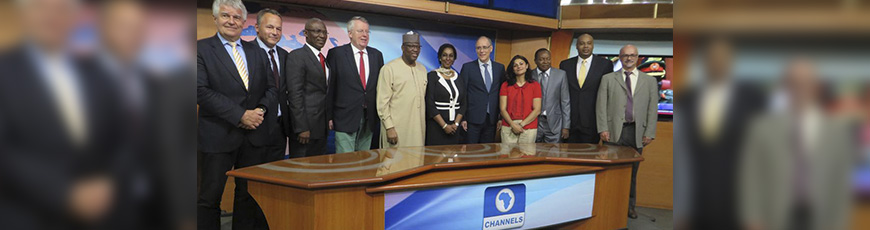
Deutsche Welle and Channels TV have agreed on a partnership that DW’s Director General Peter Limbourg said the deal further demonstrates the long tradition of showing a positive view of Africa.
The collaboration was announced in Lagos on 17 July at Channels TV headquarters. Speaking at the event, Limbourg said the coverage on Channels TV by DW correspondents at the German Stock Exchange in Frankfurt will bring economic information not only about Germany but also about Europe to Nigeria.
“Channels is a great station and a perfect partner for us. Working together means having concrete projects,” Limbourg said. Channels is one of Nigeria’s largest television networks. Limbourg said the partnership will expand to other shows such as Africa on the Move – a programme that showcases ordinary people seeking to make positive changes to their environment. “We at Deutsche Welle think that we have to report the great things that happen in Africa, especially in Nigeria. We will like to bring another African picture into the discussion,” Limbourg said.
The head of Germany’s international broadcaster said the collaboration would include input from both sides. “We don’t want to have a one-sided picture of Africa. I am even more convinced to do more of these kinds of things,” Limbourg said. Under the partnership, journalists from Channels TV will benefit from DW training.
Solid partnership
John Momoh, CEO of Channels TV, said the relationship with Deutsche Welle looks like it was “made in heaven.” He said the whole idea is to be able to tell African stories to wider societies, specifically to Europe and then to the rest of the world.
“This is part of our strategy to tell the African story, especially that of Nigeria, from the African perspective so that we do not leave this key element of definition of who we are, what we do and why, to other people to tell on our behalf,” Momoh said.
He said the partnership will enable Channels television “to take the lead in covering Nigeria and the rest of the African continent.”
Boason Omofaye, head of business news at Channel TV, is particularly pleased about having the Frankfurt Stock Exchange on his programme. “As someone who has covered the financial market for the last 26 years, it will be nice to see the Frankfurt Stock Exchange live on Channels Television,” Omofaye said.
He said their newly-launched partnership is strategically important from the economic and business perspective, given that Nigeria is the largest economy in Africa while Germany is Europe’s largest. “For Nigerians in Germany, for Germans in Nigeria, who are interested in terms of buying stocks, buying Nigerian bonds, investing in Nigerian government treasury bills, the partnership brings something new to the table,” Omofaye said.
The collaboration with Channels TV is the latest move by Deutsche Welle to further strengthen its presence in Africa.
First-of-its-kind architecture set to accelerate Ultra HD delivery to cable households
SES S.A. (NYSE Euronext Paris and Luxembourg Stock Exchange: SESG), one of the world’s leading satellite operators, today announced it has initiated the first-ever live and linear Ultra HD (UHD) trial with cable MSO (Multiple System Operator) Armstrong.
Armstrong is testing SES’s camera-to-screen Ultra HD ecosystem at its headquarters cable lab in Butler, Pennsylvania. SES’s Ultra HD offering, first unveiled in April 2015 at the NAB Conference, combines broadcast and IP technologies in a fully-managed, scalable service. The solution leverages satellite’s inherent broadcast advantages and the multicasting capabilities of DOCSIS 3.0, the advanced transmission standard in use by Armstrong and other leading cable systems today.
“We have a great long-term partnership with SES that enables us to innovate with satellite-delivered content solutions and provide exciting new potential offerings, said Mike Giobbi, Chief Technology Officer for Armstrong. “We look forward to testing Ultra HD on our cable system and working closely with SES on this exciting solution.”
“We are very excited to have Armstrong as the first to test our linear Ultra HD solution in a real-world environment,” noted Steve Corda, Vice President of Business Development for SES in North America. “The outcome of these tests will support progress toward our objective of accelerating the roll-out of linear-live Ultra HD. The roll-out into cable TV households across North America will allow a very cost efficient, scalable and high performance delivery system.”
Voice of America, in partnership with AudioNow Digital, has launched an audio-only app that will allow users to listen to VOA programming over data or cellular voice connections. That option is especially valuable for VOA audiences in emerging markets where streaming audio is not available or cost prohibitive.
VOA Mobile Streamer, which is available on Apple and Android platforms, will provide broadcast audio programming in 33 languages. In addition to on-demand programming, the app also offers live 24/7 radio streams in more than a dozen languages.
“We are very pleased to add this app to our suite of mobile products,” said Kelu Chao, acting director of the Voice of America. “VOA Mobile Streamer allows us to better serve and connect with audiences in low-bandwidth countries and provide them with high-quality news and information they can’t get elsewhere. By giving our audience access to our radio broadcasts via voice VOA is now availab! le on even the simplest of mobile phones.”
“We worked with VOA and AudioNow to make a very non-traditional news app experience,” added Adam Martin, acting director of the Broadcasting Board of Governors’ Office of Digital and Design Innovation. “Mobile Streamer’s unique and refreshing design is particularly attractive to younger audiences, and its accessibility in low-bandwidth areas is crucial to reaching key audiences.”
VOA Mobile Streamer leverages AudioNow’s international Interactive Voice Response infrastructure and will showcase thousands of hours of VOA audio programmes that are produced each week.
SES S.A. (NYSE Euronext Paris and Luxembourg Stock Exchange: SESG) announced today that the leading German and Austrian pay TV-provider Sky Deutschland has secured additional capacity for Ultra HD broadcasts on ASTRA at 19.2 degrees East.
Ultra HD delivers four times the resolution of today’s HD TV, providing more dramatic action for sporting events and a more compelling experience for premium movies and documentaries.
“At Sky Deutschland, we believe in being innovative with our offerings and providing our customers with the best television experience, and have therefore been investing in Ultra HD. The agreement with SES gives us planning security in terms of capacity so that we can continue to develop Ultra HD and get it ready for the market,” said Holger Ensslin, Chief Officer of Legal, Regulatory Affairs and Distribution at Sky Deutschland.
“We are pleased to partner with Sky Deutschland as they embark on their Ultra HD journey. There is no better way to broadcast Ultra HD than on satellites: unlike other infrastructures, satellites can deliver Ultra HD programmes in the best quality available and cost-effectively all over the country,” said Ferdinand Kayser, Chief Commercial Officer at SES. “That, coupled with the extensive reach of 19.2 degrees East, will ensure that Sky Deutschland’s Ultra HD content will be made readily available to all satellite households in Germany and Austria.”
International news agency, Agence France-Presse (AFP) has invested in Quantel’s new sQ 1800 servers for its brand new global news production solution. AFP’s Enterprise sQ system supports more than 50 simultaneous users at the Paris headquarters, a large operation in London, 10 further international bureaux and 100+ roving journalists.
The sQ 1800 servers are 100% compatible with AFP’s existing Enterprise sQ system, providing a zero-risk system upgrade with more disk space for original footage and support for more editing workstations. When the new system goes live, scheduled for late 2015, AFP expect to produce more than 100 unique video stories a day, with localized versions for six different markets, all in TV and web formats, making a total output at least 1,200 media assets every day. In addition to daily news ingest, all system users will have access to the online archive, expected to accumulate up to 3,000 hours of media every year.
Philippe SENSI, deputy CIO at AFP, said, “The new servers are an investment for the future, allowing us to take maximum advantage of the latest generation of disk and processing technologies. We have developed a close relationship with Quantel and Snell over the past year, with our support team travelling to Quantel and Snell’s Newbury, UK headquarters every two months to work with the development team to debrief and get an update on the project plan.”
Tim Thorsteinson, CEO at Quantel and Snell, said, “We’re working very closely with the AFP team to ensure their workflow has the ability to adapt and grow as future requirements in the industry change. The new servers give AFP unbeatable speed from ingest to editing to playout, maintaining its position as one of Europe’s leading fast-turnaround news production facilities.”


 VOA Mobile Streamer, which is available on Apple and Android platforms, will provide broadcast audio programming in 33 languages. In addition to on-demand programming, the app also offers live 24/7 radio streams in more than a dozen languages.