15 December 2015
With over 8,000 miles of successful road testing, Kymeta and Intelsat take significant step towards making global, high-speed connectivity for the connected car a reality
Completion of the first maritime product prototype provides path to scalable, high quality, low cost mobility solutions and compatibility with fleet of Intelsat satellites.
Kymeta Corporation and Intelsat S.A. (NYSE: I), the world’s leading provider of satellite services, have successfully completed initial testing of the mobility performance of Kymeta’s flat-panel antennas on Intelsat’s global satellite network for both maritime and automotive applications. Kymeta and Intelsat are the first companies to meet this significant milestone with a flat panel, software-based antenna.
In the automotive portion of the test, the team embedded Kymeta’s flat-panel antenna into the roof of an automobile and over the course of 8,000 miles, proved that the company’s mTenna™ technology was able to automatically acquire and track satellite signals while on the move. The Ku-band antenna was able to both transmit and receive signals with Intelsat satellites. It is designed for Intelsat’s current satellites and its next generation high throughput satellites, Intelsat EpicNG, the first of which is expected to launch on January 27, 2016.
Kymeta has also completed building and testing its first glass-on-glass, thin-film-transistor-based antennas, with receive and transmit on the same aperture. This maritime prototype is the workhorse of Kymeta’s 70cm Ku-band product and are currently being produced on existing liquid-crystal display TV display lines, marking the first step towards mass-volume and low-cost attainability for Kymeta antennas.
“We’re excited about these significant milestones and what they mean for our customers,” said, Dr. Nathan Kundtz, Chief Executive Officer of Kymeta. “In partnership with Intelsat, we’re ushering in a new generation of mobile communications that is lower cost and higher bandwidth.”
Kymeta’s flat panel, software-based antennas simplify the access to Intelsat’s satellite fleet by removing the need for mechanical components and by using software to electronically point, steer and acquire the satellite signal. This allows for both the rapid setup and installation of the hardware, in addition to the improved ability to acquire and track satellite signal. Working together, Kymeta and Intelsat will ensure that mobility customers are able to receive fast, reliable and cost-effective connectivity regardless of location.
“At Intelsat, we are pursuing innovation in both satellite technology and ground systems to enable simpler access to our services,” stated Stephen Spengler, Chief Executive Officer of Intelsat. “Our partnership with Kymeta will help ensure that our customers have much easier and more cost effective access to our fleet to leverage the power and higher performance of our satellites to solve their complex connectivity issues. Together, I look forward to using our collective expertise to expand the addressable markets for satellite technology and provide ubiquitous and fast broadband services to the billions of people and devices that need connectivity.”
14 December 2015
Globecast, the global solutions provider for media, today announced that it has launched a new satellite platform on the AMC-11 satellite. As a result, prospective and current clients can benefit from the most powerful orbital position in the US for distribution to cable headends. This is evidenced by the fact that the satellite already hosts over 70 major Tier-1 American channels.
Eddie Ferraro, Managing Director, The Americas, at Globecast said, “This new platform on AMC-11 is in a very desirable orbital position. Using DVB-S2 modulation means we can offer a larger and more diverse range of premium cable distribution capacity, over and above our capacity on SES-3. Because we also offer origination and playout services supported by Media Factory, our cloud-based content preparation platform, this means we can provide our customers with end-to-end solutions to reach their chosen audiences.”
AMC-11, which covers the entire North American and Central American area, is owned by SES. “Steve Bunke, Vice President, Sales of North America, at SES said, “Globecast is a long-term partner and has platforms on other SES satellites serving the Americas and Europe. SES is pleased that Globecast has chosen to build a new platform on AMC-11, which is located at a premium orbital position. Together, we aim to enable the cost-effective and optimal delivery of broadcasting services across the Americas.”
The new AMC-11 platform also allows Globecast to offer all content providers a Tier -1 neighborhood and the best possible North American footprint coverage at a competitive price point. The platform and uplink are managed out of the state-of- the-art Culver City facility near Los Angeles.
Sports channel Gol TV, a 24/7 network dedicated to soccer and an existing customer, is the first to have taken the opportunity to transition their HD feed onto Globecast’s new platform. As well as Gol TV, Globecast has signed additional contracts with companies including Revenue Frontier.
13 December 2015
Starting Tuesday, December 15, 2015, West European viewers can receive Deutsche Welle’s Arabic-language television program via Astra satellite. DW and satellite-operator SES arranged the partner project with the aim of reaching refugees who come from the Middle East. Plans are made to expand the program in the coming months into a conduit of information and an aid to integration. Politicians are welcoming the initiative.
The Arabic-language TV program of the German foreign broadcaster will be transmitted in Europe via Astra 1M. DW (Arabia) offers round-the-clock news and information about Germany. Until now it was available in Germany exclusively via Internet livestream at dw.com/arabic.
Norbert Hölzle, Senior Vice President Commercial Europe of SES, pledged to DW Director General Peter Limbourg to transmit the channel at no cost for twelve months.
Limbourg: “Thanks to SES, we are in the position to make available a high-value TV-program for refugees and all interested parties from the Arab region. It is an important goal of ours to convey European values and to provide access to reliable information from a German perspective, initially in their native language. In that way, Deutsche Welle contributes to the refugees’ participation in German society.”
Hölzle outlined the motive behind the pro-bono project: “We are a market leader in Europe, and we see it as our duty to provide good, additional offerings. At the same time, we want to show how important social engagement is to us.”
The charitable project is not the company’s first, Hölzle said. For example, SES was engaged in Haiti and Nepal after devastating earthquakes there, as well as in the Philippines after the typhoon. In the midst of the Ebola crisis, SES used its satellite fleet to broadcast an educational channel throughout West Africa.
Hölzle: “With this project we want to contribute towards providing better information and integration for the refugees. Deutsche Welle is an ideal partner, because as an internationally-oriented media company it has a good reputation as a fair and neutral intermediary.”
DW (Arabia) offers a diverse program with an emphasis on providing information, understanding, and cultural exchange.
Politicians respond
Peter Altmaier, chief of staff of the German Chancellery in charge of coordinating the country’s refugee policy, welcomed the initiative. “This mission of democracy, freedom of opinion and cultural exchange can provide a valuable contribution to the integration of Arab refugees fleeing from war,” Altmaier said.
Minister of Culture Monika Grütters said: “The media, especially international broadcasters like Deutsche Welle, assume a special responsibility in times marked by war and terror. People from war-torn areas seeking safety, not only in Germany, are reliant on it for trustworthy and objective information about the situation in their homeland as well as that in their places of refuge. The continuing dialogue with the Arab world about values and ideologies as well as about the worth of respecting universal human rights is more important than ever.”
Deutsche Welle acts as a symbol for democracy and freedom of opinion and against intolerance and terror, the culture minister said. “Shows like Shababtalk also contribute to that, in addressing topics that are critical of society and are often taboo in the Arab-speaking world. I thank SES for making this possible,” Grütters added.
Germany’s commissioner for migration, refugees and integration, Aydan Özoğuz, said: “Information knows no boundaries. I therefore greatly appreciate that Deutsche Welle’s Arabic TV program can now be received via satellite in West Europe. DW stands for democracy, freedom of opinion and cultural exchange – now it does in our country as well.”
Step-by-step expansion planned
Initially, the full extent of the Arabic channel will be adopted as it is currently received in Arab countries. Adjustments are planned to match the needs of the target group in Germany – including, for instance, a German-language course crafted for television and bought-in features from German and European partners.
A satellite-receiver is all that is necessary to receive the new channel. The service can therefore be easily accessed at refugee accommodation facilities.
A publically traded company, SES has its headquarters in Luxembourg. By its own account, it operates over 50 geostationary satellites worldwide. SES offers services for broadcasters, content and Internet providers, mobile and stationary network providers, business associations, and governmental organizations. (Source: DW press release)
10 December 2015
SES S.A. (NYSE Euronext Paris and Luxembourg Stock Exchange: SESG) announced today that SES-9 has safely arrived at Cape Canaveral, Florida, and is being processed for a mid-January 2016 launch on board Space X’s newly upgraded Falcon 9 rocket.
SES-9 will be positioned at 108.2 degrees East and provide both replacement and incremental capacity for a prime video neighbourhood over Asia which already serves over 22 million households with high quality broadcast solutions. The spacecraft will be co-located with SES-7 and increases SES’s global video capabilities to serve fast-growing markets in Asia, such as Indonesia and the Philippines.
The spacecraft is also designed to deliver reliable data connectivity to homes and enterprises across Asia, and provides dedicated beams to support growing mobility communications needs across the Indian Ocean.
SES-9 was built by Boeing Satellite Systems and is designed to operate for 15 years in geosynchronous orbit with a 12.7-kilowatt payload and 57 high-power Ku-band transponders (equivalent to 81 × 36 MHz transponders). SES-9 will use a chemical bi propellant apogee motor to quickly achieve a 24h synchronous orbit and then electric propulsion to circularise the final orbit and to remove eccentricity at 36,000 kilometers over the equator. Subsequent on-orbit manoeuvres will be executed with electric propulsion.
Martin Halliwell, Chief Technical Officer at SES, commented: “SES-9 is the latest step in the globalisation of SES’s video capabilities, and provides additional capacity to serve a range of Next Generation Data and Mobility applications in the Asia-Pacific region. As SES’s first spacecraft to use electric propulsion, SES-9 incorporates some of the latest innovations, helping SES to reduce cost and deliver the next generation of satellite today.”
10 December 2015
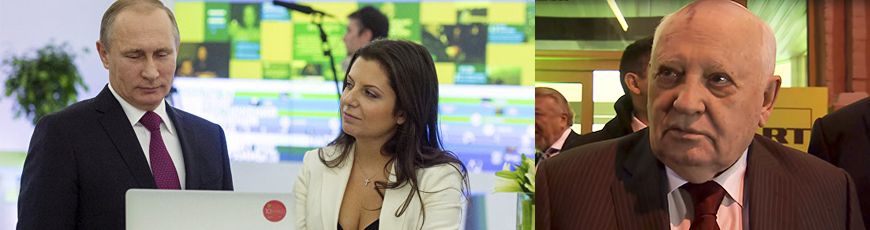
International news channel RT 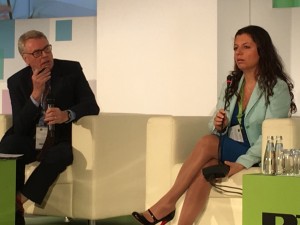 marked its tenth anniversary with a major conference in Moscow on 10 December. The theme of the one-day event – attended by a range of international delegates from the world of media and politics as well as delegates from across Russia – was “Information, messages, politics: the shape-shifting powers of today’s world”. Guest speakers from the worlds of news, politics and security are taking part in lively discussions.
Speaking in a panel on security and surveillance on a link from London, Julian Assange provided thoughtful analysis of the state’s need for surveillance of the public.
RT editor-in-chief Margarita Simonyan spoke about the role of the channel in the global media environment, highlighting the channel’s 3 billion views on YouTube.
Arnab Goswami, well-known presenter on India’s Times Now, talked of the “hegemony of Western news” and urged India to join the increasing number of global news channels.
In the evening, a gala reception attended by Vladimir Putin and Mikhail Gorbachev, along with many other Russian politicians and guests from national and international TV and radio channels, was held to round-off the day’s celebrations.
9 December 2015
Burmese-speaking users of Viber now have access to the BBC’s news updates thanks to the launch of the BBC Burmese channel on the app. The BBC Burmese channel on Viber will deliver several updates of key news stories of the day, in text, images as well as short audio and video clips.
With its population of 48.7 million, Myanmar (also known as Burma) has 29 million active mobile subscriptions. According to the international telecoms providers operating in the country, Myanmar is among world leaders in smartphone usage.
BBC Burmese Editor, Tin Htar Swe, comments: “While BBC Burmese audio news bulletins are available for listening on mobile phones in Myanmar, this is the first time BBC Burmese content is made available on a chat app. With Viber’s reported 14.8 million unique users* in Myanmar, we can now connect with our audiences – existing and new – through this growing platform, offering them access to news from the BBC, in their language.”
To access the BBC Burmese Public Chat on Viber App, users are required to:
- go to their App Store and download the Viber App on their smart phone; Viber will ask them to provide their phone number – that’s all they need to register
- once they are in Viber, they need to click on the ‘Public’ icon – this takes them to Viber Public Chats
- hit the magnifying glass and search for the BBC Burmese Public Chat
- hit ‘Follow’ – and the chat will be visible whenever the ‘Public’ icon is clicked.
BBC Burmese reaches 6.9 million people every week (2015). The BBC Burmese Facebook page has over 3.7 million fans (December 2015). The BBC Burmese radio programming is broadcast on shortwave and on Asiasat5 satellite television channel and streamed online via bbcburmese.com. Selected radio programming is rebroadcast by some of the country’s nationwide FM networks. BBC Burmese TV news bulletins are broadcast live on the national TV channel, Myanmar National Television (MNTV) at 20.45 local time (14.15 GMT) Monday to Friday, and are streamed live on the website bbcburmese.com.
BBC Burmese is part of BBC World Service which also offers a Public Chat channel in Nepali on Viber App. BBC World Service’s content in other languages is also available via messaging apps such as LINE, We Chat and Telegram.
