15 February 2016
RICHARD QUEST NAMED EDITOR-AT-LARGE
CNN Worldwide announced today the expansion of its CNNMoney brand internationally, across both TV and digital, to provide consumers around the world its industry-leading business and financial news and analysis. With the addition of staff in London, Dubai, New Delhi and Hong Kong, CNNMoney will launch new franchises, series, features and reporting tailored directly to the regions and audiences it covers.
CNNMoney International builds on the success of CNNMoney U.S., while utilising the power and reach of CNN International, all under one banner.
“By uniting our portfolio of U.S. and international business reporting under the CNNMoney brand, we now offer an even more compelling product to globally-minded consumers hungry for a smart, accessible business and financial news experience – everywhere in the world,” said Mike McCarthy, senior vice president and general manager of CNN International.
Coverage from CNNMoney will span Asia, Europe, the Middle East, Africa and Latin America. It will focus on global markets and the economy, business strategy, corporate leadership, global brands, business travel, lifestyle and luxury, as well as industries such as auto, energy and technology.
The venture will tap the talents of Richard Quest, Nina dos Santos and Maggie Lake whose programmes will represent CNNMoney on television. CNNMoney View with Nina dos Santos will air at 6a ET from London,CNNMoney with Maggie Lake will air at 9a ET and Quest Means Business, anchored by Richard Quest, will air from New York at 4p ET. In addition, Quest will now serve as editor-at-large for CNNMoney and he will pen a global daily newsletter “CNNMoney Presents: Quest Means Business,” timed to the open of the Asia markets.
Also joining the CNNMoney roster are John Defterios, emerging markets editor based in Abu Dhabi; Andrew Stevens, Asia Pacific editor based in Hong Kong; Eleni Giokos, Africa business correspondent based in Johannesburg; and Samuel Burke, CNNMoney business correspondent based in New York. The multi-platform editorial teams will be led by Penny Manis, director of global business news programming based in New York, and Mark Thompson, managing editor of CNNMoney International who is based in London.
The global initiative will also expand CNNMoney’s data-driven storytelling and digital war rooms to international bureaux, arming reporters with the most advanced tools and analytics available to drive and react to stories in the global marketplace.
“CNNMoney is a unique business offering built on the pillars of journalistic excellence, unprecedented scale of premium audiences and industry-leading use of data insight,” said Petra Malenicka, SVP, Advertising Sales, Western Europe and the Americas, CNN International. “The synergy of the CNNMoney brand, the highly relevant content and the effective turn-key commercial solutions powered by granular targeting creates the most compelling advertising proposition for any brand that wants to engage with the premium business audience at scale in specific regions, markets or globally.”
For more information on CNNMoney’s global expansion and products, see the editor’s note from CNNMoney Executive Editor Lex Haris here. (Source: CNN press release)
11 February 2016
Following its launch in Japan, Euronews confirms the success of its expansion in the Asia/Pacific region and announces new agreements in South Korea and Mongolia.
Since 2012, expanding distribution in Asia and Pacific has been a priority for Euronews, which now reaches 23.5 million subscribers in 15 countries* of the region, marking an all-time high.
Within the region South Korea is now the country with the greatest distribution of international news media, with over 6.5 million subscribers.
Euronews and Hyundai HCN have announced that, since January, the Euronews English service has been available 24/7 via the mobile application Everyon TV.
Designed for all equipment and every brand of smartphone, tablet and computer, the free application has already been downloaded by 6.5 million users. This distribution via an OTT platform is a first for Euronews in this country, where it is already broadcast via the cable operator Tbroad and by IPTV through Korea Telecom.
Everyon TV is a N-screen service which provides 250 live channels via PC, smart phone, smart TV and OTT for free in everywhere.
In Mongolia, Euronews confirms its presence with two new agreements for the 24/7 English service.
Euronews is now available in the basic offer of the country’s digital terrestrial television network operated by Mongolia Digital Broadcasting (MNBC) and has also become a part of the leading satellite platform DDish.
Arnaud Verlhac, Worldwide Distribution Director of Euronews said: “Asia/Pacific is an extremely competitive market where there are real opportunities for international media. Our strategy of proximity, reflected by the assignment of a member of our distribution team to Singapore in September 2015, enables us to be more reactive and closer than ever to our clients.”
Sabrina Mimouni, Euronews Asia-Pacific Distribution Manager, added: “These latest agreements are representative of the multiple distribution tools available to media. Euronews’ adaptability is a key element in this region, which is highly sought-after by the international media and where national competition is strong.”
* Euronews APAC
23.5 million subscribers in 15 countries
Euronews is available mainly in English:
. Southeast Asia: Cambodia, Hong Kong, Indonesia, Malaysia, Philippines, Thailand
. Central Asia: India, Mongolia
. Northeast Asia: South Korea, Japan, Taiwan
. Pacific: Australia, New Caledonia, New Zealand, Papua-New-Guinea
(Source: Euronews press release)
11 February 2016
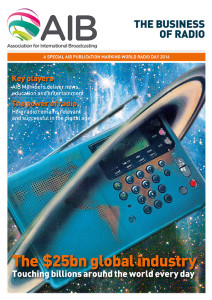 Radio, the oldest electronic mass medium, is in good health and well positioned for the future. That’s the message from the Association for International Broadcasting as World Radio Day 2016 is marked internationally.
“Radio generates revenues of well over US$25m every year,” comments Simon Spanswick, chief executive of the Association for International Broadcasting (AIB). “Radio is a major a generator of economic growth and employment – both in front of and behind the microphone. Every day, it touches the lives of billions of people, providing news, information, entertainment and education. At the AIB we’re delighted to join with our Members to celebrate the continued relevance and importance of radio on 13 February, the day designated by UNESCO as World Radio Day.”
The AIB is publishing a special souvenir book to demonstrate the value of radio internationally. ‘The Business of Radio’ provides insight into the radio industry and profiles Members of the AIB who operate radio networks and the service providers that keep radio on the air around the world.
‘The Business of Radio’ is being sent to opinion-leaders including parliamentarians and media regulators around the world to remind them of the key role that radio continues to play, even in the digital age of mobile apps and social media.
“The strength of radio is its ability to connect people in a way that other media cannot,” continues Spanswick. “At the AIB, we are delighted to see that our radio Members are reacting positively to the changes in media consumption habits. For example, they make sure that their programmes are available via multiple platforms, increasing their reach as they do. The AIB is pleased to be accompanying them on their journey into radio’s bright future.” or as a downloadable PDF at
‘The Business of Radio’ includes articles contributed by a number of the AIB’s Members, including the BBC, Broadcasting Board of Governors, RNW Media, Radio Taiwan International and DW. It is available in digital page-turning format at http://aib.org.uk/Resources/BizofRadio.html or as a downloadable PDF here.
10 February 2016
New appointments to focus on content sales around US elections, digital products and branded channel launches
CNN has appointed a new Commercial Director, EMEA, and Head of Product for its Content Sales, Partnerships and Out of Home business as it increases its content and services offering for international affiliates and partners.
Kostas Oikonomou joins CNN International as Commercial Director, Content Sales and Partnerships, EMEA, to work with existing and new TV and digital publishers across the region to license CNN’s award-winning content, utilise CNN reporting, consultancy and training, and launch CNN-branded linear and digital channels. Oikonomou has a long track-record of editorial, commercial and consultancy roles at Discovery Communications, Al-Jazeera English, Associated Press and NBC News.
Hristo Guertchev is appointed as CNN International’s Head of Product for Content Sales and Out of Home. Guertchev will work closely with CNN editorial, technology and commercial teams to define, develop and deliver products and services for CNN’s international TV and digital affiliate publishers and out of home partners such as hotels and airlines. Guertchev joins CNN International Commercial from Reuters, where he spent six years in a range of commercial and product roles, most recently as Senior Product Manager, Video.
The appointments come at an important time for CNN International Commercial as it offers partners an enhanced offering for CNN content – particularly from CNN Politics in the build-up to the US Elections – and a wider range of training, consultancy and brand licensing opportunities. This portfolio of services spans: the CNN Journalism Fellowship programme, which has trained over 1,000 journalists from CNN affiliates since it was launched in 1989 and now includes Digital and Leadership training programmes; full-service support and consultancy to launch new affiliate channels such as the successful N1 channel in the Adria region; and working closely with partners to launch CNN-branded linear and digital channels such as CNN Philippines, CNN Indonesia and digital-only service CNN Greece. New products planned for CNN International clients include an API and new forms of digital delivery of content to publishers and out of home partners.
Both Guertchev and Oikonomou report to Greg Beitchman, Vice President, Content Sales and Partnerships, CNN International.
“I’m delighted to have Kostas and Hristo on-board to spearhead CNN International’s growth in content sales and services for our growing range of partners,” said Greg Beitchman. “CNN has the distinctive content, trusted brand values and decades-long know-how to help linear and digital publishers remain relevant in a news landscape that continues to change at rapid pace. As 2016 looks set to be a busy news year in sports, politics, business and news, CNN International Commercial is committed to bringing a greater range of content and services to our partners.”
About Kostas Oikonomou
Kostas Oikonomou has a history of working on both the journalistic and commercial sides of news and media organisations. Most recently in strategic consulting for Discovery Communications, Kostas previously spent eight years at Al-Jazeera English in a variety of roles across digital and TV, consultancy, business development and editorial. Based in Washington and Doha, Oikonomou managed large teams to deliver news coverage and in business areas such as strategic planning and analytics. Prior to Al-Jazeera, he held editorial roles at Associated Press and NBC News, including covering the 2004 Olympics in his home city of Athens. Oikonomou gained an MBA from Said Business School, University of Oxford, UK, in 2012.
About Hristo Guertchev
Hristo Guertchev joins CNN after six years at Reuters News Agency where he held business development and product roles in Switzerland, Singapore and London. Most recently as Senior Product Manager, Guertchev has managed the Reuters video portfolio and defined commercial policy for broadcast and digital products. He also delivered new propositions such as a multi-million dollar revenue-generating live streaming video product. In 2014, Guertchev was selected for Thomson Reuters Leadership Development Programme and holds a Masters in International Management at the London School of Economics and ESADE Barcelona.
About CNN International
CNN’s portfolio of news and information services is available in seven different languages across all major TV, digital and mobile platforms reaching more than 400 million households around the globe. CNN International is the number one international TV news channel according to all major media surveys across Europe, the Middle East and Africa, the Asia Pacific region and Latin America and recently expanded its U.S. presence with its launch on CNNgo. CNN Digital is a leading network for online news, mobile news and social media. Over the years CNN has won multiple prestigious awards around the world for its journalism. CNN has 42 editorial offices and more than 1,100 affiliates worldwide through CNN Newsource. CNN International is part of Turner, a Time Warner company. (Source: CNN press release)
9 February 2016
The World Teleport Association (WTA) today announced that Pierre-Jean Beylier, CEO of SpeedCast, has been named as its 2016 Teleport Executive of the Year. Mr. Beylier will be honored during WTA’s Teleport Awards for Excellence luncheon on March 8 during SATELLITE 2016. The Teleport Executive of the Year award is presented to an individual for demonstrated entrepreneurship, leadership and innovation in the development or operation of a teleport-based business.
Under the leadership of Pierre-Jean Beylier, known as PJ, SpeedCast executed five acquisitions in 2015, which doubled the company’s revenue, while achieving 99% retention of the staff in the acquired companies. This remarkable performance stems from corporate values summed up in the acronym “CAST” – Customer-focused, Agile and responsive, Success through people and Team spirit. The work of integration these acquisitions is called Project Bordeaux, whose goal is to turn six companies into one streamlined and efficient organization. Project Bordeaux stresses communication: giving all team members visibility into what the organization is doing, what it has achieved and what is coming next. The result has been increasing cross-team collaboration leading to a higher “win” ratio and faster project delivery.
PJ also leads the company’s engagement with humanitarian and charitable organizations. The company has contributed equipment and technical support under the NetHope initiative for recovery from Huricane Haiyan. SpeedCast is a corporate supporter of charitable events including Australia’s Big Red Ride, which raises money for muscular dystrophy research, World Championship Sailing in Japan, and other events. With its focus on nonprofit organizations, SpeedCast is also a major supplier to such NGOs as UNHCR, UHHDOC and Save the Children International. From his base in Hong Kong, PJ has built a company with global reach across the mobile, maritime, energy, government, mining and NGO markets.
FaceTime for Android: The human race is known to be greedy and wanting everything that the other person has. This era is the era of technology. Facetime for PC Download Learn how to Install Facetime for Windows PC Using Bluestacks App Player.
“A healthy technology sector offers opportunities to small, entrepreneurial companies as well as to midsize and large firms with the potential to acquire them,” said executive director Robert Bell. “The teleport industry is just such a sector and executives like PJ Beylier not only build on the success of the companies they acquire but increase the potential of the industry for growth.”
During the 2016 Teleport Awards for Excellence luncheon ceremony, hosted by Crystal, WTA will also honor its Independent Teleport of the Year and Teleport Technology of the Year.
(Source: WTA press release)
9 February 2016
Russian speakers in Estonia, Latvia and Lithuania rank Kremlin-backed media as the least trustworthy among international, Russian Federation and domestic news sources, according to research presented by the Broadcasting Board of Governors yesterday.
In addition, only those survey respondents who considered Russian-backed media to be credible showed a majority support for President Vladimir Putin’s domestic and international policies. In the three Baltic nations and Moldova, consuming Russian-backed media did not correlate with support for Russia’s policies.
The BBG data found that domestic media ranked first in trustworthiness in Estonia (80 percent) and Latvia (79 percent). International media took first in Lithuania (74 percent) and in Moldova there was a statistical tie between international media (45 percent), Russian-backed media (42 percent) and domestic media (42 percent).
The findings were unveiled at Thursday’s research briefing conducted by the BBG and Gallup on the consumption and influence of Russian-language media in Russia’s periphery.
Gallup’s World Poll data, which was conducted in 2014 shortly after the Russian annexation of Crimea and hence over a year before the BBG data in the Baltics and Moldova was collected, examined how respondents in 12 former Soviet Union countries followed news about Russian actions in Ukraine and Crimea. Data showed the majority of respondents followed the events very closely and reported finding Russian media reliable. For some, that translated into support for some Russian policies. According to the 2014 Gallup findings, in seven of the 10 countries surveyed, the majority of respondents who consumed both “Western” and Russian media showed support for Russia’s annexation of Crimea. “Western” media as defined in the Gallup World Poll survey did not specifically include or exclude U.S. international media, according to Gallup presenter Neli Esipova.
Since this survey was initiated, the BBG language services at Voice of America (VOA) and Radio Free Europe/Radio Liberty (RFE/RL) have added or expanded more than 35 new programs on multiple media platforms in Russian, Ukrainian, and other languages to reach new audiences in the former Soviet space and around the world.
Jeffrey Trimble, Deputy Director for the International Broadcasting Bureau, outlined the BBG’s strategy in the region and highlighted the flag-ship program Current Time, a daily 30-minute Russian-language television news program produced by VOA and RFE/RL. Current Time is now on the air in nine countries via 25 media outlets. The European version airs in Ukraine, Moldova, Georgia, Lithuania, and Latvia, with segments of the program airing in Israel. A Central Asia version airs in Kyrgyzstan, Tajikistan and Kazakhstan. Weekend Current Time programs — “Itogi” by VOA and “Nedelya” by RFE/RL — are on the air as well. Current Time also reaches Russian-speaking news seekers worldwide via digital platforms curated by RFE/RL’s DIGIM team, which was launched in September 2015 and which produces and disseminates innovative cross-platform digital content, promotes the Current Time brand in the digital space, and engages Russian-language audiences on social media.
Russian authorities do not allow placement of Current Time on domestic television stations.
Presenters at the research briefing cautioned that comparing the Gallup World Poll survey and the Gallup survey conducted for BBG was problematic, as the surveys targeted different countries, were conducted over a year apart and had several methodological differences, including question wording, context and sampling.
A video and briefing documents are available on the BBG website. (Source: BBG press release)
