16 November 2016
The BBC World Service has announced its biggest expansion since the 1940s, in a move designed to bring its independent journalism to millions more people around the world, including in places where media freedom is under threat.
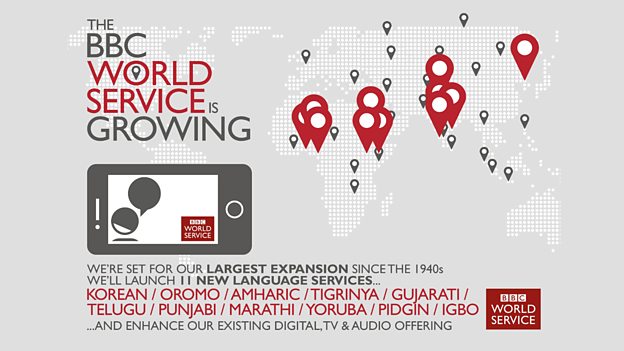 The BBC World Service will also expand its digital services to offer more mobile and video content, a greater social media presence, and new ways of reaching its audience around the globe.
The BBC World Service will launch 11 new services in Afaan Oromo, Amharic, Gujarati, Igbo, Korean, Marathi, Pidgin, Punjabi, Telugu, Tigrinya, and Yoruba. This means the BBC World Service will be available in 40 languages including English. The expansion will also mean more journalists on the ground in locations across the world.
The expansion includes plans for the BBC to:
- Produce extended news bulletins in Russian, with regionalised versions for surrounding countries, a relaunched website, new digital formats and more journalists on the ground
- Enhance its television services across Africa, including over 30 new TV programmes for partner broadcasters across sub-Saharan Africa
- Enhance the BBC Arabic offer by delivering new regional programming across the Arab world
- Broadcast short-wave and medium-wave radio programmes aimed at audiences in the Korean peninsula, supplemented by digital content online and on social media
- Invest in World Service English, with new programmes, more original journalism, and a broader agenda
- Continue with the digital transformation of the BBC World Service, including new TV news bulletins, so that all 40 languages will eventually have a video offer
- Use its global presence to provide an even greater focus on analysis and explanation, or ‘slow news’, helping audiences to make sense of the world by explaining the ‘why’ as well as the ‘what’.
Tony Hall, Director-General of the BBC, said: “This is a historic day for the BBC, as we announce the biggest expansion of the World Service since the 1940s. The BBC World Service is a jewel in the crown – for the BBC and for Britain.
“As we move towards our centenary, my vision is of a confident, outward-looking BBC which brings the best of our independent, impartial journalism and world-class entertainment to half a billion people around the world. Today is a key step towards that aim.”
Francesca Unsworth, BBC World Service Director, said: “Through war, revolution and global change, people around the world have relied on the World Service for independent, trusted, impartial news. As an independent broadcaster, we remain as relevant as ever in the 21st century, when in many places there is not more free expression, but less.
“Today’s announcement is about transforming the World Service by investing for the future. We must follow our audience, who consume the news in changing ways; an increasing number of people are watching the World Service on TV, and many services are now digital-only. We will be able to speed up our digital transformation, especially for younger audiences, and we will continue to invest in video news bulletins. What will not change is our commitment to independent, impartial journalism.”
The BBC World Service will focus particularly on increasing audience reach with younger people and women.
The BBC’s Director-General has set a target for the BBC to reach 500m people worldwide by its centenary in 2022.
This expansion is a result of the funding boost for the BBC World Service announced by the UK Government last year. Further details of the new services will be announced in due course. The first new services are expected to launch in 2017.
15 November 2016
The Broadcasting Board of Governors today released its annual impact numbers which show the agency had its largest ever increase in its weekly worldwide audience to 278 million people, up from 226 million in 2015. These increases occurred across all platforms with digital platforms seeing the largest percentage growth, followed by radio and television.
“The unprecedented growth we’ve seen this year further illustrates the need for U.S. international media particularly in parts of the world where access to balanced, impartial news is severely limited or non-existent,” said BBG CEO and Director John Lansing. “In media markets increasingly dominated by disinformation and propaganda, more and more people are turning to BBG networks for fair, accurate, fact-based reporting.”
The increases include gains in highly competitive media markets that are of strategic importance to the United States. Digital audiences increased from 32 million to 45 million while those for radio rose by 27% to 130 million. Television audience also grew, increasing 23% to 174 million.
In addition to weekly audience size, the BBG measures its impact using quantitative, qualitative, digital and anecdotal data on a wide range of factors including program quality and credibility, engagement with the news process, and audience understanding of current events. Key accomplishments include:
- MBN’s Raise Your Voice-Iraq developed new television programs encouraging Iraqis to share their thoughts and opinions on extremism and the underlying causes of terrorism. This programming provides firsthand accounts of the realities of life under ISIL, including the pain and suffering of families and communities.
- RFE/RL and VOA actively engaged online in providing alternatives to Russian disinformation. In FY 2016, RFE/RL’s DIGIM, the social media arm of Current Time, received 120,000 average weekly engagement actions on Facebook and VOA Russian averaged 45,000 per week.
- VOA and RFA increased their social media outreach in Southeast Asia with huge gains in video viewing and engagement on Facebook and YouTube. VOA Vietnamese averaged 2.7 million video views weekly on YouTube, and RFA averaged over 600,000.
- OCB hosted a two-day conference on internet freedom in Cuba. The event convened a broad spectrum of digital innovators and independent journalists from Cuba and elsewhere to exchange ideas and provide important information about the state of the internet in Cuba.
To learn more about the BBG’s performance measures, the 2016 Performance and Accountability Report, along with the BBG’s 2016 audience overview and explanation of research methodology are available here.
(Source: BBG press release)
15 November 2016
Intelsat S.A. (NYSE: I), operator of the world’s first Globalized Network, powered by its leading satellite backbone, tonight was named “Satellite Operator of the Year” during the 2016 Arab States Broadcasting Union (ASBU) presents BroadcastPro Selevision Awards. The result was announced during a ceremony in Dubai.
Nominees were judged by a panel of experts across the MENA region on their work toward improving communications in the Middle East and North Africa and the lives of the people living there. Intelsat, as well as other operators in the region, enable voice communication, provide Internet access to fiber-lacking areas and give access to education or healthcare to those in remote locations.
“This award recognizes Intelsat’s continuing leadership as the innovator in space-based communications. In 2016, Intelsat delivered on the promise of high throughput satellite (HTS) technology when it launched the first two satellites in the Intelsat EpicNG network, providing immediate benefits to users,” said Shahrokh Khanzadeh-Amiri, Managing Director, MENA, Intelsat. “The launches established Intelsat as the first operator to implement a backward-compatible, open architecture HTS platform. Intelsat EpicNG will support the growth of telecom operators, service providers and media organizations with higher performance, improved economics and simplified access.”
Intelsat has also continued to give communities access to affordable, high-quality and reliable television/video programming. Intelsat 36, which has now entered service, bolsters the penetration of high definition programming for viewers in the broader Middle East and Africa regions.
The ASBU presents BroadcastPro Selevision Awards cover a broad range of categories to reward excellence in various fields across the broadcast workflow, from production and post-production to traditional broadcast and new media platforms.
(Source: Intelsat press release)
15 November 2016
The AIBs 2016 were attended by guests from all over the world – Argentina to Australia, Qatar to the UAE, the USA to Norway.
A selection of pictures taken by our regular photographer Alex Beaton at the event appear below. Click on a picture to see it at full size.
Find out who won and who received commendations in our Winners Book here.
The AIBs 2017 will open for entry in April.
[flickr_set id=”72157674809307002″]
14 November 2016
Arab Satellite Communications Organization – Arabsat – participates in AFRICACOM Conference & Exhibition held in Cape Town, South Africa, from 15-17 November 2016.
Eng. Khalid bin Ahmed Balkhyour, President & CEO of Arabsat, stated that “Through our participation in this show, we are looking forward to presenting our services provided to the African continent, as our 5th generation satellites are covering the entire African continent broadcasting TV, telecommunications and Internet satellite services. Arabsat satellites also broadcast dedicated bouquets over North Africa and other dedicated bouquets over the whole African continent including TV & telecom broadcast, in addition to the existence of several ground satellite stations inside Africa connected to the European and the Asian satellite ground stations to provide Internet services and mobile networking. ARABSAT will also showcase the capabilities of its 6th generation satellites, scheduled to be launched next year which will provide extra massive satellite capacities covering the whole African continent and its potential market with full in Orbit – back up.”
Balkhyour concluded that “We are currently working hard on several important strategic projects to operate many of our new orbital positions and keep up with our customers increasing needs, maintaining Arabsat status as the best choice to provide customers’ needs in satellite broadcasting & Telecommunication services.”
(Source: Arabsat press release)
10 November 2016
The Association for International Broadcasting has presented its Founders Award to Abdul Rahman Ramadhan
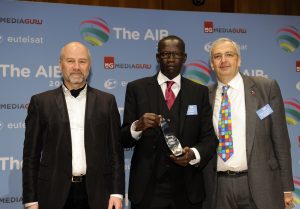
Abdul Rahman Ramadhan (centre) receives the AIB Founders Award from Alexey Nikolov, Chairman of the AIB Executive Committee and Managing Director, RT (left) and Simon Spanswick, Chief Executive, AIB (right)
Abdul Rahman Ramadhan started work in 1980. It wasn’t a typical career for someone living in Nairobi’s Kibera slum. He graduated from the local madrasa and chose the profession of sound, landing a job at the Camerapix news agency run by Mohamed Amin in the Kenyan capital.
He honed his skills on the job, working with the standard location sound kit of the time – a Nagra reel-to-reel tape recorder. Those skills, which would be developed over the following three and a half decades, have brought the world sound from across Africa.
For Abdul has recorded the sound that has accompanied TV news reports from many of Africa’s most troubled places and challenging events. His first truly dangerous assignment was the civil war in Sudan in 1992. This was the first war zone that the young sound man had experienced. Along with the other Camerapix team members, Abdul dodged bullets from soldiers and bombs dropped from Antonov planes. He slept among the dead to avoid detection – a certain route to death.
Soon after, he accompanied Mo Amin to Ethiopia which was in the grip of the worst famine to hit the country in a century. It was the pictures and sound captured by Mo Amin and Abdul for the BBC and other organisations of the plight of tens of thousands of starving people led to the establishment of Live Aid. Bob Geldof saw the report that Michael Buerk filed for the BBC and was so moved that he organised Band Aid that recorded the global hit “Do They Know It’s Christmas?”, followed in 1985 by Live Aid.
In 1994, with his wife pregnant with their second child, Abdul was sent by Mo Amin to Rwanda where the genocide had started. There Abdul and the Camerapix team witnessed many of the atrocities that occurred during the 100 days of the genocide. It was the first time that Abdul had seen tens of people being killed at the same time. In Somalia, it was just one killing a day, he recounts. In Rwanda, Abdul saw gangs killing ten people or more at a time, all in the most horrific ways.
He’s covered stories in his native Kenya, too, including the election violence in 2008. The two main tribes in the country fought running battles and up to 1,500 people died in the violence, with half a million or more displaced. Abdul was on hand, recording the sounds of battle on his own home turf.
Abdul is sanguine about the risks to his own life, saying that when his time is up, that’s just the way it is, however his life should end.
His wife supports him, despite not knowing if Abdul will come back from his latest assignment. She knows that capturing the sound that tells the most important stories is in Abdul’s blood, and that it is far more than just a job.
Sound is Abdul’s passion. Over the past 35 years, he has brought us some of the most momentous moments from Africa’s recent history.
Abdul shows no sign of hanging up his microphone. The Association for International Broadcasting is proud to recognise the work that Abdul has undertaken to help bring us the stories from Africa that need to be told. The AIB Founders Award pays tribute to a remarkable man – the Sound Man Abdul Rahman Ramadhan.
