4 September 2018
SatADSL defines itself as a business-oriented company. It is currently present in some forty countries and develops specific solutions for niche sectors, including hotels, microfinance institutions, schools, and rural radio broadcasting companies. Let’s discuss the strengths and strategies of the company with Thierry Eltges, CEO and co-founder of SatADSL.
What are the assets and specificities of SatADSL?
Thierry Eltges: One of our competitive strengths is that we have our own service platform: the Cloud-Services Delivery Platform (C-SDP). This platform allows us to provide an offer that is unique from our competition today: any operator or Internet Service Provider (ISP) can now start a satellite business anywhere in the world and without infrastructure investments. You should know that it takes a small fortune to start such a business and the financial risk is high. Operators or ISPs wanting to start selling their own services have to invest in a satellite hub and enter into a contract to lease satellite capacity for several years.
And the SatADSL C-SDP can offer advantages that other companies cannot match?
Thierry Eltges: First, there is no need to buy expensive equipment. Operators and ISPs who start their business using our services only need to buy satellite terminals that are relatively easy to install and use. You could say that SatADSL assumes the financial risk. Secondly, our C-SDP is connected to several teleport operators. This means that in case of an outage in one operator’s network, we can quickly switch to another operator.
How important is your network of local partner distributors?
Thierry Eltges: This is certainly another of our strengths that sets us apart from our competitors. We actually have two types of partners: on the one hand, we work with a network of distributors ‒ mostly African companies with local VSAT and Internet licenses offering satellite services. They must be able to carry out installations and provide after-sales service themselves. SatADSL invoices the connectivity services – subscriptions or vouchers – to these distributors, who in turn invoice their own services to their end users. On the other hand, we work directly with end-user customers, including European companies active in Africa. We rely on the same network of distributors to do the technical installations, provide the licenses, etc. These distributors invoice us for their services and SatADSL invoices the end-user customer.
What is your strategy for the future of SatADSL?
Thierry Eltges: We will continue to invest heavily in research and development. More than a third of our team is dedicated to innovation and we work extensively with the European Space Agency (ESA). We also want to expand geographically. We already have customers in Africa and the Middle East and we want to go to Asia and South America. This is, by the way, another reason why we invest so much in our C-SDP: we want to be able to provide both global connectivity and multi-technology capacity. It is part of our “horizontal” business model to encourage cooperation with teleport and satellite operators. This model challenges the “vertical” model endorsed by some large satellite operators to the benefit of the end customer, who can enjoy an optimal service at the lowest price.
Does this mean that the satellite capacity available on the market will increase significantly in the coming years?
Thierry Eltges: Absolutely! On all five continents, more and more companies and operators are investing in new satellite technologies. Our goal is to continue developing our C-SDP to make it a truly open platform, including all technologies, satellites, frequency bands and operators. This will allow us to continue providing the best solutions using the best available technologies at the best price. The satellite market is currently undergoing major changes and very large projects are under study. For example, Google wants to launch 800 satellites into low orbit. Facebook also wants to be present in the stratosphere. This involves many different technologies, sometimes even beyond satellite technology. And we need to be ready!
What else can be said about the technological developments?
Thierry Eltges: Until now, geostationary satellites are mostly used as communication satellites. They circle 36,000 km above the Earth’s equator at a fixed position and use spot beams to cover an entire continent. This technology requires very large receiving antennas and powerful antenna amplifiers, leading to very high costs. As a result, the main technological evolution today is to increase the frequency and to narrow the beams with high-throughput satellites (HTS) to 30 to 50 small spot beams, instead of one large spot beam. This technology makes it possible to concentrate power in a limited area and to have more capacity available at a lower price. But there is only room for a few hundred satellites on this specific orbit arc and the orbital positions are allocated to each country depending on its size. This is one of the reasons why several operators are preparing to launch mega-constellations of low Earth orbit (LEO) satellites, to which our C-SDP will also be able to connect in the future.
3 September 2018
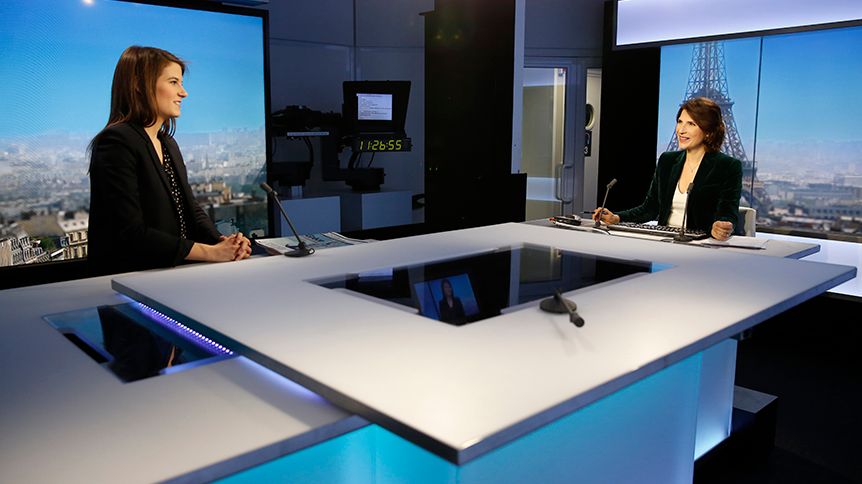
Arqiva, the international satellite and media services provider, has today announced an upgrade of its five-year contract with France 24 to incorporate the launch of a new high definition (HD) channel in the UK.
France 24, an international rolling news channel broadcast in French, English, Arabic and Spanish to 355 million households around the world, has been available to UK audiences in standard definition (SD) in the UK since 2012. The announcement means that UK customers of Sky and Freesat can access its breaking news coverage in HD with immediate effect.
Arqiva will provide its satellite services to deliver the France 24 service to Sky and Freesat through its media facility in Paris. Using state-of-the-art encoding, Arqiva is also helping France 24 optimise the use of satellite capacity for HD delivery.
Alex Pannell, Managing Director, Satellite & Media at Arqiva, said: “The most satisfying wins are undoubtedly those that result from a long-standing, successful relationship with a partner – we are delighted that we can help France 24 with the next phase of its growth.
“Arqiva prides itself on delivering high quality services that are flexible to the specific needs of our customers, and as France 24 reaches more and more audiences in the coming years, we look forward to evolving our proposition with them.”
David Couret, Director of Technical Distributions at France 24 added:“The launch of France 24 HD represents an important step in our journey to bring instant, high quality news and events coverage to UK viewers, and it is crucial to have a trusted partner like Arqiva working alongside us on this project.
“Arqiva helped us launch our first UK SD channel back in 2012, and its reliable service and technical expertise has been critical in helping us to grow in this essential market.”

3 September 2018
Journalists jailed for seven years for reporting on Rohingya mass killing
The Association for International Broadcasting is deeply troubled by the jailing of two Myanmar journalists for allegedly contravening the country’s Official Secrets Act.
Wa Lone, 32, and Kyaw Soe Oo, 28, were found guilty by a district judge in Yangon and sentenced to seven years in jail. The reporters were arrested on 12 December 2017 while investigating the killings of ten Rohingya men and boys, and other abuses involving soldiers and police, in the Rakhine State village of Inn Din.
The reporters were found guilty of receiving classified documents in what a police witness at their trial admitted was a sting operation designed to block or punish them for reporting on a mass killing of Rohingya Muslims in Rakhine, a clear case of entrapment. This follows the UN Independent International Fact-Finding Mission on Myanmar report published on 27 August that said Myanmar’s top military generals, including Commander-in-Chief Senior-General Min Aung Hlaing, must be investigated and prosecuted for genocide in the north of Rakhine State, as well as for crimes against humanity and war crimes in Rakhine, Kachin and Shan States,
“The Association for International Broadcasting deplores the jailing of the two Reuters reporters in Myanmar,” said Simon Spanswick, AIB Chief Executive. “Wa Lone and Kyaw Soe Oo were working for a major international news agency carrying out a legitimate investigation into killings in the country. This is a clear case of responsible journalism being silenced by the authorities who fear the uncovering of truths that could harm their legitimacy. This Association joins with other organisations and the diplomatic community in Myanmar in condemning these verdicts and their negative impact on journalism and freedom of expression in the country. We call on the authorities to overturn these sentences at the earliest opportunity and demonstrate to the world community that the country respects journalistic freedom.”
According to Reuters, US ambassador to Myanmar Scot Marciel said the “deeply troubling” verdict could undermine the confidence the Myanmar people had in the justice system.
The UN Resident and Humanitarian Coordinator in Myanmar Knut Ostby said he was “disappointed”.
“Unbelievable! More and more, responsible journalism is found to be a crime in Myanmar!” Yanghee Lee, the United Nations’ special rapporteur on human rights in Myanmar, said on Twitter.
British ambassador Dan Chugg, speaking on behalf of EU members, said the verdict had “dealt a hammer blow for the rule of law”.
The AIB is lodging complaints with the Myanmar Ambassador in London and in Washington DC.
Picture credit | Reuters journalist Wa Lone departs Insein court after his verdict announcement in Yangon, Myanmar, September 3, 2018. (REUTERS)
Download the AIB press release here.

30 August 2018
The International Broadcasting Convention (IBC) will be held in Amsterdam from Thursday 13 to Monday 17 September 2018. SatADSL will be present at the major event of the year for the broadcast and video technology industry. 1,700 exhibitors and 57,000 attendees are expected.
Amsterdam hosts IBC each September, attracting attendees and exhibitors from 170 countries. Just like the NAB Show in Las Vegas, IBC brings industry leaders in broadcasting, telecommunications, media, and entertainment together in fifteen halls.
This year’s event focuses on how companies are preparing for the future, with particular attention to speed and agility – the two key elements in every forward-thinking strategy. A prestigious line-up of some 400 speakers has been assembled to explore the theme of “Shaping The Future Together”.
SatADSL will take part in this event for the second time. If you are a satellite operator or an Internet service provider, we will be happy to meet you at stand “5.C31” in Hall 5. Michel Dothey, our Chief Commercial Officer, Fulvio Sansone, our Chief Technology Officer, and Caroline De Vos, our Chief Operations Officer, will showcase the SatADSL services: satellite IP connectivity, business solutions and specific business-oriented solutions. They will also show you what makes SatADSL different from the competition: the unique Cloud-Services Delivery Platform (C-SDP). Finally, they will present the new PaaS offer (Platform as a Service), opening the SatADSL C-SDP to every satellite, hub or IP service operator and bringing an additional level of added value to our current services.
To welcome you in the best conditions, we invite you to contact us today at caroline.devos@satadsl.net or +32 2 351 33 74 to arrange a meeting at our stand. You can also contact Michel Dothey at +32 495 53 06 12.
For more information about IBC: https://show.ibc.org.

29 August 2018
Encompass Digital Media has announced that it has signed a definitive agreement to acquire Babcock International Group’s (Babcock’s) Media Services business. This deal expands Encompass’ scale in EMEA and extends the company’s combined channel play-out, transmission and digital products portfolio while adding international radio distribution to its suite of services.
“Acquiring Babcock’s Media Services business increases our presence in the EMEA region, expands our video services offering, specifically in the live streaming sports arena, and bolsters our collective relationships with some of the most important media companies and public service broadcasters around the world,” explains Chris Walters, Encompass CEO. “We are thrilled to be adding a large number of highly regarded industry professionals to the Encompass team.”
The amount of technical complexity required to generate and deliver content to viewers continues to grow exponentially, and the acquisition of Babcock’s Media Services business represents a continued push to offer end-to-end, highly reliable and scalable services to media companies. With combined resources, Encompass will offer enhanced solutions to capture, process and deliver video content from any source, in any format, to any destination in the most efficient manner possible.
“I am delighted that Babcock’s Media Services business is becoming a part of one of the leading global providers of managed video services. The combination of Encompass’ significant international presence and prestigious customer base, together with Babcock’s growing capabilities in the rapidly expanding live streaming market and our market-leading position serving many of the world’s leading international radio broadcasters, will further cement Encompass’ global reputation as THE provider of choice,” states Nick Thompson, Managing Director of Babcock’s Media Services business.
Encompass has existing facilities in the UK, US, Singapore, Argentina, Latvia and India; this acquisition will grow its operations in the UK and Singapore and add operations in Oman and Ascension Island.
28 August 2018
The Red Bull Air Race uses the Ghost Plane and more graphic tools to add a new level of storytelling to the World Championship of air racing.
Take a combination of speed, the most agile raceplanes, a unique aerial track and some of the most stunning locations in the globe, and you have the Red Bull Air Race. Created by RedBull in 2003, the Red Bull World Championship has the best pilots in the world compete to fly flawlessly through the racetrack, passing giant air-filled gates with precision while trying to set the best time. The pilot finishing the track in the fastest time takes the race victory. Tens of thousands of fans gather around the world to watch this exciting motorsport competition live, while even more fans tune in to the live video production that is enhanced with augmented reality (AR).
A race at this scale can be tricky to watch from the ground. Fans want to know how fast the pilots are going, if they pass the gates correctly, and how did their competition do?
“The Red Bull Air Race is a sport which is hard to understand if you just watch it, because you don’t see the difference between two pilots,” says Stefan Koch, TV Director at Red Bull Air Race “The key is to attach people to the story.”
Engaging the audience
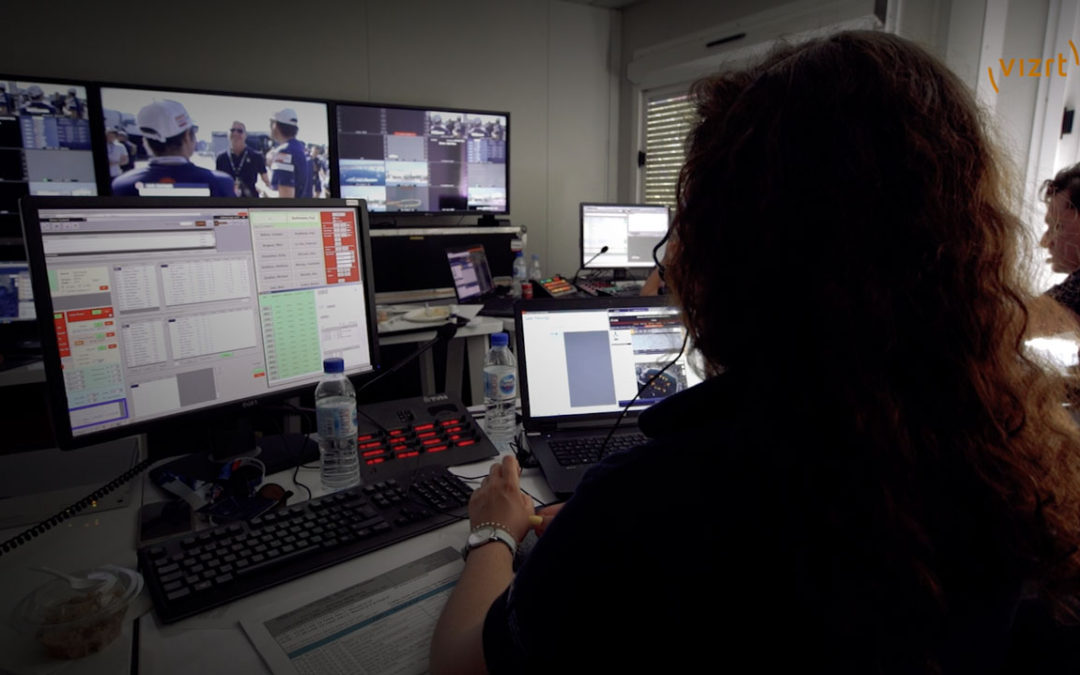
Red Bull Air Race, together with the production company netventure, have taken innovative approaches to grab the viewer’s’ attention and explain the air racing action. For the fans in the stands, several big video walls are in place. These video walls show race data visualized by netventure using Vizrt graphics tools that allow to share the excitement in real-time.
The real-time graphics are controlled with Viz Trio, which gives an operator full control of which pilot’s stats to share and when. The graphics and the tools to manage them play an instrumental part in creating an exciting story for both the live audience onsite and viewers on TVs and mobile platforms.
The ghost plane
The second innovation created by Red Bull Air Race and the support from netventure is the Ghost Plane. The ghost plane allows a visual head-to-head comparison between two pilots.
“They (Red Bull Air Race) wanted to add some more excitement during the competition since you cannot have two airplanes in the race track at the same time, says Antonio Bleile, Virtual Graphics Developer at netventure. “They wanted a tool to visualize competitors against the actual flying pilot.”
A real raceplane overlaid with an AR plane is the perfect solution for the audience to see in real-time who is winning. Accuracy is the key for a feature like this to work properly. netventure developed a plugin for Viz Engine to read flight data from the cockpit and apply it to the AR plane. Viz Engine has an open architecture allowing users to develop their own plugins to work specifically for their storytelling needs.
Capturing every emotion

Red Bull Air Race also wants to share the emotions of the pilots with the viewers. This is different to most other races however, because once the pilot crosses the finish line, they can’t relax, they need to remain focused and land their planes. Cameras have been installed inside the cockpit of each raceplane to capture every cheer or disappointment of the pilots. In addition, the pilots are interviewed on the ground as soon as they get out their planes. These interviews are recorded and ready to be broadcast live, with the help of a Vizrt partner EVS. The input from the recording is edited with Vizrt graphics by netventure and shared live on the video walls and broadcast live through Red Bull Air Race
“Emotion is part of successful sports event. Combining Vizrt’s graphics with the adrenaline rush of the planes racing at high-speed through the track, the Red Bull Air Race is one of the most exciting new sports today,” said Yan Heydlauf at Vizrt.
