10 October 2014

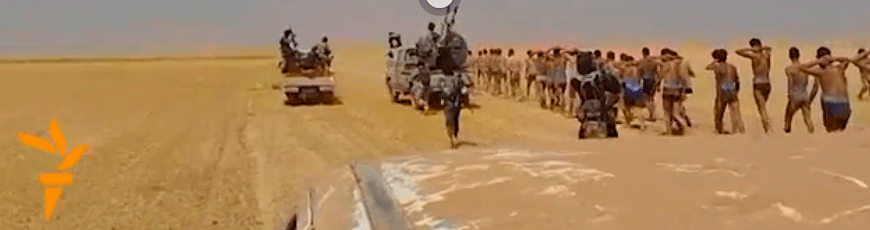
The Central Asian language services of RFE/RL have released a new video story documenting the growing number of recruits from Central Asia who are joining militants fighting for IS in Syria and Iraq. Research carried out by RFE/RL suggests that many are recruited while working in Russia as migrant workers.
RFE/RL has also introduced a new blog, Under the Black Flag, that provides a daily report on developments relating to IS in Iraq, Syria, Iran and the Former Soviet Union.
In addition, RFE/RL has an infographic showing which countries are countering IS and how they are achieving that.

26 September 2014
• US President remarks shows support for Al Jazeera staff to be freed
• Australian PM also urges Egyptian leader to release jailed trio
• Al Jazeera marks UNGA with viral campaign for #FreeAJstaff
Doha- 26th September, 2014
World leaders at the United Nations General Assembly (UNGA) have highlighted the importance of press freedom, and called on Egypt to release the three jailed Al Jazeera staff.
The wrongful imprisonment of Baher Mohamed, Peter Greste and Mohammed Fahmy was raised by US President Obama in his first meeting with his Egyptian counterpart Abdel Fattah el-Sisi.
According to the Deputy National Security advisor Ben Rhodes, Obama reminded the Egyptian leader of his duty to human rights, including the rights to free speech and the rights of the three jailed Al Jazeera journalists:
Rhodes said: “The president expressed his view that those journalists should be released.”
President Obama’s emphasis on releasing the men follows a similar meeting between Tony Abbott the Australian Prime Minister and Sisi for twenty minutes.
After the meeting Abbott said: “I think he (Sisi) will do his best to be helpful”.
At UNGA similar calls for Egypt to release the three journalists were made by the British Foreign Secretary Phillip Hammond who told Al Jazeera: “On the question of Al Jazeera journalists, I’ve raised this question personally with President Sisi. I raise it every time I see Foreign Minister Shoukry. The current situation is that the journalists have, as I understand it, appealed their convictions and that means this remains at the present time a judicial process. And we have to respect the separation of judicial and executive power. Once that judicial process is complete, if that sentence still stands, we would look to the executive to intervene and ensure they are released.”
In a campaign to increase even further awareness of the jailing of the Al Jazeera three, an advert was placed in the New York Times and Times Square New York to remind the Egyptian leader and other officials that the three men have been arrested, detained, charged and sentenced for just doing their job of honest, free and fair reporting.
Australian Peter Greste, Egyptian-Canadian Mohamed Fahmy and Egyptian producer Baher Mohamed were convicted in June of aiding terrorism and spreading false news that portrayed Egypt as being in a state of “civil war”. Greste and Fahmy received seven-year terms, while Mohamed was sentenced to 10 years, in a case that sparked international outrage.
Since their arrest in December 2013, Al Jazeera has received international support calling for their freedom from human rights organisations, news networks and various governments.
On social media the advert placed in the New York Times alone gave 800,000 impressions on Twitter in the first five hours.
Commenting on president Obama’s call for the release of the Al Jazeera three, an Al Jazeera spokesperson said:
“For nine months since the arrest of Baher Mohamed, Mohammed Fahmy and Peter Greste, world opinion has stated that these men are innocent and have committed no crime, yet nearly 300 days later they still languish behind bars. Al Jazeera welcomes the direct involvement of President Obama and Prime Minister Abbott by reminding the Egyptian authorities that it is their moral duty in the name of free speech and human rights that they release our colleagues who are innocent and renowned Journalists.”
Calls for the release of Al Jazeera staff have previously been made from the White House, the British Foreign and Commonwealth Office, the European Union, the Australian Government and over 150 rights groups, including Amnesty International, the Committee to Protect Journalists and the International Press Institute.
Over 200,000 people have signed petitions globally, including two petitions signed by 150,000 people presented to the Egyptian Vice Counsel in Sydney by Australia’s leading journalists.
Over 40 of the world’s top journalists have also signed a letter demanding the release of the journalists, and media outlets across the globe have staged their own protests, including BBC, CNN, ITN, Channel 4, Fairfax Australia, Toronto Star, VRT deredactie and Iran’s Shargh Daily.
High profile supporters include leading media personalities Larry King, Christiane Amanpour, Jon Snow, Piers Morgan, Stephen Fry, Ben Wedeman, Brian Stelter, Alex Thompson, as well as Naomi Klein, Reza Aslan, Mia Farrow and Bianca Jagger.
Similarly public calls of support for the release of the journalists has occurred throughout the social media campaign #FreeAJStaff, with over 137,000 people who have shared their support on Twitter, reaching 112 million people, and delivering over 2 billion impressions.
-Ends-
For more information email pressoffice@aljazeera.net
Follow on twitter & facebook
For more information on #FreeAJStaff
19 September 2014
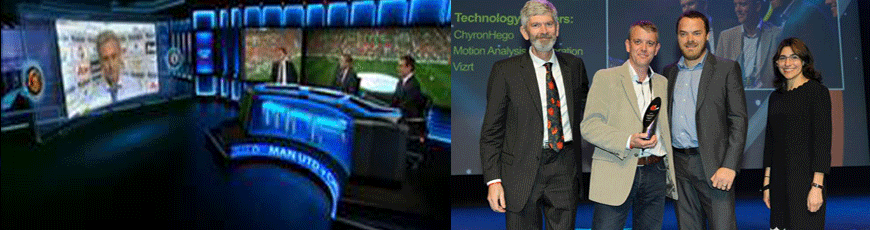
Vizrt, together with Sky Sports and ChyronHego, win the IBC 2014 Innovation award in a ceremony held at the Amsterdam RAI during IBC 2014.
Vizrt’s Rex Jenkins accepted the award along with Mike Ruddell from Sky Sports, and Mark Bowden from ChyronHego.
Vizrt worked with Sky Sports and ChyronHego to create a unique studio production for their flagship production “Monday Night Football” (MNF). The production that aired first on August 19th 2013 is a game-changing evolution of the show which premiered in 1992 when Sky Sports first obtained English Premier League rights. The key innovation that led to the award was the creation of a virtual set that gave the illusion of having a much larger physical set in the MNF studio.
The award ceremony, held Sunday, September 14th at the Amsterdam RAI, featured several awards for innovation in broadcasting. Vizrt’s Rex Jenkins accepted the award along with Mike Ruddell from Sky Sports, and Mark Bowden from ChyronHego.
Building a new studio
A unique requirement of the Sky Sports studio is that the virtual studio graphics should sit alongside and be visually-indistinguishable from the physical-set elements. This meant that not only must the graphical rendering be ‘photo-real’ but the tracking must be accurate enough so that when cameras move, the rendered virtual graphics would exhibit a seamless blend between reality and virtual.
Sky’s creative team have been designing Vizrt 3D graphics for live coverage for over 10 years, so they are accustomed to designing in Viz Artist. However, the concept of Virtual Studio design to this degree of photo-realism was new. Given the design-complexity of the 3D studio design and required functionality built into it, care had to be taken to ensure graphics-rendering performance was optimised to run in real-time.
The result was a genuine collaborative effort, not just on implementing the design, but also with the Sky Engineers who needed to learn how to operate and support the new technology. From the time when the installation started and to the first live-broadcast show in August 2013, regular training-sessions were conducted for Sky designers and technical staff at Sky and the Vizrt UK staff.
The final on-air product is a studio which appears massive in size but also very flexible, allowing the Sky MNF presenters to have several set locations. The presenters could utilize data driven-graphics displayed in monitors or immersed into the studio as part of the virtual set. Using a tracking system by MotionAnalysis, the virtual set was able to be tracked with extreme precision, allowing the physical and virtual set to appear seamless as the camera pans from one part of the set to another.
10 September 2014
- 63% expect 4K UHDTV consumption to be mainstream within five to seven years;
- 42% have made the decision to launch a 4K UHDTV service and have a specific timeframe for its rollout, with 23% planning to launch in less than four years;
- 35% of non-technical executives expect Direct-to-Home (DTH) will be the first segment to gain momentum as compared to 60% of technical executives who believe Video on Demand is where 4K UHDTV will first take hold.
Since it was first announced, 4K Ultra High Definition Television (4K UHDTV) has been met with both excitement and skepticism within and outside of the media industry. According to new research from Intelsat S.A. (NYSE: I), the world’s leading provider of satellite services, 4K UHDTV will be main stream within 10 years. In fact, 42% of Intelsat’s survey respondents stated that they have made a firm decision to launch a 4K UHDTV service and have a specific timeframe for its roll out (23% within the next four years). The main driver cited by media companies was the ability to provide the competitive differentiation necessary to attract new subscribers to their linear broadcast and cable television channels.
Intelsat surveyed technical and non-technical (primarily marketing) media executives from its global customer base, which is comprised of many of the world’s largest media companies that conduct business on a regional and global basis. The nearly 80 respondents represent a statistically significant sample of the pool of potential respondents.
While the majority of respondents believe that 4K UHDTV adoption is inevitable—in stark contrast to initial views of the 3DTV trend from several years ago—there is disparity in terms of what segments and business models are regarded as likely to adopt 4K UHDTV first, with non-technical executives having significantly different views from technical executives. Digital cinema (38%), over the top (OTT) and direct-to home (DTH) are the most widely mentioned segments for 4K UHDTV to gain momentum and those views differ sharply between technical and non-technical participants. In addition, 60% point to video on demand as the business model expected to first gain momentum, almost double the 34% stating that linear channels will be the first to do so.
“While it is becoming more evident that the transition to 4K UHDTV is highly likely, the road to adoption will take many paths, given the business model evolution resulting from the multi-screen viewing environment,” stated Peter Ostapiuk, Vice President, Media Product Management, Intelsat. “As with high definition television, socio-economics, demographics and technology infrastructure will determine the adoption timeline. This time, however, media companies are more focused on building the right business model that will enable them to deliver high quality and reliable content delivery across multiple platforms and, at the same time, achieve a strong return on their investment.”
Media professionals surveyed believe that the pace of 4K UHDTV adoption will vary by region. For example, 47% believe 4K UHDTV will first take hold in Asia Pacific; 34% expect North America to be the early adopter and only 16% believed Western Europe would be the first to roll out the new technology.
While Media Professionals are Optimistic about 4K UHDTV, Critical Factors Necessary for Accelerated Timeline to Take Hold
Respondents cited higher transmission and content production costs (67%), availability of more efficient transmission technologies (62%), affordable television sets (51%) and ability to achieve a return on their investment (71%) as issues of greatest concern to them going forward.
Roughly a third of those surveyed stated that a critical mass of content (38%), sufficient household penetration (35%) and available 4K UHDTV-enabled set top boxes (31%) are important factors in accelerating the roll-out of 4K UHDTV. Movies (53%) and sports (42%) are the most widely identified types of 4K UHDTV content expected to gain momentum first.
“Satellite will positively impact the adoption of this new and exciting technology and serve as a strategic partner to media customers,” continued Ostapiuk. “It’s clear that our customers will introduce 4K UHDTV as a way to distinguish their brands, and the ubiquitous and extremely high quality of satellite will deliver an immersive experience with cost efficiency. With the ability to easily handle transmission of multiple viewing formats across a hybrid distribution infrastructure, Intelsat is prepared to support this emerging growth opportunity for our global media customers.”
Supporting Resources:
Note to Editors:
Intelsat commissioned independent market research firm Market Connections, Inc. to survey Intelsat’s media customers in July 2014 on awareness of and plans for 4K UHDTV content demand, development and distribution. The statistically valid response from 77 media professionals features the opinions of content and platform providers from 24 different countries. (Source: Intelsat press release)

9 September 2014
Middle East markets are attracting more and more attention from the world economies, and increasingly influence global business.
Euronews’ new programme “Business Middle East” focuses on the constantly changing environment that is driving global market evolution. Get a clearer view of the region’s key economic issues with insight and analysis from top market strategists in Abu Dhabi.
The new 4-minute weekly programme is produced and hosted by Daleen Hassan. Each Tuesday she examines a major economic issue in the region and assesses the world economy’s overall influence on it. The programme opens with a story analysing the main subject of the episode, then Daleen discusses the issues raised in an interviews with an expert who provides insight, background information and opinion.
First episode: ECB’s decision eagerly awaited
For her first programme this week, Daleen Hassan looks at how the upcoming European Central Bank´s decisions could affect the Middle East markets.
Click here to watch the first episode 1n 13 languages.
To shed light on these issues Euronews’ Daleen Hassan spoke to ADS Securities’ Chief market strategist Nour Eldeen Al Hammoury in Abu Dhabi. He has more than eight years of experience in foreign exchange and global economic developments, as well as central bank policies and intermarket analysis (global markets relationships).
About Daleen Hassan
Daleen Hassan, a seasoned Syrian broadcast journalist, joined Euronews Arabic service in 2010.
Daleen worked as producer, reporter and news anchor for several Media and TV in Syria and Abu Dhabi.
She covered several events in various parts of the world such as Dubai, Abu Dhabi, Lebanon, France and Syria.
Before Euronews, she was PR coordinator for the World Arab Institute in Paris, France.
At Euronews she is part of the team that covers international news, both as a news duty editor and a presenter, interviewing experts and leading politicians such as Najib Mikati, former Lebanese prime minister, Ali Zidan former Libyan prime minister, the former Iraqi Foreign Minister Hoshyar Zebari.
Daleen has a Masters degree from Lyon 2 Lumière University in Cinematography and Audiovisual Studies and a BA in journalism and media from the University of Damascus. She is fluent in English and French in the professional media and production environment.
@daleenhassan Daleen Hassan
Business Middle East
First broadcast: every Tuesday
A 4 minute programme by Daleen Hassan, available in the channel’s 13 languages services*, on air, on www.euronews.com/business-middle-east, and on Euronews’ mobile apps.
* Arabic, English, French, German, Greek, Hungarian, Italian, Persian, Portuguese, Russian, Spanish, Turkish and Ukrainian
Broadcasts (CET): Tuesday at 09:45, 11:15, 12:45, 14:45, 15:45, 17:45, 00:45, 02:45, 04:45; Wednesday at 08:45, 10:15, 12:15, 16:15, 18:15, 19:45.
8 September 2014
In a first for international broadcasters, BBC World Service has announced the launch of TV programming in Hausa. BBC Hausa’s 10-minute TV news bulletins will now bring the BBC’s coverage of regional and international news to viewers of Nigeria’s Capital TV (Kaduna) as well as the West African satellite TV channel, Adom TV (on the Multi TV platform). The Monday to Friday prime-time programme will also be streamed live on the website bbchausa.com.
Controller of Languages, BBC World Service, Liliane Landor says: “We are proud to be the first among international broadcasters to launch TV content in Hausa. It’s another landmark as we continue our move towards new, digital platforms. BBC Hausa’s trusted, engaging radio and online content and its quick, innovative response to the explosion of mobile media and social networks has maintained its huge popularity in Nigeria and across West Africa. The new TV bulletins will further broaden BBC Hausa’s appeal to audiences – on TV and online – and reinforce the BBC’s presence on the African media arena.”
The newBBC Hausa TV programming adds to the BBC Hausa content available on radio, online and via mobile devices, currently reaching around 19.9 million people every week. BBC Hausa Editor, Mansur Liman, says: “We hope this ground-breaking launch will further expand and diversify our audience base in the region via rebroadcasting TV channels and among the audiences that come to us via bbchausa.com.”
Commenting on her new role, the lead presenter of the BBC Hausa TV news bulletins, Aichatou Moussa, says: “It is a new and exciting challenge which I am looking forward to. With the launch of the BBC Hausa fast-paced, vibrant TV news bulletins, we are getting even closer to our audiences who will join us to live the news story with the BBC.”
The programme’s second presenter, Elhadji Diori Coulibaly, adds: “Having worked on the radio and online platforms, I am really excited to have such an excellent opportunity now to connect with our audiences on TV.”
As part of BBC Hausa’s pioneering move towards digital platforms, its website bbchausa.com was among the very first non-English African sites made available to users on mobile devices using Responsive Design technology. With over 96% of the traffic to bbchausa.com coming to its mobile version, BBC Hausa operates on a ‘mobile-first’ basis, with its website content optimised to be viewed on mobile devices.
BBC Hausa is part of BBC World Service. (Source: BBC press release)
