BBC World Service’s content in four languages is now available to users of a leading global news app for smartphones, tablets and wearables, News Republic.
Thanks to a content syndication agreement between BBC World Service and News Republic, more than 12 million active users of the News Republic news app now can access the BBC World Service news content from BBC Chinese, BBC Hindi, BBC Mundo (in Spanish) and BBC Russian.
Head of Business Development, BBC World Service, Simon Kendall, says: “We are pleased to announce this exciting development with News Republic, which will contribute to BBC World Service’s substantial audience reach in the digital space. We look forward to reaching out to new audiences through this innovative digital platform and to providing our loyal World Service audience with a new way of consuming our multilingual content.”
Gilles Raymond, CEO of News Republic, adds: “BBC World Service has a superior reputation in the news business and we are pleased to contribute to their digital deployment by bringing their news to our rapidly growing user base. Mobile apps, such as News Republic, provide the innovation required to address mobile news consumers’ demands for easy to navigate, personalised, trusted and timely news on the go, and partnering with BBC World Service will considerably enhance the content offered.”
BBC World Service also offers its own news apps for several of its language services: BBC Arabic and BBC Chinese available on iOS, BBC Brasil (iOS and Android), BBC Hindi (Android), BBC Mundo (iOS and Android), BBC Russian (iOS and Android) and BBC Turkce (Android). There is also an app for BBC News (in English), available on iOS and Android.
News Republic is free to download from Google Play for Android smartphones and tablets, and for iPhone, iPad and iPod touch on the App Store.
One of the world’s oldest countries, the Republic of Georgia has plenty of wonders to discover.
In this series of programmes, Euronews’ journalist Denis Loctier crosses Georgia, learning more about this country’s traditions, its history and its modern day life.
Warming to Tbilisi
Episode 1: Monday 1st June at 23:45 CET
The journey begins in the country’s largest city, its capital – Tbilisi.
The city is a patchwork of ancient and modern urban spaces, reflecting Tbilisi’s history from its foundation in the fifth century to the latest architectural achievements.
“Georgia is trying to preserve its ancient history. Sometimes a plain stone at a corner can tell you more than a book of many pages,” says Rezo Gabriadze, a Georgian artist Denis Loctier met in the capital.
Emerging from the long Soviet era and the severe difficulties of the 1990s, today’s Georgia has reinvented itself as an open, friendly country, welcoming guests from all around the world.
Emerging from the long Soviet era and the severe difficulties of the 1990s, today’s Georgia has reinvented itself as an open, friendly country, welcoming guests from all around the world.than a book of many pages,” says Rezo Gabriadze, a Georgian artist Denis Loctier met in the capital.
Kakheti, Georgia’s cradle of wine
Episode 2: Monday 15th June at 23:45 CET
In this episode of Georgian Life, Denis Loctier visits to Kakheti, Georgia’s main wine-producing region in the country’s East. Wine grapes have been cultivated in these lands for 8,000 years, which, archaeologists say, makes Kakheti the cradle of wine.
We discover the unique Georgian way of making wine, passed on by the Orthodox monks through the ages.
Batumi, Georgia’s top Black Sea resort
Episode 3: Monday 29th June at 23:45 CET
For this last episode, Euronews explores Batumi, the marvel of the Black Sea, and the party capital of the region.
The main city of Adjara, an autonomous republic in South-West Georgia, Batumi is the place young people come looking for warm sea, cool clubs and a never-ending holiday atmosphere.
At night Batumi’s boulevard throngs with couples and party-goers, drawn to the music and dancing on the beach, on the streets and in the restaurants.
Georgian Life
Three episodes of 5 minutes starting on Monday 1st June at 23:45 CET
Follow it simultaneously on all digital platforms in the 13 language services of Euronews
Having joined Euronews in 2001, Denis Loctier directs, writes and hosts feature programmes on science, technology, culture, social and political affairs. He produces and presents Euronews’ award-winning Futuris series on European research in action, as well as the Russian Life saga discovering hidden jewels in the world’s largest country.
Beyond feature production, Denis Loctier reports breaking news, interviewing major newsmakers in Europe and around the globe. A Lomonosov Moscow State Universitygraduate, Denis holds PhD degrees in Russianphilology and in information and communication sciences (Université Lumière Lyon 2).
Beyond feature production, Denis Loctier reports breaking news, interviewing major newsmakers in Europe and around the globe. A Lomonosov Moscow State University graduate, Denis holds PhD degrees in Russian philology and in information and communication sciences (Université Lumière Lyon 2).
About Euronews
Euronews, the most-watched news channel in Europe, is an independent and multi-platform media hub. Euronews covers news worldwide, offering a unique perspective on events through factual analysis. Six hundred journalists, from more than 30 countries, report round-the-clock in 13 editions (Arabic, English, Persian, French, German, Greek, Hungarian, Italian, Portuguese, Russian, Spanish, Turkish and Ukrainian). Established in 1993 in Lyon, France, the channel is received by 420 million homes in 156 countries, and offers a complete range of products: websites, smart TV, radio, on-board technology (for cars), and portable technology (mobile apps, smartwatch).
In 2015 Euronews will launch Africanews, the first pan-African multilingual news channel.
“Azeri authorities have acted illegally and arbitrarily, causing profound, and in several cases permanent, suffering and dislocation for our staff and their families,” said Nenad Pejic, RFE/RL editor in chief. Pejic also indicated that the company is prepared to take all steps to defend its rights and interests, and those of its staff members, against the government’s actions.
These actions include the raid of RFE/RL’s Baku bureau together with the confiscation of company documents, stamps, and equipment without due process; the interrogation and detention of Baku bureau staff without legal representation; the expulsion of the bureau’s legal counsel from court proceedings; the cancellation of previously approved tax audits; threats to staff members’ relatives; and arbitrary bans restricting the travel of some employees.
RFE/RL also challenges the government’s allegations against Khadija Ismayilova, an internationally recognized investigative reporter and contributor to RFE/RL, who was arrested on December 5 and remains in prison on charges that derive from the allegations against RFE/RL.
RFE/RL’s Azerbaijani Service, known locally as Radio Azadliq, is continuing its newsgathering and reporting functions in Azerbaijan, and is operating on digital and satellite platforms, despite the closure of its bureau.
Said Pejic, “We will continue working to fulfill our mission, as we have for more than sixty years. We regret the actions taken by the government of Azerbaijan against RFE/RL and its staff over the past several months. RFE/RL has always operated legally in Azerbaijan. We call on the government of Azerbaijan to fulfill its obligations with regard to basic rights and freedoms and stop this campaign of repression, which is hurting its citizens and crippling its future.”
The campaign to secure the release of Peter Greste, Baher Mohamed, Mohamed Fahmy and Abdullah Elshamy has won a major PR Award. The SABRE Awards EMEA, organized by leading PR publication The Holmes Report, gave the #FreeAJStaff campaign a Gold Award for issues management at their annual ceremony in London.
There were 2,000 entries in this year’s competition, which “recognises Superior Achievement in Branding, Reputation and Engagement.” The campaigns were evaluated by a jury of more than 40 industry leaders.
The win comes shortly after the PRWeek Global Awards gave Al Jazeera ‘Highly Commended’ recognition in their Crisis & Issues category for the same campaign.
Both judging panels looked at how the situation went from being a story about journalists arrested in Egypt, to being the biggest press freedom campaign in the history of the news media. The campaign was also nominated by the Middle East PR Association earlier this year.
Mostefa Souag, acting director general of Al Jazeera Media Network expressed his gratitude:
“This recognition from the PR industry is extremely humbling. We were faced with a grave situation and this campaign rose to the challenge. This campaign has had everything: the cultivation of a hashtag that went viral; scores of events in all the continents of the world; extremely nimble and effective crisis communications; the gathering together of the entire news industry; and support from world leaders. All of this was in the noble cause of supporting press freedom.”
Abdulla AlNajjar, Executive Director of Global Brand and Communications, thanked everyone involved in the campaign:
“Congratulations are due to the hundreds of thousands of people who have been involved in #FreeAJStaff from right around the world. What’s kept us going is the vision of securing freedom for our guys who sacrificed much for the sake of journalism and fulfilling the public’s right to know. A lot of stamina has been needed to keep this going. We will not stop until the right verdict has been reached and justice has also been served for those convicted in absentia.”
Elshamy was arrested by Egyptian forces in August 2013. He was released in June 2014 after he went on hunger strike to protest his imprisonment without charge.
Greste, Mohamed and Fahmy were arrested on 29th December 2013, and were incarcerated for more than 400 days. They were convicted in June 2014 after a trial that prompted outrage across the world. The verdict was thrown out on appeal, with Mohamed and Fahmy released on bail in February 2015 before a retrial which is ongoing. Greste was deported that same month on presidential order. The campaign for their release prompted Egyptian president Abdel Fattah el-Sisi to say he wished that the whole thing had not happened, and he promised to release the journalists if the courts didn’t.
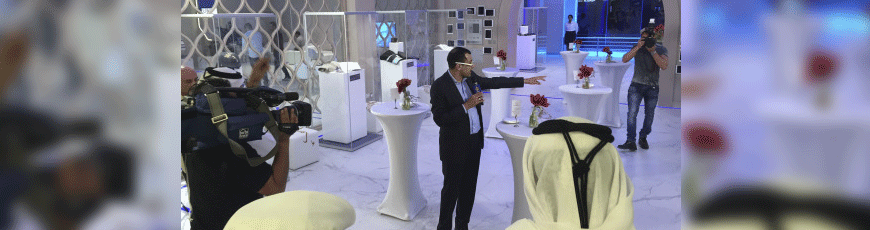
The public can explore the worlds of journalism, news, current affairs and documentaries at Al Jazeera’s first café opened in May in Doha, capital of Qatar, home to Al Jazeera Media Network.
Located in Katara, at Building 4 on Shakespeare Street, the innovative new concept is at the centre of Doha’s fast developing cultural area. The cafe gives visitors an exclusive look inside broadcast media while they can also enjoy a range of fresh organic dishes.
As well as boasting a suitably international menu for one of the world’s leading media organisations, the cafe features an interactive studio where members of the public can take away videos of themselves reading from a teleprompter on an Al Jazeera set.
AIB CEO Simon Spanswick tried out the studio (pictured left) during a visit to Doha and Al Jazeera Media Network at the beginning of June. “This is a great initiative,” says Spanswick. “It brings Al Jazeera closer to its audience with a truly hands-on experience. Visitors have travelled from across the Gulf region to visit the Cafe during its first couple of weeks of operation, trying their hand at news reading and weather presenting, as well as sampling the cuisine.”
At the entrance to the cafe is a selection of historic artefacts from the Qatar-based Network, including some of its first broadcasting equipment from 1996 and equipment damaged in attacks on the Kabul and Baghdad bureaux in 2001 and 2003 (picture, right).
The cafe itself boasts a smart contemporary design for its multiple zones. Menus are loaded on tablets while a range of flat screens show the network’s TV channels and digital properties, keeping patrons up to date with news from around the world.
Abdulla Alnajjar, Executive Director for Global Brand and Communications at Al Jazeera said:
“What we’re offering here is an experience that makes people feel part of Al Jazeera, the Al Jazeera team and the Al Jazeera environment. The cafe is a hub for conversation, debate and sharing of ideas and opinions. People have always felt part of Al Jazeera, and most recently this has chiefly meant engaging with us online. The cafe fuses together our modern connections with the traditional idea of the coffee house as a centre of community. “A lot of thought has gone into the design, the interaction, and the menu. We hope that the public will like it, and we look forward to the conversation.”
Al Jazeera Cafe is open to the public and can be followed on Twitter, Facebook and Instagram at #aljazeeracafe
AIB is pleased to support Project Everyone, launched by filmmaker Richard Curtis who also founded the Comic Relief charity.
In September 2015, the United Nations are launching global goals, a series of ambitious targets to end extreme poverty and tackle climate change for everyone by 2030.
If the goals are met, they ensure the health, safety and future of the planet for everyone on it. And their best chance of being met is if everyone on the planet is aware of them.
So the simple but mighty ambition of Project Everyone – is to share the global goals with 7 billion people in 7 days.
Project Everyone is harnessing the power of global media – TV, radio and online – to tell the world about the Sustainable Development Goals. A number of AIB Members have already signed up to this important innovative initiative. Now’s your chance to take part and help make the world a better place.

 ’s content in four languages is now available to users of a leading global news app for smartphones, tablets and wearables, News Republic.

 The public can explore the worlds of journalism, news, current affairs and documentaries at Al Jazeera’s first café opened in May in Doha, capital of Qatar, home to Al Jazeera Media Network.
 AIB CEO Simon Spanswick tried out the studio (pictured left) during a visit to Doha and Al Jazeera Media Network at the beginning of June. “This is a great initiative,” says Spanswick. “It brings Al Jazeera closer to its audience with a truly hands-on experience. Visitors have travelled from across the Gulf region to visit the Cafe during its first couple of weeks of operation, trying their hand at news reading and weather presenting, as well as sampling the cuisine.”
 At the entrance