BBC announces subscription service for USA

BBC announces subscription service for USA

BBC announces subscription service for USA

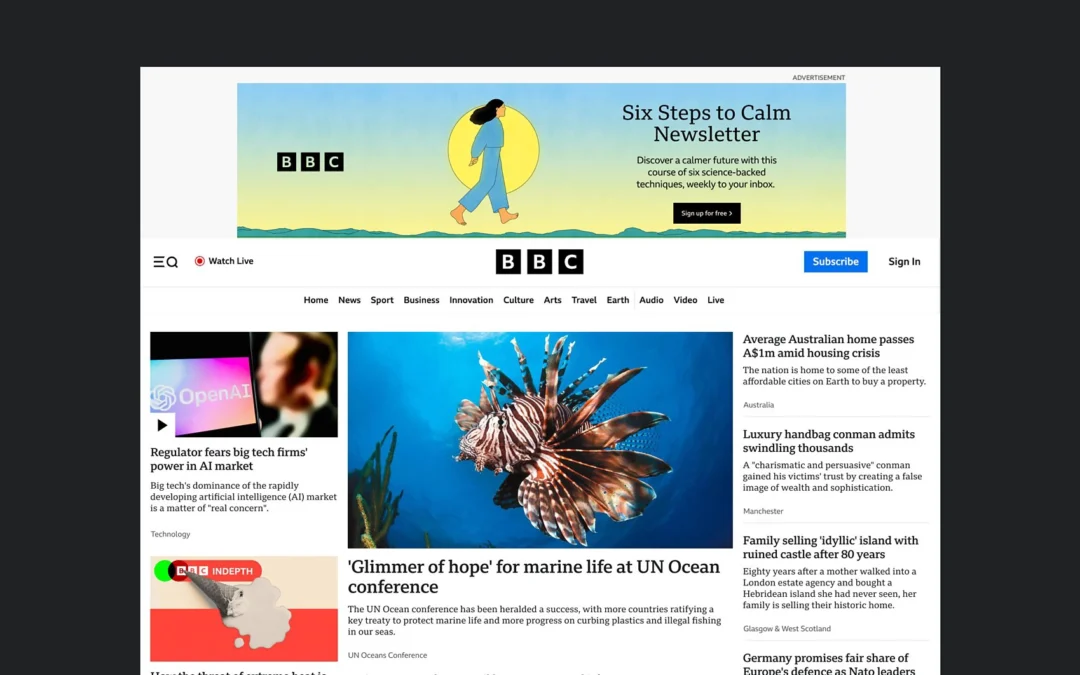
BBC Studios and BBC News has launched the first phase of a pay model for BBC.com visitors in the U.S., offering its most loyal users a premium experience and a new way to enjoy even more of the BBC’s acclaimed journalism and storytelling.

In the initial phase of the launch, for less than $1 a week ($49.99/year) or $8.99/month, users who join will get unlimited access to the BBC’s news articles, feature stories and the 24/7 livestream of the BBC News channel. In the coming months as we test and learn from audience consumption, ad-free documentary series and films (including the full BBC Select documentary catalogue), ad-free and early release podcasts, and exclusive newsletters and content will be included in the offer. This pay model launch supports BBC Studios’ ongoing effort to grow international commercial revenue that helps fund the BBC’s journalism and storytelling and delivers greater value for the licence fee.

Following a period of significant investment in technology and journalism, BBC.com relaunched last year and has seen double-digit year-on-year growth. Today, BBC.com reaches 139 million visitors globally, including nearly 60 million in the U.S. alone.

Rebecca Glashow, CEO BBC Studios Global Media & Streaming said: “Over three years ago, we set out on a bold mission: to completely reimagine how we deliver the BBC’s world-class news and factual content to consumers in the U.S.. Our goal? To serve our audiences better than ever before—and unlock new opportunities for growth. Today, the next phase of that vision becomes reality. We’re bringing more of the BBC’s trusted, high-quality content together in one powerful, easy-to-access destination. Over the next few months, as we test and learn more about audience needs and habits, additional long-form factual content will be added to the offer for paying users. This is a major milestone and just the beginning of an exciting new chapter.”

Deborah Turness, CEO, BBC News said: “Through our partnership with BBC Studios we are growing our audiences in North America – providing more people with news they can trust at a time of dramatic global uncertainty.”

BBC.com is employing a dynamic pay model—an intelligent, engagement-based pay model trusted by leading news publishers globally. All users visiting the site from within the U.S. will be assessed based on how they interact with our content, including how much they read and how long they stay.

This approach allows casual readers to explore freely, while offering our most engaged users the opportunity to unlock even more. By opting to pay, readers gain unlimited access to all the site’s content. It’s a premium experience designed to keep visitors informed and connected—while directly supporting the future of independent, fact-based reporting.

Visitors who choose not to pay will still have access to select global breaking news stories, BBC Radio 4 and BBC World Service radio livestreams, BBC World Service Languages sites, and a variety of free newsletters and podcasts.

The site will remain ad-supported, providing global brand partners with continued opportunities to connect with the BBC.com audience in impactful and meaningful ways.

The website, which is commercially funded and operates separately from other BBC platforms in the UK, identifies users based on their device’s geolocation, an industry standard practice to ensure compliance with the laws and content rights restrictions in each country. UK Licence Fee payers travelling to the U.S. for holiday or work can access their usual content via the BBC News app, as long as they’ve downloaded the latest versions from the UK app stores before travelling.

There will be no change to the services that people in the UK will receive and have access to. All the content that’s available on BBC.com is also available to UK audiences through the BBC’s various channels and services. There are no current plans to introduce a pay model outside of North America.

About BBC Studios

The main commercial arm of BBC Commercial Ltd, BBC Studios generated revenues in the last year of £1.8 billion and a third consecutive year of profits of over £200 million. Able to take an idea seamlessly from thought to screen and beyond, the business is built on two operating areas: the Content Studio, which produces, invests and distributes content globally and Media & Streaming, with BBC branded channels, services including bbc.com and Britbox International and joint ventures in the UK and internationally. The business made more than 2,800 hours of award-winning British programmes last year for a wide selection of public service and commercial broadcasters and platforms, both in the UK and across the globe. Its content is internationally recognised across a broad range of genres and specialisms, and includes world-famous brands like Strictly Come Dancing/Dancing with the Stars, the Planet series, Bluey and Doctor Who.
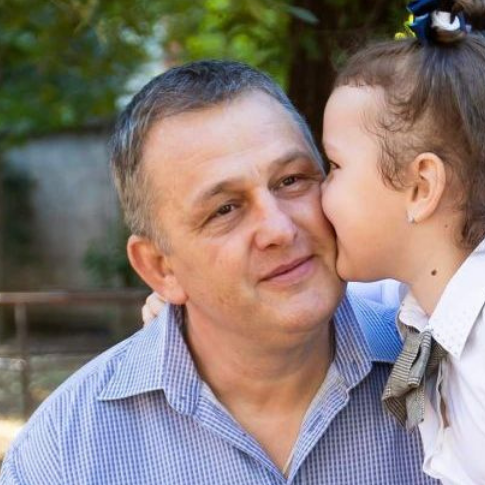
Ukrainian RFE/RL Journalist Vladyslav Yesypenko Released from Custody in Occupied Crimea

Ukrainian RFE/RL Journalist Vladyslav Yesypenko Released from Custody in Occupied Crimea

Ukrainian RFE/RL Journalist Vladyslav Yesypenko Released from Custody in Occupied Crimea

Radio Free Europe/Radio Liberty (RFE/RL) welcomes Vladyslav’s release and thanks the U.S. and Ukrainian governments for efforts to bring him home.

Ukrainian Radio Free Europe/Radio Liberty (RFE/RL) journalist Vladyslav Yesypenko has been released from Russian custody in occupied Crimea.

RFE/RL President and CEO Stephen Capus said: “For more than four years, Vlad was arbitrarily punished for a crime he did not commit. He paid too high of a price for reporting the truth about what was taking place inside Russia-occupied Crimea. For that, he was tortured, physically and psychologically. While we celebrate his joyous reunion with his wife Kateryna, and their young daughter Stefania, we cannot overlook this family’s pain at the hands of Russian authorities.

“RFE/RL extends its deepest gratitude to the U.S. and Ukrainian governments for working with us to ensure that Vlad’s unjust detention was not prolonged. We also thank the global press freedom community for their tireless advocacy on behalf of RFE/RL’s dedicated journalists.” 

This follows the releases of former RFE/RL journalist Ihar Karnei on June 21 and RFE/RL journalist Andrei Kuznechyk in February from unjust detention in Belarus thanks to the significant efforts of the Trump administration.

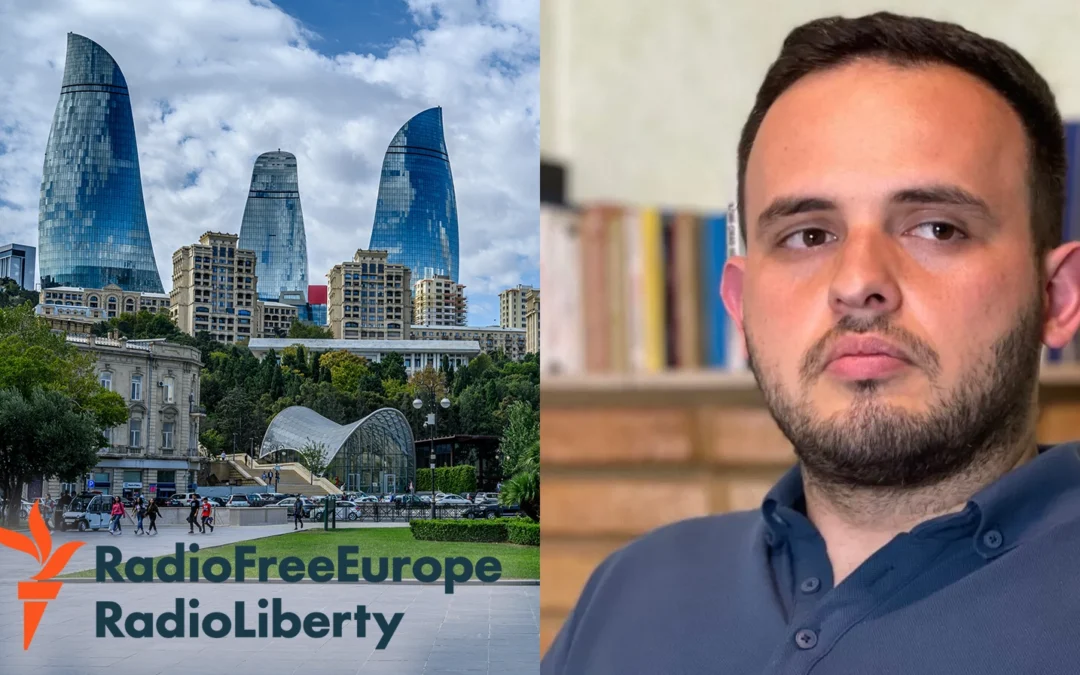
RFE/RL Journalist Farid Mehralizada Sentenced to Nine Years in Prison in Azerbaijan

RFE/RL Journalist Farid Mehralizada Sentenced to Nine Years in Prison in Azerbaijan

RFE/RL Journalist Farid Mehralizada Sentenced to Nine Years in Prison in Azerbaijan

Radio Free Europe/Radio Liberty (RFE/RL) called the case against Farid a “sham.”

An Azerbaijani court convicted and sentenced Radio Free Europe/Radio Liberty (RFE/RL) journalist and economist Farid Mehralizada to nine years in prison on spurious charges on 20 June 2025.

In a speech before the court, Farid defended his innocence and the importance of a free press in Azerbaijan:

“Independent media is one of the greatest means of service to the state, the nation, and humanity. Unfortunately, journalism in our country today is almost equated with terrorism.” 

Farid has been detained since May 30, 2024, when he was violently abducted in Baku by unidentified men and taken to a police station. He was initially charged with “conspiring to smuggle foreign currency” in connection with a case authorities brought against the independent media outlet Abzas Media, for which Farid never worked. On August 19, 2024, authorities invented new charges against him.

RFE/RL President and CEO Stephen Capus said: “Farid has already lost a great deal. Unjustifiably detained for more than a year, he missed the birth of his child, and now waits for elusive justice. Denying this man his fundamental rights is unnecessarily cruel. Instead of perpetuating this sham, it’s time to reunite Farid with his family.”

Increasing restrictions on journalists in Azerbaijan have put significant pressure on RFE/RL’s Azerbaijani Service. Its Baku bureau was forced to shut down in 2014 and its website was blocked in 2017. Azerbaijani Service journalists have been the targets of intimidation campaigns and physical violence.

BBC issues statement about Gaza films

BBC issues statement about Gaza films

BBC issues statement about Gaza films

BBC statement issued 20 June 2025

BBC News is determined to report all aspects of the conflict in the Middle East impartially and fairly. Over a year ago we commissioned Gaza: Doctors Under Attack, a documentary about the plight of medics in Gaza, from an independent production company, Basement Films.

We paused production of this film in April, having made a decision that we could not broadcast the film while a review into a separate Gaza documentary was ongoing. With both films coming from independent production companies, and both about Gaza, it was right to wait for any relevant findings – and put them into action – before broadcasting the film.

However, we wanted the doctors’ voices to be heard. Our aim was to find a way to air some of the material in our news programmes, in line with our impartiality standards, before the review was published.

For some weeks, the BBC has been working with Basement Films to find a way to tell the stories of these doctors on our platforms.

Yesterday it became apparent that we have reached the end of the road with these discussions. We have come to the conclusion that broadcasting this material risked creating a perception of partiality that would not meet the high standards that the public rightly expect of the BBC. Impartiality is a core principle of BBC News. It is one of the reasons that we are the world’s most trusted broadcaster.

Therefore, we are transferring ownership of the film material to Basement Films.

Contrary to some reports, since we paused production of Gaza: Doctors Under Attack in April, it has not undergone the BBC’s final pre-broadcast sign-off processes. Any film broadcast will not be a BBC film.

The BBC has produced powerful coverage of this conflict. Alongside breaking news and ongoing analysis, we have produced award winning documentaries such as Life and Death in Gaza, and Gaza 101. We have also investigated allegations of abuse of Palestinian prisoners and Israel’s attacks on Gaza’s hospitals. Just today we are running a powerful piece of longform journalism that captures the final two weeks inside a Gaza hospital before it was forced to close.

We want to thank the doctors and contributors and we are sorry we could not tell their stories. The BBC will continue to cover events in Gaza impartially.

AIB dismayed as Togo bans French international media for three months

AIB dismayed as Togo bans French international media for three months

AIB dismayed as Togo bans French international media for three months

The Association for International Broadcasting is dismayed by the decision of Togo’s High Authority for Audiovisual and Communication (HAAC) to suspend the broadcasts of France 24 television and Radio France Internationale in the country for three months.

According to the press reports, HAAC claims that the Paris-headquartered broadcasters have “repeated failures, already reported and formally recalled, in terms of impartiality, rigour and verification of facts”. In 2024, the HAAC put RFI “on notice” for “unfair treatment of information” and “dissemination of false news about the country”.

“This suspension of independent fact-based news organisations deprives citizens of Togo of important information sources,” says AIB Chief Executive Simon Spanswick. “At a time when rumour spreads on social media platforms, the checks and balances provided by international broadcasters such as RFI and France 24 are vital to counter mis- and disinformation. The AIB calls on the HAAC to rescind its reported suspension rapidly and to allow RFI and France 24 to resume broadcasting in Togo.”

Also in June, a correspondent working for France’s TV5 Monde, Flore Monteau, has been arbitrarily detained in Togo. Monteau had been covering anti-government demonstrations in Lomé and was filming the dispersal of protesters by security forces. CPJ says that police seized her equipment and forced her to delete footage of the protests. She was also required to unlock her mobile phone by the police.

Togo, with a population of just under 9 million, is ranked 121st in the World Press Freedom Index 2025 published by Reporters Without Borders.

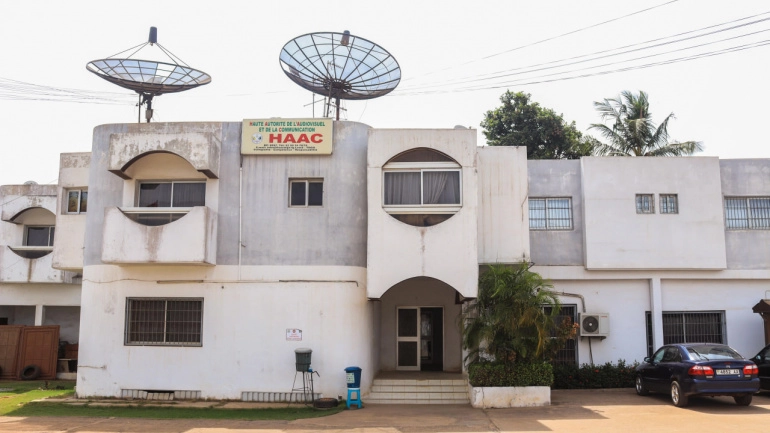
Image: HAAC headquarters in Lomé; courtesy Republique Togolaise

As conflict grows, so do audiences to threatened US international broadcasters

As conflict grows, so do audiences to threatened US international broadcasters

As conflict grows, so do audiences to threatened US international broadcasters

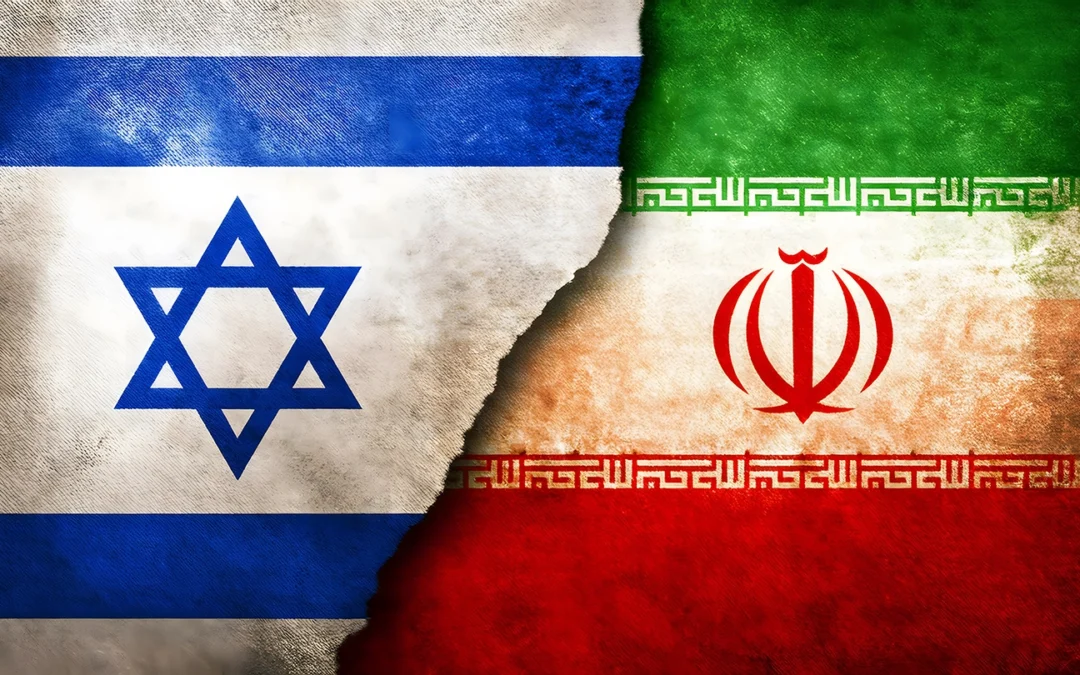
US-funded media organisations Radio Free Europe/Radio Liberty (RFE/RL) and Middle East Broadcasting Networks (MBN) are bringing millions of people in Iran and across the Middle East real-time, 24/7 news coverage of the war between Israel and Iran.

As fighting began over the weekend, Iranians surged to RFE/RL’s Persian-language Service, Radio Farda, for responsible news and information. On Friday 13 June, Farda’s extremely popular Instagram profile attracted 62.5 million video views, a spike of 344%, and traffic to its website rose by 77% compared to its 30-day average. Farda is increasing its coverage to include ten-minute audio news bulletins at the top of the hour 24/7 to meet the needs of our audiences.

Even before the war began, more than 6.6 million Iranians, ten percent of the adult population, accessed Farda each week to get news that was not produced by the state-controlled propaganda networks.

Farda also provides the outside world a valuable and unparalleled look inside the Islamic Republic. This report features listeners from Tehran describing the intensity of the Israeli attacks on the country’s nuclear facilities.

Across the Arab Middle East and North Africa, where news is often state-controlled and anti-American, MBN’s Alhurra.com and social media platforms are covering the Israel-Iran hostilities for millions of Arabic speakers. They featured exclusive interviews with high-level figures such as former U.S. State Department Spokesman and Iran expert Alan Eyre and former Israeli National Security Advisor Eyal Hulata.

A segment with Hulata, “Why Israeli Jets Didn’t Use Saudi Airspace,” attracted more than 53,000 views in less than 40 minutes. Another clip, “How Israel Targeted Iranian Leaders Simultaneously,” also garnered strong audience engagement.

This coverage comes as the United States Agency for Global Media (USAGM) attempts to shutter RFE/RL and MBN by unlawfully cancelling their grant agreements.

As a result, MBN has been forced to terminate 90 percent of its staff and RFE/RL has furloughed some staff and reduced programming. USAGM shut down a transmitter it owns in Kuwait that Farda could use to reach the people of Iran. It has since been reactivated for use by Voice of America (VOA) for only 15 minutes a day after USAGM executives called VOA’s Persian Service back to work on short notice to cover the hostilities and give voice to U.S. officials and experts.

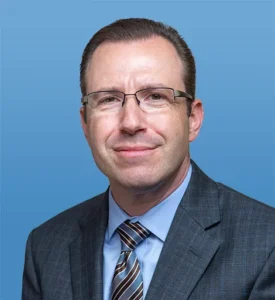
Ilan Berman, a leading Iran analyst who serves on the boards of RFE/RL and MBN (pictured), said:

“This is the most decisive moment in modern Iranian history since the Islamic Republic’s founding in 1979. America needs to seize it to talk directly to the Iranian people – to educate, to inspire and to tell them that a different future could lie ahead. The more we can do that, the better.

“I’m glad RFE/RL and MBN are still functioning, albeit at diminished capacity. The current conflict with the tyrannical rulers of Iran underscores the need for American voices to counter the lies and disinformation of U.S. adversaries. These tools can’t be allowed to disappear.”

Berman was the Trump administration’s transition team leader at USAGM before new leadership arrived earlier this year.