
29 April 2015
 Broadcasters responded rapidly to the devastating earthquake in Nepal that is believed to have killed more than 10,000 people and made hundreds of thousands homeless.
BBC World Service is now broadcasting additional programming on shortwave in both Nepalese and in English while BBC Media Action – the BBC’s international development charity – is working with the Nepali Service on BBC World Service (radio and online) and local partner radio stations to broadcast ‘Lifeline’ programming.
Liliane Landor, Controller of World Service Languages, says: “Information is vital and we are doing all we can to make sure that our audiences in the affected areas receive their local and regional news as well as ‘Lifeline’ programming designed to give practical information to help deal with the aftermath of the earthquake.”
The Nepali language programme is available on shortwave as follows:
Nepali dawn transmission (01:30-01:45 GMT) on 11995 kHz (25 metre band) and 15510 kHz (19 metre band)
Nepali evening transmission (15:00-16:00 GMT) on 9650 kHz (31 metre band) and 5895 kHz (49 metre band)
The availability of World Service English on short wave to Northern India and Nepal has been extended with the service now starting one hour earlier than normal at 23.00 GMT.
Additional frequencies for World Service in English (to S Asia) from 23:00 GMT to 24:00GMT: 5895 kHz (49 metre band) and 9540 kHz (31 metre band)
From 00:00GMT the broadcasts continue as normal on 12,095kHz, 9,410kHz and 5970kHz.
For broadcasters covering the disaster, Reuters-TIMA are operational from the Radisson Hotel, Kathmandu offering
- HD/SD live stand-up positions
- Multi format playout facilities
- Editorial support
- International point-to-point delivery via the Reuters-TIMA network
The External Services Division (ESD) of All India Radio reacted quickly to the situation.
As soon as the News of devastating Earthquake ravaging large part of Nepal started trickling in, as an immediate measure, SOS announcements advising people not to panic and take precautionary safety measures against the possible aftershocks were made. Thereafter, the service got in touch with the MEA officials and by 7 pm, the helpline numbers of MEA, the Indian Mission in Kathmandu were repeatedly announced. People were advised to take all precautionary measures, as per the guidelines provided by the NDMA. Appeal of ADG, NDMA was also recorded over telephone and broadcast.
Since all lines of communication had broken down, the Nepali Service being broadcast on short-wave remained the only available communication link to reach out to the distressed people in Kathmandu valley and the hinterland Nepal.
Normal programming of the whole evening transmission was changed and programmes relating to the Earthquake were broadcast continuously.
5 March 2015
 Find out all about the AIB’s #iamabroadcaster conference, held in London on 18 and 19 February, in the delegate book all participants received.
Delegates travelled from across Europe, the Middle East, Africa and North America to join the conversations that took place at #iamabroadcaster. Speakers from Sydney, New Delhi, New York, London, Bucharest, Tomsk and Moscow participated, either at the venue or via an ipDTL broadcast-quality video link. You can read about all the speakers in the delegate book, and learn about the conference Platinum Sponsor, Channels TV.
#iamabroadcaster is just one of AIB’s activities that support our global members, and the wider media industry. Talk to us to find out more about the Association and its work.
5 March 2015
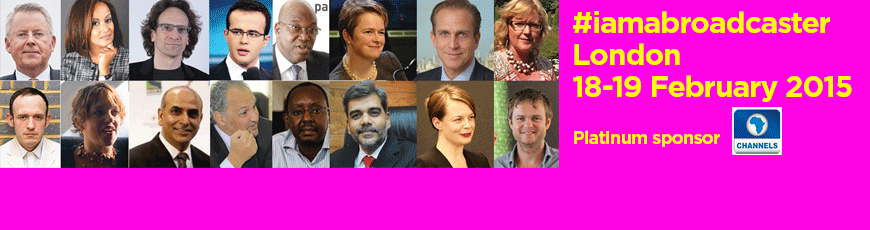
 At the AIB’s #iamabroadcaster conference in London in February, Michael McEwen, Director-General of the North American Broadcasters Association, kindly provided an overview of the media market in the region.
McEwen (pictured left) recounted the experiences of members of NABA and talked about the challenges – and opportunities – that face his organisation’s members.
You can watch McEwen’s address here.
20 January 2015
Join us for the #iamabroadcaster conference taking place in London on 18 and 19 February 2015

With speakers from across Europe, the Middle East and Africa, plus contributions from around the world via IP video connection, this two-day conference will provide a unique briefing about the state of the media industry in markets around the world.
The conference, on Wednesday 18 and Thursday 19 February, brings together a remarkable range of attendees who are travelling to London to share knowledge and ideas on media finance, audience engagement, future devices, TV news, telcos vs broadcasters, storytelling, connectivity, brands, and outsourcing.
See the latest agenda here.
The conference is run by AIB, the not-for-profit international industry association for TV, radio and online broadcasting. And since we’re not in the business of pleasing shareholders with this event, delegates will get two packed days of relevant, timely and useful information and networking.
You can reserve delegate places today – and to make sure that we make the conference as accessible as possible, we’re offering one-day passes for either the Wednesday or the Thursday to allow people who can’t spare the time to attend both days to take part in the conference for a shorter time.
Reserve delegate places through the AIB’s online booking service here.
Join us for the best briefing for the start of 2015 in London on 18 and 19 February.

7 January 2015
 AIB and its Members are horrified by the appalling attack on the offices of Charlie Hebdo, the French weekly satirical magazine, in Paris on 7 January 2015.
“Today’s dreadful attack by gunmen on staff at Charlie Hebdo will not stifle the press in France, nor in any other country,” says Simon Spanswick, chief executive of the Association for International Broadcasting. “Everyone at AIB and its global membership offers their sympathy to the families of those killed and injured in the attack, and support for colleagues at the magazine.”
Despite the outrageous and distressing attack, AIB’s support for freedom of expression and for the media remains total.
#JeSuisCharlie #IAmCharlie
28 November 2014
AIB is pleased to announce the first confirmed speakers for the #iamabroadcaster summit that is taking place in London on 18 and 19 February 2015.
This two day high-level conference will bring together media leaders from around the world for discussion and debate on the state of the media industry, and look at the opportunities and challenges facing media houses. With input from broadcasters, agencies, digital media houses and analysts from all round the world, #iamabroadcaster will start a range of conversations about the media industry. You shouldn’t miss this major event that will also include the inaugural Sir David Frost Memorial Lecture that will be given by a major international political figure who was interviewed by Frost a number of times over the last two decades.
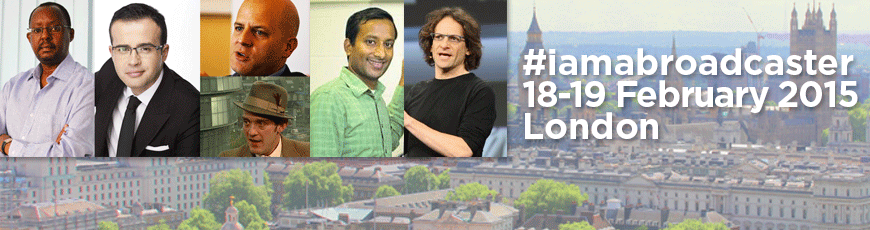
 Eugene Nyagahene [pictured left] is Chairman and CEO of Tele-10 Group in East Africa. Tele-10 is one of Africa’s most innovative media companies, producing channels and delivering content via traditional TVs as well as mobile devices to a growing number of subscribers in Uganda, Rwanda and Kenya. Eugene will be joining the “Where’s the cash” session on day one of the conference.
Mihai Gadea [pictured second from left] is Chief Executive of national commercial news broadcaster Antena 3 in Romania. He will join the discussion about the future of news at the start of day two.
Matteo Berlucci [centre top] is a serial entrepreneur who founded Livestation and is currently CEO Digital at Northern & Shell in the UK. He’s taking part in the “hyperfragmented future” session on day two.
Tom Roope [centre bottom] is founder and director of The Rumpus Room, a digital agency that helps brands and broadcasters create sustainable strategies for engagement with consumers and audiences.
Professor Harish Bhaskaran [second from right] is Associate Professor of Materials and EPSRC Fellow in Manufacturing at the University of Oxford who has led work that has resulted in the development of a nanometre technology that could lead to bendable and wearable displays within the coming decade.
Anthony Rose [right] led the development of the BBC iPlayer and today is founder director of Beamly that aims to revolutionise the second screen experience and engagement between broadcasters and audiences.
You can see the outline agenda for #iamabroadcaster here, and reserve places – taking advantage of the early-bird rate – here. Or download the off-line booking form to fax back: Early booking form 2 011214.
