The Association for International Broadcasting (AIB) has today – 12 May 2016 – condemned the leaking of the personal details of thousands of journalists and media workers who have reported from eastern Ukraine and the support for the publication by member of the Ukrainian parliament.
Above – Simon Spanswick, AIB chief executive, interviewed on RT English
On 7th May, a group of hackers claimed on the website Myrotvorets (Peacemaker) that they had breached computers used by pro-Russian separatists in eastern Ukraine to keep track of journalists they had allowed to work in the region. The hackers published a database containing the names, affiliations, and contact information of more than 7,000 individuals. The database includes over 4,500 local and international journalists and media workers who have reported from the conflict zone.
According to the US based Committee to Protect Journalists (CPJ) the separatists have been collecting journalists’ contact information as part of an accreditation process even though their authority over eastern Ukraine is not internationally recognised.
The Ukrainian Prosecutor General’s Office on Wednesday announcedthat it had opened an investigation into the publication of the journalists’ names and contact information under article 171.1 of the Ukrainian Criminal Code, which covers “obstruction to journalism.”
The hackers wrote that they did not know what the consequences of their action would be, but added, “Be certain: It is important to publish the list because these journalists collaborate with terrorist guerillas.”
“The Association for International Broadcasting and its Members condemn without equivocation the publication of these data,” said Simon Spanswick, chief executive of the AIB. “The names and contact data of many journalists and news crews working for AIB Members – and hundreds of other agencies, TV channels, radio stations and newspapers – are included in the release. There is no excuse for releasing information of this sort. The journalists working in East Ukraine were there legitimately, reporting the situation for the benefit of audiences and readers throughout the world. Accusations that the journalists ‘collaborated with terrorists’ are completely unfounded and without any substance. We call on the authorities in Ukraine to take steps to have these data removed from the Internet and to prosecute those involved in this hack.”
Oksana Romanyuk, head of the Institute for Mass Information, a press freedom group in Kiev, told the CPJ that the hackers’ actions had remained largely unnoticed until Tuesday, when Anton Geraschenko, a member of Ukraine’s parliament, praised them on the social media site Facebook. Geraschenko suggested that Ukraine’s authorities should introduce specific actions to “counter Russian propaganda.”
Geraschenko’s recommendations included: “imposing control over broadcast programming and cable networks to prevent distribution of information that could destabilize Ukraine’s sovereignty and territorial integrity;” “imposing control over accreditation of reporters, specifically those from Russia;” “deportation of reporters found in breach of national laws;” and “developing legal and technical resources to block online content that incites to violence and destabilises Ukraine’s national security.”
Ukrainian and foreign journalists have condemned the publication of personal data of reporters, including those from the Ukrainian broadcaster Hromadske TV, the Moscow-based newspaper Novaya Gazeta, Polish daily Gazeta Wyborcza, the BBC, The New York Times, The Daily Beast, The Economist, and others. In a statement signed by 37 journalists and published on Wednesday 11th May, they rejected the description of the accredited journalists as “collaborators with terrorists” and demanded that the personal data leak be investigated by law enforcers, saying it violated Ukraine’s privacy laws, the nation’s constitution, and the European Convention on Human Rights
According to the statement, journalists started receiving threats by phone and email after the list was made public. The signatories said that by obtaining accreditation from the separatists, they were able to inform the public of the crimes committed in the area, including the downing of the Malaysian Airlines plane over the region in July 2014.
The journalists also said that in 2014 alone, at least 80 journalists were detained by eastern Ukrainian separatists in connection with their work and that some of them were tortured. They urged the hackers to remove the list from the Internet.
The AIB encourages the journalists and media workers on the list to take extra precautions for securing their email accounts and digital information.
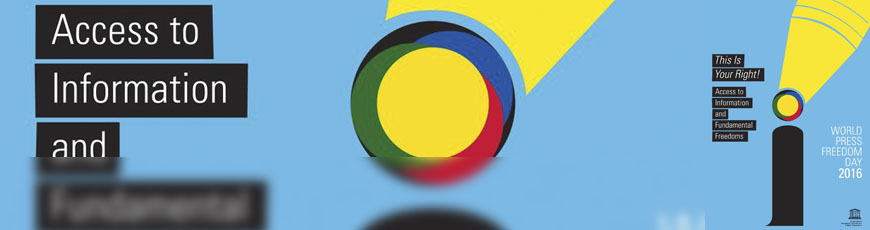
3 May marks World Press Freedom Day. The international day was proclaimed by the UN General Assembly in 1993 following a Recommendation adopted at the 26th Session of UNESCO’s General Conference in 1991. This in turn was a response to a call by African journalists who in 1991 produced the landmark Windhoek Declaration on media pluralism and independence.
Every year, 3 May is a date which celebrates the fundamental principles of press freedom; to evaluate press freedom around the world, to defend the media from attacks on their independence and to pay tribute to journalists who have lost their lives in the exercise of their profession.
The Association for International Broadcasting (AIB) is launching its twelfth annual festival of factual TV, radio and online productions – the AIBs – on Monday 4 April at MIPTV. These awards, run by the not-for-profit global trade association for international broadcasting, are recognised as the preeminent celebration of documentaries and other factual genres from across the globe.
Over the past 11 years, the AIBs have rewarded the world’s leading factual storytellers who have reported on immensely significant issues to global audiences. The winners have sought out the truth, challenging those with power and influence. Their investigations have often been undertaken in difficult and dangerous situations, sometimes in remote parts of the world, where establishing the facts is not straightforward.
“Winning an AIB represents the pinnacle of achievement for factual programme makers,” says Simon Spanswick, chief executive of the Association for International Broadcasting. “Each year we see the most remarkable stories told and extraordinary facts uncovered. Because this festival is a truly global celebration, we are privileged to see work from every continent, from broadcasters and production companies large and small. The competition is incredibly strong each year and this contributes to the outstanding nature of the AIBs.”
Past television winners have covered subjects as varied as refugee crises in Africa and the Middle East to war crimes in South Asia, the high price of cheap food in Western Europe to narrowly averted nuclear disaster in Japan. In radio, the variety of stories has been equally diverse, ranging from Sudan’s independence to slavery in Asia, the Haiti earthquake to the high price of cheap credit.
Last year’s winner of the coveted investigative documentary award was Human Harvest by Flying Cloud Productions, a programme that investigated claims that first emerged from China in 2006 that state-run hospitals were killing prisoners of conscience to sell their organs. The judges said that this programme effectively captured the horror of the story through credible testimony and proactive research, complemented by outstanding production values and solid structures.
Keeping children informed is a key part of many broadcasters’ work, and the AIBs provide a platform for the makers of children’s factual programming to showcase their work. The AIBs have rewarded producers covering subjects from growing up in a war zone to body image and eating disorders, each story told imaginatively and sensitively helping children understand complex and often frightening issues.
“Since these awards are truly international, the AIBs are open for work produced in any country and in any language,” Spanswick continues. “Our winners have included work produced in Mandarin, German, Arabic, Danish, Swedish and Spanish, to give a few examples, as well as English. Language is definitely not a barrier in this festival.”
The AIBs 2016 have 17 categories:
TELEVISION
Journalism
Short form journalism
Domestic current affairs documentary
International current affairs documentary
Investigative documentary
Specialist programme
Science
Children’s factual
Short feature
Sport
ON-AIR TALENT
TV personality
Radio personality
RADIO
Journalism
Current affairs documentary
Investigative documentary
Creative feature
ONLINE
Online production
The AIBs 2016 are open for entry until 30 June. In September, the international panel of judges will assess the work and the results will be announced in London on 2 November at the AIB’s star-studded award dinner.
Full information is available in the entry book, available for download at theaibs.tv.
Radio, the oldest electronic mass medium, is in good health and well positioned for the future. That’s the message from the Association for International Broadcasting as World Radio Day 2016 is marked internationally.
“Radio generates revenues of well over US$25m every year,” comments Simon Spanswick, chief executive of the Association for International Broadcasting (AIB). “Radio is a major a generator of economic growth and employment – both in front of and behind the microphone. Every day, it touches the lives of billions of people, providing news, information, entertainment and education. At the AIB we’re delighted to join with our Members to celebrate the continued relevance and importance of radio on 13 February, the day designated by UNESCO as World Radio Day.”
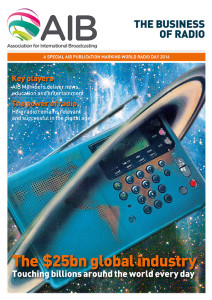
The AIB is publishing a special souvenir book to demonstrate the value of radio internationally. ‘The Business of Radio’ provides insight into the radio industry and profiles Members of the AIB who operate radio networks and the service providers that keep radio on the air around the world.
‘The Business of Radio’ is being sent to opinion-leaders including parliamentarians and media regulators around the world to remind them of the key role that radio continues to play, even in the digital age of mobile apps and social media.
“The strength of radio is its ability to connect people in a way that other media cannot,” continues Spanswick. “At the AIB, we are delighted to see that our radio Members are reacting positively to the changes in media consumption habits. For example, they make sure that their programmes are available via multiple platforms, increasing their reach as they do. The AIB is pleased to be accompanying them on their journey into radio’s bright future.” or as a downloadable PDF at
‘The Business of Radio’ includes articles contributed by a number of the AIB’s Members, including the BBC, Broadcasting Board of Governors, RNW Media, Radio Taiwan International and DW. It is available in digital page-turning format at http://aib.org.uk/Resources/BizofRadio.html or as a downloadable PDF here.
The AIB will be marking World Radio Day 2016 with a special publication celebrating the work of the Association’s Members that work in this important branch of the media.
Every day, radio touches the lives of billions of people across the planet, and many AIB Members produce programming that informs, educates and entertains hundreds of millions of people on every continent.
We’re publishing a special booklet that explains about the work of AIB Members involved in radio, either producing programming or providing the technology that delivers the programmes onto people’s radio sets, mobile devices or computers.
The booklet will be available for policy makers, regulators and parliamentarians around the world. For more details about the book and how to be involved, contact Tom Wragg at AIB headquarters.
The new Executive Committee of the Association for International Broadcasting has been elected by AIB Members.
Four of the existing Executive Committee Members stood for re-election and were unanimously voted in for a second two-year term. Six candidates from across the AIB’s international membership were nominated for the remaining two places on the six person Committee.
The new Executive Committee – which provides governance of the AIB’s permanent Secretariat and assists with the formulation of the AIB’s strategic direction and overall work plan – is now comprised of:
Anastasia Ellis, Managing Editor, Bloomberg Media EMEA
Simon Kendall, Head of Business Development, BBC World Service
Klaus Bergmann, Director of International Relations, Deutsche Welle
John Maguire, Director of International Development, France Médias Monde
Alexey Nikolov, Managing Editor, Russia Today
Travis W.K. Sun, Vice President, Radio Taiwan International
The Committee members hold office for a two-year period.


 The AIB will be marking World Radio Day 2016 with a special publication celebrating the work of the Association’s Members that work in this important branch of the media.