11 October 2005
For MIPCOM 2005, the European Audiovisual Observatory has released the latest figures on national television fiction broadcast in the 5 largest territories in Europe, as elaborated by the EUROFICTION network
Production volume grows in Germany, the UK and Italy but declines in France and Spain
Contributions by private broadcasters on the increase and by public broadcasters in decline.
Overall domestic fiction volumes have risen
The supply of first-run domestic drama (co-productions included) on the unencrypted television channels of the five largest European countries (France, Germany, Italy, Spain, the United Kingdom) has slightly increased in 2004 with regards to the previous year. And since in 2003 there was a relevant and generalized quantitative fall in the programming of local fiction across Europe, this means that the downward trend of the European television industry has been halted, if not substantially reversed.
In actual fact, the total amount of 5513 hours broadcast by these 5 countries in 2004 marks an modest rise of just 133 hours (+ 2,5%) in comparison with 2003.
Italy, the UK and Germany on the increase, downswings elsewhere…
The downward trend seems to be halted and even reversed in some territories, but still continuing and even accelerating in others. Far from being homogeneous, the contemporary Eurofiction landscape is divided if not fractured into two main areas comprising Spain and France on the one hand, and Italy, the United Kingdom and Germany on the other.
A downward trend in Spain and France
1. The television industry in the first area is feeling the blow of arrested development. This is the case for Spain and France. Spanish fiction, which reached the peak of over 1300 hours in 2001, has consistently diminished year after year, falling to 932 hours in 2004 (minus 8,6% compared with 2003, and minus 29% compared with 2001). What is more, it is the drama commissioned by the public channels, which turns out to be most affected by the downward trend (155 hours lost from 2003 to 2004). As for France, the ups and downs of the related figures from 2000 on don’t disguise the substantial decrease, which, again in 2004, confirms French fiction as the “last in line” of European production, in terms of broadcast hours.
Germany, the UK and Italy on the up
2. The other territories are experiencing the thrust of renewed development. German fiction, although still remaining below the 1800 hours it was able to reach in 2000-2002, has pulled itself up from the decrease of the previous year thanks to an extra 50 hours. This has been made possible by the advent of domestically produced telenovelas, launched for the first time in 2004 by the public channel ZDF; given their success, the German telenovelas are destined to multiply, further boosting the fiction production of the strongest television industry in Europe.
Even more remarkable is the growth of Italian domestic drama, which increased by 85 hours (+13%) in 2004. Italy is the only country where all the quantity indicators (hours, titles, episodes) are on the increase, shortening the gap with the more established and mighty fiction factories of Germany and United Kingdom, and diverging by this progressive trend from the Spanish regression. Both Italy and Spain, almost starting from scratch, were the most dynamic television industries in Europe in the late nineties. Whereas Spain is weakening, Italy is still strengthening its production capacities, with the aim of achieving 1000 hours per year in the near future.
In the UK there has been a rise of 100 hours in drama supply (+ 7%), mainly due to the new digital channels BBC3 and BBC4.
Italy, Germany and the United Kingdom are the only countries in which the public channels have increased their programming of home-grown fiction. Even though the public broadcasters remain the principle commissioners and providers of domestic drama in Europe the balance of the share has slightly shifted toward the private channels in 2004: local fiction broadcast by the latter increased by 158 hours (from 39% in 2003 to 41% in 2004), whereas the serious decreases in the volume broadcast by the Spanish channels and other minor decreases in the UK traditional public channels and in France, together with the growth in volume broadcast by the private channels, have lowered the share of the public broadcasters from 61% to 59% of the whole output.
7 October 2005
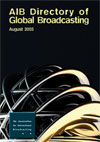 The latest edition of the twice-annual AIB Directory of Global Broadcasting has been published.
Completely revised and updated and including more information than previous editions, the new AIB Directory of Global Broadcasting provides an unrivalled range of information about the world’s leading international and national broadcasters, including key contacts in each organisation.
From the VP of Transmissions and Systems at Televisa in Mexico to the director of news at Jordan Radio and TV, from the programming director at VT4 in Belgium to the general manager of Show TV in Turkey, the AIB Directory of Global Broadcasting has the contacts you need to do business.
Updated twice every year, the Directory is published by the industry association for the international broadcasting industry. Compiled from constant research that feeds into the AIB’s database of more than 23,000 contacts in broadcasting worldwide, the AIB Directory of Global Broadcasting is an essential reference work for everyone who works in broadcasting or provides services to the broadcasting industry.
With more than 140 pages of data, including a world map section the AIB Directory of Global Broadcasting provides the information you need whether you’re at your office or travelling.
Download sample pages
here.
Order today – an annual subscription that will provide this edition (August 2005) and the updated issue to be published in January 2005 costs just £75 (that’s around 107 or around US$140).
Click here to order via the secure AIB web shop.
Alternatively, download a fax-back order form
here.
7 October 2005
After rumours in the television industry, Al Jazeera International – the new English-language news channel launching in 2006 – has confirmed that television host, author and producer Sir David Frost, the only person to have interviewed the last seven Presidents of the United States and the last six Prime Ministers of the United Kingdom, has joined the line-up of key on-air talent at the new 24-hour English-language news and current affairs channel.
“We are thrilled to have Sir David Frost join Al Jazeera International,” said Managing Director Nigel Parsons. “Hes a one-man international broadcasting phenomenon and our viewers can look forward to the substance and quality that have marked his distinguished career.”
Sir David said: “This is a great adventure the first and perhaps the only brand-new international TV news network for the 21st Century. Most of the television I have done over the years has been aimed at British and American audiences. This time, while our target is still Britain and America, the excitement is that it is also the 6 billion other inhabitants of the globe. As someone said, a new show for a new channel for the new century.”
Sir David will also continue with his BBC work, the upcoming Frost Interview specials as well as Through the Keyhole.
Landmark interviews have always been a feature of Sir Davids career. Among the many world figures that he has interviewed are the six most recent British Prime Ministers (Harold Wilson, James Callaghan, Edward Heath, Margaret Thatcher, John Major and Tony Blair), Prince Charles, The Duke of York, the Duchess of York and The Princess Royal in the United Kingdom; the seven most recent Presidents of the United States. His Nixon Interviews achieved “the largest audience for a news interview in history” (New York Times). In addition to their unprecedented impact in the United States, the interviews were also seen – either in English or dubbed into local languages – in almost every television nation in the world. Other notable interviews include Colin Powell, Henry Kissinger, Robert F Kennedy, Pierre Trudeau and Brian Mulroney in North America; John Howard, Robert Hawke, Malcolm Fraser and Gough Whitlam in Australia; Indira Gandhi, Benazir Bhutto and President Musharraf in Asia; King Hussein, Golda Meir, Moshe Dayan, Menachem Begin, Yasser Arafat, Yitzhak Rabin, Shimon Peres and Benjamin Netanyahu in the Middle East. Nelson Mandela, Thabo Mbeki and F.W. de Klerk in South Africa, and President Putin in Russia. Outside the field of world affairs, the roster is equally impressive – from Orson Welles, Tennessee Williams, Noel Coward and Peter Ustinov, to Artur Rubinstein, Woody Allen, Muhammad Ali and the Beatles.
Al Jazeera International, headquartered in Qatar, will launch in the Spring of 2006. With broadcasting centres strategically placed across the world in Doha, Kuala Lumpur, London, and Washington D.C. and dozens of news bureaux worldwide, the channel will bring English speakers across the world a fresh perspective on world news and current affairs. Sir David Frost will broadcast from Al Jazeera Internationals London broadcast centre. Details of his onscreen work with the channel will be revealed closer to launch.
6 October 2005
Harris Corporation’s Broadcast Communications Division announced on 5 October that three Brazilian radio broadcasters have selected Harris as the exclusive digital transmission vendor for their HD Radio(tm) launches.
The country’s three largest radio broadcasters, Radio Bandeirantes, Radio Globo and RBS Group recently announced plans to launch HD Radio broadcasts on September 26, commemorating the 70th anniversary of AESP, a radio and television emissions association based in Sao Paolo, and Brazil’s National Day of Radio. The HD Radio standard will allow all three broadcasters to simulcast analog and digital broadcasts over the same band, ensuring their listeners a choice to go digital or continue receiving analog broadcasts. By selecting Harris, all three radio groups have also ensured enhanced business models for their AM stations, enhanced audio quality and data capability for their FM stations, and a reduction in monthly operating costs due to intelligent combining techniques.
A total of six stations – one FM and one AM from each group – are now transmitting in HD Radio:
* Radio Bandeirantes selected a Harris Z-Series(tm) Z16HDs FM transmitter for Band News FM, and an IBOC equipment rack to upgrade an existing Harris DXD100 AM transmitter to HD Radio. Both stations are located in Sao Paulo, the largest city of Brazil.
* Radio Globo purchased a Harris Mini-HD(tm) 600 Watt FM transmitter for CBN Radio in Sao Paulo, and an IBOC equipment rack to upgrade an existing Harris 3DX-50 AM transmitter for Radio Tiradentes in Belo Horizonte.
* RBS Group purchased a Harris Mini-HD(tm) 600 Watt FM transmitter for Itapema FM, and an IBOC equipment rack to upgrade an existing Harris DXD100 AM transmitter to HD Radio for the Radio Gaucha AM station. Both stations are located in Porto Alegre, in the southern portion of Brazil.
“Harris has been actively working with Latin American radio broadcasters and government officials on digital radio since we held the first international on-air HD Radio demonstration ever in Porto Alegre in March 2003,” said Nahuel Villegas, Caribbean and Latin America regional director for Harris Broadcast Communications Division. “The more than 100 Latin American broadcasters who attended that first event experienced a demonstration that showed the vastly improved audio quality and compelling business case afforded by digital radio. The selection of Harris as the exclusive transmission provider for Brazil’s maiden HD Radio launch is a result of our efforts over the past several years, and we are privileged to be at the technological center of this enormous radio event for Latin America.”
Harris provided all three groups with FM combining methods that reduce monthly transmission-related operational costs. Radio Bandeirantes has employed Harris’ exclusive Split-Level(tm) combining method, which can reduce operational costs by up to 10 percent over the traditional method of high-level combining FM and HD Radio transmitters using a 10dB coupler. Radio Globo and RBS Group are employing separate amplification, a feature of the Mini-HD(tm) Series. Mini-HD Series transmitters greatly reduce the power reject load that is common with high-level combining. By transmitting over two separate antennas, broadcasters use only 10 percent of the digital wattage output compared to high-level combining. Transmitter power, initial capital investment and overall power consumption are greatly reduced as a result.
5 October 2005
Harris Corporation’s Radio Broadcast Systems business unit recently traveled to Vietnam to participate in a three-day DRM consortium held in Dong Hoi, the capital city of the Quang Binh province. Engineers at Voice of Vietnam (VoV), the radio arm of the country’s state broadcaster TNVN, initiated the conference to educate VoV officials and various government advisers for broadcasters about DRM and its many benefits as a digital radio standard.
The consortium, held July 28-30, was deemed successful by participants, including the VoV’s engineering department. Harris provided a demonstration on the ease of launching a DRM broadcast by converting an operational DX(r) 200 medium-wave AM transmitter to broadcast at 40kW DRM. Various presentations, including a DRM overview by Mr. Trung, director of the Broadcast Engineering Department for VoV, and a discussion on coverage measurements by VT Communications, accompanied Harris’ presentation on transmitter conversion. The DX(r) 200 transmission could be heard 120 Km to the south using professional receivers and 65 Km to the north with weaker aerial and receiving devices.
“Harris’ DRM equipment provided exceptional clarity even in the robust mode needed to maintain coverage. We believe this demonstration confirmed that Harris’ DRM equipment provides the clearest audio quality of any DRM solution on the market today. This is an extension of Harris’ leadership in the high-power medium-wave market that the company has held for many years,” said John Hall, manager, AM Products and Programs for Harris BCD’s Radio Broadcast Systems business unit. “At the International Broadcasting Convention (IBC) 2005, our customers repeatedly pointed to Harris’ DRM solution as providing the best audio quality at the lowest bit rate. We are very excited about the opportunities that DRM brings to broadcasters, from increased audio quality to additional revenue potential through datacasting that can be obtained with a minimal investment. We look forward to delivering more digital efficiency, audio and data capabilities to international broadcasters as DRM technology matures.”
The Vietnam demonstration is the latest of many that Harris has sponsored or participated in this year, including those in Mexico, South Africa, China, Thailand, Romania, and Australia. Harris, a charter member of the DRM Steering Board, offers a DRM On-Air Upgrade Kit that is designed to make the digital transition as swift and easy as possible for countries that support the format. With the world’s largest installed base of high-power AM transmitters – including approximately 1,500 DX(r) medium wave transmitters and power blocks worldwide – Harris is in a unique position to propel DRM acceptance.
“The Voice of Vietnam is well known in the radio industry as a forward-looking broadcaster, providing on-air programs for international and domestic markets from both its Vietnam-based transmission facilities and third-party network providers around the world,” said Hall. “Broadcasters like VoV are driving DRM acceptance, and Harris has made an effort to provide strong educational background and technical demonstrations to broadcasters considering DRM. We are privileged to have been involved in this important demonstration and similar ones around the world.”
The Harris DRM On-Air Upgrade Kit features a content server to encode audio and combine it with digital program information to create a single bandwidth-efficient digital bitstream that is sent to the modulator. A DRM modulator situated in a rack beside the transmitter accepts the digitally prepared signal, creates the CODFM signal for transmission,
and provides phase and magnitude signals to the transmitter.
4 October 2005
Radio Australia has re-started its French news service, which closed eight years ago as a result of budget cuts. The service is available in an audio file format, sent to radio stations in New Caledonia, Tahiti and Vanuatu and beamed to the region’s 500,000 French-speaking inhabitants.
‘There has always been a demand for it but budgetary constraints meant that we couldn’t respond to that demand,’ Radio Australia head Jean-Gabriel Manguy said.
The new French news service is named ’24H dans le Pacifique’, announces Radio Australia’s French website (http://www.abc.net.au/ra/francais).
