24 May 2007
An Uzbek reporter for Deutsche Welle faces up to 10 years in prison after being accused of defaming President Islam Karimov. Yuri Chernogayev is accused of defaming President Islam Karimov.
The DW correspondent said Tashkent prosecutors also charged him with tax evasion and “illegal dissemination of information threatening public security and order.”
“This is a provocation with many episodes,” he told The Associated Press by telephone from the Uzbek capital. “They want other journalists to watch out and shut up.”
Authorities in the tightly controlled ex-Soviet republic have stepped up pressure on Western and independent journalists since after the bloody crackdown in 2005 on an uprising in the eastern city of Andijan; survivors and human rights groups say hundreds were killed by government troops, while the government insists fewer than 200 died.
In the months following the Andijan uprising, Karimov’s government shut down the local offices of the BBC, Radio Free Europe/Radio Liberty and a dozen US-funded aid groups, two of which worked to promote free media.
Several journalists working for foreign media have also been jailed or beaten. In March, Chernogayev and his colleague, Natalya Bushuyeva, were accused of tax evasion. After Bushuyeva left Uzbekistan, Chernogayev was accused of aiding her escape, but after several interrogations he said he was left alone by authorities.
Chernogayev said he was told to stay in his apartment until the trial begins next week.
Last year, Deutsche Welle’s two Uzbek reporters were stripped of their media accreditation after reporting that 30 people had frozen to death on a stranded bus en route to Russia. Authorities denied the incident happened.
“This is a travesty of justice designed to silence those working for foreign media,” Reporters Without Borders said in a statement posted on its Web site.
Uzbek media are strictly monitored and censored, and the independent online publications are filtered by government-controlled Internet service providers.
24 May 2007
Mr Hanh Tran has been selected as the new Chief Executive of Radio Australia.
Hanh is currently Executive Producer of Vietnamese content for Radio Australia and was, from 1997 until 2001, Head of the Vietnamese Service at the BBC World Service. Hanh has led the Vietnamese content team at Radio Australia in response to new media opportunities. The Vietnamese service of RA is built around online content on radioaustralia.net.au.
Having worked as a radio commentator, producer, reporter and presenter, Hahn has over 10 years experience in international broadcasting.
Hanh came to Australia in the late seventies as a Colombo Plan student and studied forestry at the Australian National University and media at the University of Canberra. Hanh is a recognised photographer with work in the Parliament House Art Collection. He lectured in photomedia at both the Canberra Institute of the Arts and at the Australian Centre for Photography.
“I am pleased to announce the appointment of Hanh Tran as Chief Executive of Radio Australia,” ABC Managing Director Mark Scott said today.
“I am delighted that from a very strong field of internal and external applicants that the next person to lead Radio Australia has come from our own team of managers and executive producers.
“He will bring a wealth of expertise in radio and digital media that will contribute to enhancing the services provided by Radio Australia, while exploring opportunities to expand the service into new markets.
“Radio Australia, together with the Australia Network, International Projects and International Relations, is part of the new entity I announced in February. ABC International provides an opportunity for cross platform production in an area of core ABC activity: producing content for international audiences, particularly in the Asia Pacific.”
Mr Tran will begin in the role of Chief Executive immediately.
24 May 2007
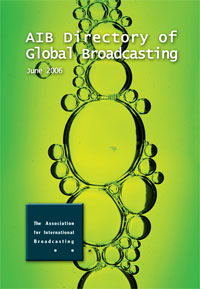
Completely revised, comprehensively updated…and now with an extensive update supplement
that’s the current edition of the AIB Directory of Global
Broadcasting.
The latest edition of the only guide to broadcasters domestic and
international, television and radio, throughout the world is now on
sale…exclusively from its publisher, the Association for International
Broadcasting.
The 148 page Directory has extensive data on the world’s leading
broadcasters, including some of the most hard-to-come by intelligence on who’s
who in broadcasters in countries as diverse as Ethiopia (currently upgrading its
broadcasting infrastructure), Sudan, Afghanistan, countries across Latin America
and more.
With additional information including population and electricity supplies
(plus the type of electric plugs you’ll need to power your equipment), the
AIB Directory of Global Broadcasting is a must have for anyone in media,
selling to media, or a straightforward interest in the broadcasting sector.
Order your copy today – it’ll be with you rapidly, placing you in the best
position to make contact with the world’s broadcasters – from heads of news and
heads of sport to technical directors and chief engineers.
Download a sample page
here and order online by clicking
here.
17 May 2007
The Polish parliament [Sejm] unanimously passed a resolution on 10 May to mark the 55th anniversary of the first programme aired by Radio Free Europe.
“The Sejm thanks Radio Free Europe authors, employees and associates in Poland and in the West on the occasion of the 55th anniversary of the RFE first broadcast from Munich,” the resolution reads.
“Their daily, arduous work allowed many of our compatriots to get to know the world during the decades of communism, allowed them to get to know the uncensored truth about Poland.”
The resolution recalls that Radio Free Europe spoke about Stalinist crimes, helped to understand the Solidarity trade union and raised hopes during martial law.
16 May 2007
The AIB recommends…
events, shows, content
Hometech Middle East
Dubai, UAE
15-16 May 2007
A major conference and exhibition looking at the development in home
entertainment, technology and systems. AIB chief executive Simon Spanswick
will be speaking at the conference.
11 May 2007
Al Jazeera is continuing its efforts to gain clarification on the UK Daily Mirror newspaper report of a leaked memo alleging “President Bush planned to bomb Arab TV station Al Jazeera”. The Doha-based broadcaster has repeated its call to see a copy of the relevant section of the memo.
British civil servant David Keogh and parliamentary researcher Leo OConnor were jailed on 10 May for leaking the secret four-page memo. Press and public were banned from the trial which has been heavily criticised by MPs and civil rights groups. The memo is purported to have recorded discussions regarding the events in Falluja between Tony Blair and George Bush in the Oval office in 2004. Former defence minister, Peter Kilfoyle, stated that “There remain unanswered questions about the discussions about the attack on Falluja and subsequent deaths of many hundreds of civilians.”
Al Jazeera submitted a Freedom of Information application early in 2006 requesting the disclosure of the contents of the memo but the request was denied. Any substantiation of the contents of the memo would be extremely serious not only for Al Jazeera but for media organisations across the world. It would cast significant doubts on the US administration’s version of previous incidents involving Al Jazeera’s journalists and offices. Both Al Jazeeras Kabul Bureau and Iraq Bureau were bombed by the US resulting in the death of Al Jazeera journalist Tareq Ayoub.
Al Jazeera has urged Downing Street to clarify the Daily Mirror report on the contents of the memo.
