20 February 2017
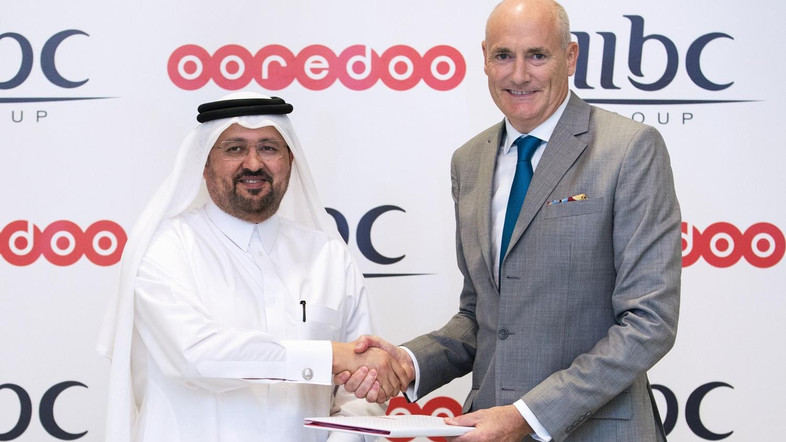
Ooredoo and MBC GROUP hosted a star-studded event at the Museum of Islamic Art last night to launch the exclusive new MBC+ Ooredoo Channel for Ooredoo TV subscribers.
The event was attended by Ooredoo Qatar CEO Waleed Al Sayed, MBC GROUP CEO Sam Barnett and a host of MBC talent including: “Sabah Al Khair Ya Arab” star Khaled Al Shaer, reporter and broadcaster Ali Al Ghofaily, journalist Ola Al-Fares, as well as presenter Ghada Mussali from MBC1 and presenter Mariam Said from ET Bil Arabi.
The MBC+ Ooredoo Channel launch is part of a multi-year Memorandum of Understanding (MoU) Ooredoo and MBC GROUP signed last year, which gave Ooredoo exclusive rights to some of the GROUP’s most popular High Definition (HD) channels in Qatar.
With this latest partnership, Ooredoo TV customers will now be able to exclusively enjoy a brand new channel and that will include a selection of MBC’s best Arabic content.
MBC+ Ooredoo Channel is available on channel 180 now and content will include: Tabakh Al Sultan, Scoop, Dahsha, El Hokm, El Hob Al Halal and much more.
Talking at the event, Waleed Al Sayed, Ooredoo Qatar Chief Executive Officer, said: “Since its launch Ooredoo TV has offered the latest and best content, whether live, On Demand or on the go via the Ooredoo TV App. This is the latest step in our vision of offering leading local and international content to Qatar and we hope you enjoy the wide range of programmes we have selected especially for Ooredoo TV customers in HD.”
MBC Group CEO, Sam Barnett said: “It’s a privilege to be partnering with such an innovative telecommunications company.
The speed and sophistication of the network provided by Ooreedoo means that viewers in Qatar are able to experience audiovisual content at industry leading levels of quality”.
Barnett further added: “It was only a few months ago when we announced our intention to work together, and now today our combined teams are ready to launch both MBC+ Ooreedoo and our premium Video On Demand service SHAHID PLUS”.
To ensure that Ooredoo’s entertainment portfolio stays ahead of the growing switch to digital content, Ooredoo and MBC GROUP have recently announced that all Ooredoo customers can now exclusively enjoy MBC’s SHAHID PLUS online service in Qatar. They can catch-up with the latest & the exclusive shows, award-winning content among many dramas and movies with no ads.
With MBC’s SHAHID PLUS service, Ooredoo customers enjoy MBC’s premium VOD service and enjoy its strong content offering (exclusive Arabic series, shows and the latest Arabic movies) on-the-go in an uninterrupted experience with no ads.
Existing Mozaic TV customers who want to upgrade to Ooredoo TV to take advantage of the MBC+ Ooredoo Channel can simply visit any Ooredoo retail shop to register and collect a free Ooredoo TV play device.
Ooredoo TV offers features such as 4K resolution, time shift, Android apps, parental control, thousands of hours of on-demand content and much more at no extra cost. Ooredoo TV is available from Ooredoo Shops, Starlink, TechnoBlue and Jumbo outlets. The service has no upfront charges, no equipment costs and no ongoing contracts.
Visit ooredoo.qa/portal/OoredooQatar/ooredoo-tv_2 for more.
About Ooredoo
Ooredoo is Qatar’s leading communications company, delivering mobile, fixed, broadband internet and corporate managed services tailored to the needs of consumers and businesses. As a community-focused company, Ooredoo is guided by its vision of enriching people’s lives and its belief that it can stimulate human growth by leveraging communications to help people achieve their full potential.
(Source: MBC press release)
20 February 2017
- HD pace accelerates across Eutelsat video neighbourhoods
- 240 new channels in 2016 represents ↗30% growth
High Definition TV continues to gain ground across the broadcast satellites operated by Eutelsat Communications (NYSE Euronext Paris: ETL) with the 240 HD channels launched in 2016 equalling the total number launched during the previous two years.
The symbolic landmark of 1,000 channels was crossed this month with the launch at Eutelsat’s HOTBIRD neighbourhood of CGTN HD, the news and current affairs channel of China’s CCTV media organisation, marking its first foray into HDTV in Europe.
Eutelsat’s key video neighbourhoods all saw HD growth in 2016, with three distinguished for exclusive content and market leadership.
Accelerating HD growth at the HOTBIRD neighbourhood
The upwards curve of HD take-up was particularly strong at Eutelsat’s flagship HOTBIRD position where HD channels increased by 25% to 250, now accounting for almost one in four channels in the HOTBIRD line-up. This dynamic is driven by three key trends:
- Progressive HD adoption by public broadcasters including RAI that has transitioned nine channels to HD and CCTV that launched three channels
- New premium pay-TV content in flagship platforms including Sky Italia, Polsat, nc+ and Nova
- A wave of new free-to-air channels that include Euronews HD and Al Jazeera English
Eutelsat 7/8° West position sets the trend in Middle East, North Africa and features exclusive HD channels
With almost 150 HD channels (up 40% in one year), of which 100 are exclusive, the 7/8° West position hosted by Eutelsat and Nilesat satellites leads the transition to HD in the Middle East and North Africa. Free-to-air channels in HD now outnumber pay, with strong brands launched exclusively at this neighbourhood including five channels launched by Kuwait TV and Echourouk News HD, the 24/7 Algerian news channel.
Eutelsat 36° East neighbourhood hits new high spot in Russia and Africa
Eutelsat satellites at 36° East that serve Russian and African markets clocked 14 additional HD channels over the last 12 months, rising to 114 HD channels. Russia’s leading NTV+ and Tricolor platforms each broadcast around 40 channels, to which can be added 32 HD channels broadcast to homes in Siberia from 56° East. In Africa, MultiChoice Africa and Zap are in the vanguard of HD, broadcasting 16 and 17 channels respectively and underscoring the trend towards higher resolution in Africa’s TV market.
Michel Azibert, Commercial and Development Director at Eutelsat, said: “2016 marked a tipping point for High Definition TV across our portfolio of video neighbourhoods, culminating in a new landmarkof 1,000 channels, many of which are exclusive to Eutelsat. We are fully equipped to accommodate this accelerating pace and to work closely with broadcasters as they transition to an enhanced viewing experience.”
(Source: Eutelsat press release)
15 February 2017
Arabsat and ONT have signed an agreement to launch a Tunisian broadcast platform on Arabsat Badr-4 at 26°E.
This platform operation will start by end of Q2, 2017 and will allow Tunisian and regional broadcasters to have direct access from Tunis to the growing 26°E neighbourhood with a coverage encompassing MENA and Western Europe.
“This platform is the result of the long term cooperation between Arabsat and the Office National de la Telediffusion Tunisien (ONT) which had started several years ago “said Khalid Balkheyour, CEO of Arabsat. “It will enhance our relationship with Tunisia where Arabsat is already present through our Satellite Control Station as well as the HQ of our strategic partner ASBU.”
“Expanding our cooperation with Arabsat will enable us to meet our customers’ needs and position ONT as a true one stop shop. We believe the 26°E neighbourhood will continue its growth through the addition of exclusive TV channels respecting the traditions of the region” added the CEO of ONT Mr Dhaker Baccouch.
Rohde and Schwarz was chosen for the installation and commissioning of the platform with the most up to date technical specifications.
(Source: Arabsat press release)
14 February 2017
Third satellite in the Intelsat EpicNG High-Throughput fleet, now with unmatched resilience over one of the world’s most trafficked routes
Intelsat S.A. (NYSE: I), operator of the world’s first Globalized Network, powered by its leading satellite backbone, today announced the successful launch of the Intelsat 32e satellite aboard an Ariane 5 launch vehicle from French Guiana. Liftoff occurred at 16:39 EST. The satellite separated from the rocket’s lower stage at 17:06 EST and signal acquisition has been confirmed.
Intelsat 32e is designed to overlay certain beams of Intelsat 29e, the company’s first Intelsat EpicNG spacecraft, increasing the throughput available in the highly-trafficked Caribbean and North Atlantic routes and providing resiliency for mobility network service providers servicing those shipping and air routes. The satellite is located at 317º East.
“This is the first of three Intelsat EpicNG satellite launches planned for 2017 as we continue to deploy our high-performance overlay on the world’s first Globalized Network. With the addition of Intelsat 32e, Intelsat is now the only satellite operator with HTS resiliency over the world’s busiest air route,” said Stephen Spengler, Chief Executive Officer, Intelsat. “Intelsat 32e also increases our capabilities to support the growth of our maritime customers in the Caribbean and the Atlantic, such as the exclusive use of our services for broadband to most of the world’s largest cruise ships sailing the Caribbean right now.”
The Intelsat EpicNG design reflects the company’s innovative approach to introducing high-throughput technology to the world’s largest community of commercial-grade satellite networks which operate on the Intelsat fleet. The design optimizes performance at the user level, providing unmatched signal efficiency and a high-speed return link perfect for uploading user-created videos to the web or back to the home office. Intelsat EpicNG is backwards compatible and fully interoperable with Intelsat’s existing satellite fleet and terrestrial infrastructure, allowing customers to use currently deployed network hardware to access the high performance connectivity. The platform’s open architecture allows customers to have control over service offerings and hardware selection, providing differentiation of service offerings.
Intelsat’s next planned launch is Intelsat 35e, scheduled aboard a SpaceX Falcon flight in the second quarter of 2017.
Supporting Resources:
(Source: Intelsat press release)
8 February 2017
The winners of this year’s DStv Eutelsat Star Awards, the unique pan-African competition that encourages young minds to explore innovative thinking in science and space technology were announced tonight in Nigeria. The sixth edition shows sustained interest from African learners aged 14 to 19, attracting over 1,000 entries from 20 countries. Levels of accuracy, creativity and originality were judged to be higher than ever before, both in the essay and poster categories.
Prizes from out of space
Entrants to the essay category were inspired to envision the role played by satellite technology in Africa’s future. The winner in this category, Leoul Mesfin from Ethiopia, struck the judges for his analysis of continental and country specific needs and for closely developing the topic. He has won a trip to Paris and onwards to a launch site to witness a rocket blast into space to place a satellite into orbit. The runner-up in the essay category was Davids Bwana from Tanzania who wins a trip for two to visit MultiChoice facilities and the South African National Space Agency near Johannesburg.
In the poster category, first place went to Emmanuel Ochenjele from Nigeria for his depiction of a constellation of diverse satellites all contributing towards the advancement of solutions to challenges such as global warming, conservation of biodiversity and stable energy supply. He will visit Eutelsat in Paris and a satellite factory to see how satellites are operated. Aobakwe Letamofrom Botswana was the runner up in the same category. The four winning schools attended by award winners and runners-up were also rewarded with a DStv installation, including dish, TV set, PVR decoder and free access to the DStv Education Bouquet.
A new generation on the fast-track for positive change
Claudie Haigneré, Europe’s leading female astronaut and now special advisor to the Director General of the European Space Agency (ESA), chaired the jury of the Awards for the first time. She commented: “Taking part in the DStv Eutelsat Star Awards for the first time has been quite simply a mind-changing experience, especially as this year’s topic was particularly challenging. The visionary ideas on Africa’s future satellite landscape developed in essays and posters underscore how Africa’s youth expect technology to drive positive change for their continent. The Jury engaged in intense discussions to award the most realistic and creative proposals that deserve to stand out on the African stage. Our congratulations go to all the finalists for their work and to the winners for their brilliant ideas.”
She was assisted in her duty by a panel of international skilled industry experts: Ronke Bello, CEO at Innovative Technology Literacy Services Ltd (Nigeria), Elizabeth Ohene, journalist and former Minister of State to the Ministry of Education, Science and Sports (Ghana), Prof. Stephen Simukanga, Former University of Zambia Chancellor and now Director General of the Higher Education Authority, Jenerali Ulimwengu, well known writer, columnist and lawyer (Tanzania).
The winners were announced in the presence of the Hon. Permanent Secretary, his Excellency Sunny Echono, representing the Minister of Communication Technology who said: “This sixth edition shows sustained interest from African youths, adding fresh impetus to the mission shared by MultiChoice and Eutelsat to encourage young minds to positively change their world via innovative thinking in science and technology. This can be attested to by the number of Ministries, Departments and Agencies present at this event.”
(Source: Eutelsat press release)
