11 June 2018
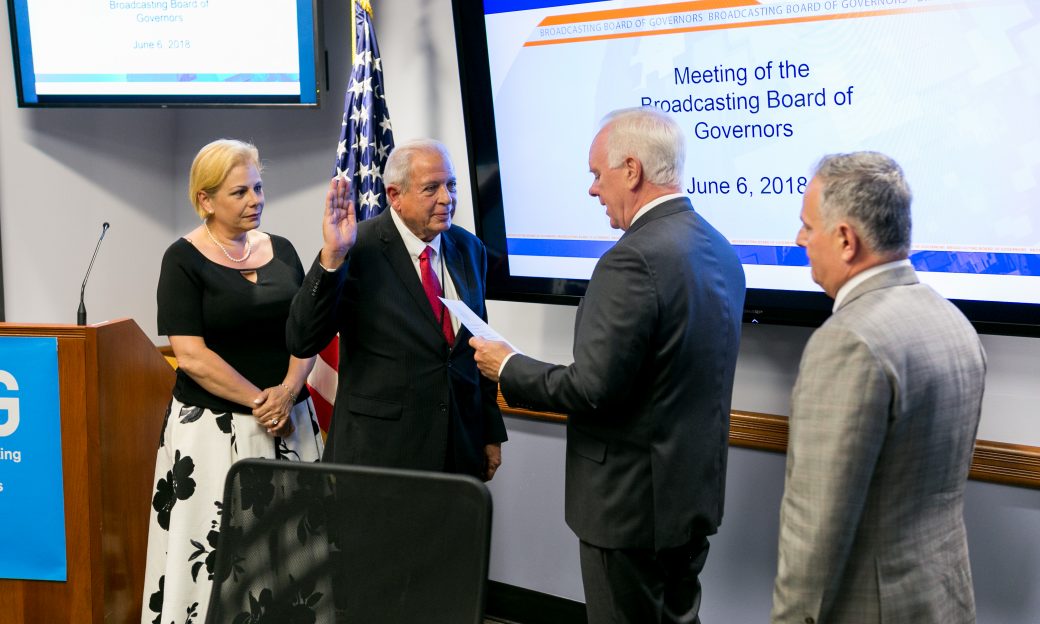
The Broadcasting Board of Governors (BBG), the independent agency, which supervises the five government-funded US international broadcasting and multimedia organizations, held its latest meeting on 06 June.
The BBG 2018 Action Plan was unveiled on 14 March.
A number of personnel changes were announced and a wide-ranging overview of recent initiatives was given by BBG networks’ senior leaders.
The board meeting highlighted also the risks faced by its journalists around the world.
BBG Board Chairman Kenneth Weinstein first welcomed Acting Under Secretary for Public Diplomacy and Public Affairs Heather Nauert to her first board meeting. Nauert, who represents Secretary of State Mike Pompeo as BBG ex officio board member, expressed support for Radio Free Asia’s (RFA) Uyghur journalists, whose families are held in Chinese reeducation camps, and sympathies for those affected by the double suicide bombing that killed 25, including three Radio Free Europe/Radio Liberty (RFE/RL) journalists, in Kabul on 30 April.
Personnel changes
Weinstein announced the following personnel changes:
The appointment of veteran journalist Tomás P. Regalado as Director of the Office of Cuba Broadcasting (OCB), Regalado was sworn in by BBG CEO John Lansing.
The departure of BBG Deputy Director Jeffrey Trimble, who will join Ohio State University after 21 years in US international broadcasting. Trimble, a fluent Russian speaker, joined the BBG as Director of Programming in 2007 after a 10-year career at RFE/RL.
On 04 June the White House announced that it had sent to the Senate, for confirmation, the nomination of conservative filmmaker and documentarian Michael Pack to succeed John Lansing as BBG Chief Executive Officer for the term of three years.
Key initiatives and collaborative activities
Leaders of the BBG networks, known as the International Media Coordinating Council (ICC), who meet twice a month, presented key initiatives and collaborative activities aimed at maximizing their operations in today’s challenging media environment.
Yolanda Lopez, director Voice of America (VOA) News Center, presented “The Dragon’s Reach”, a project coordinating resources from the five networks to highlight Chinese construction and energy projects worth more than a trillion dollars in 70 countries.
VOA Director Amanda Bennett announced that the five networks would cooperate for joint coverage of the Singapore meeting between the US president and the North Korean leader on 12 June.
OCB Director Emilio Vasquez introduced a short video highlighting the work and programmes of the network and the challenges faced by its journalists.
RFE/RL President Thomas Kent presented video reports describing the network’s coverage of recent events in Armenia that led to a peaceful change of government and of the brutal repression by Russian security forces of demonstrations in Moscow as President Putin was inaugurated. Video reports were screened to the BBG meeting. Kent said that international news networks like the BBC, CNN or France 24 used RFE/RL reports as the network, (with 19 staff in Armenia) was the only outlet to have exclusive footage of these events.
RFA Director Libby Liu described the six-part RFA series “How the West was won: The making of a police state on China’s New Frontier’”. Liu listed the measures taken by the Chinese authorities to control ethnic Uyghurs, their “staggering scope” and harshness. RFA has the world’s only Uyghur broadcast and multimedia service and some of its journalists say dozens of their relatives have been detained or sent to reeducation camps to put pressure on them.
Weinstein adjourned the meeting and announced that the next BBG board would convene at the Middle East Broadcasting Network (MBN) headquarters in Springfield Virginia, on 29 August.
17 May 2018
RNZ welcomes investment in public media
RNZ welcomes the injection of $15m to the public media sector in Budget 2018, says chief executive Paul Thompson.
“This is good news and signals the Government’s commitment to investing in a stronger, multimedia RNZ that provides freely-available, high-quality journalism and programming.”
“While we have yet to receive detail of RNZ’s share of the funding we are preparing our plans to ensure the public benefit from any increase.
“RNZ is the nation’s commercial-free public broadcaster and we will play a growing role in ensuring New Zealand is a connected and informed democracy.”
“We are also encouraged by the indication that further funding will be allocated in future budgets for full implementation of the Government’s public media policy.”
(Source: RNZ press release)
16 May 2018
O3 Productions, the drama and film production arm of MBC Group, the largest private media company in the Middle East & North Africa region, and Image Nation Abu Dhabi, one of the leading media and entertainment companies in the Middle East, announced a new partnership to co-finance and co-produce a slate of Saudi films for local, regional and international audiences.
This new deal comes in the wake of the first cinemas in two generations opening in Saudi Arabia and the Kingdom of Saudi Arabia announcing itself open for business for filmmakers from Saudi, the Arab world and internationally.
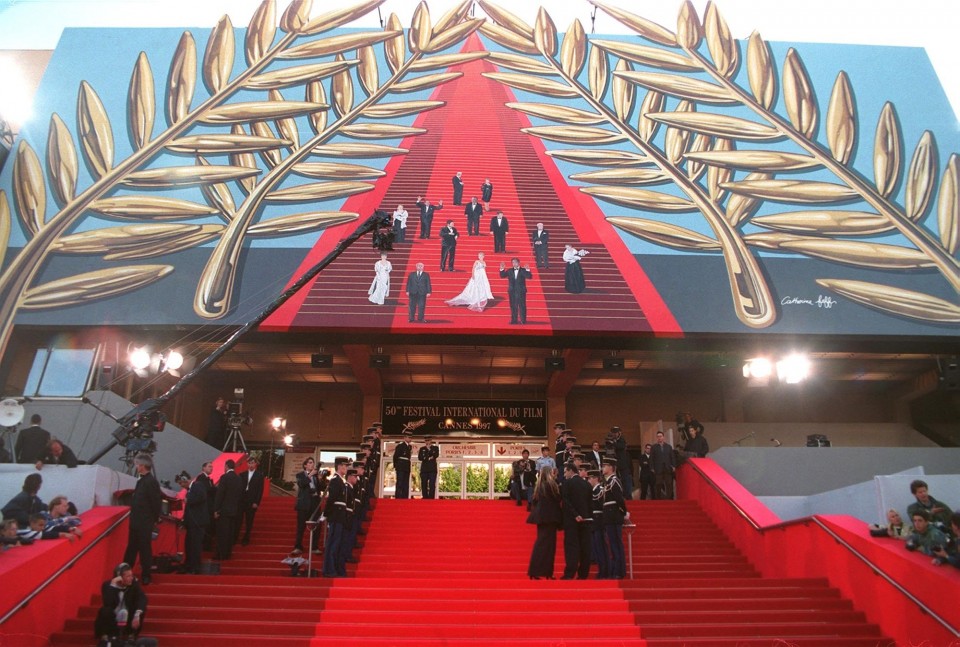
The country has a big presence at this year’s Cannes Film festival with The Saudi Film Council in town for the first time this year along with a Saudi Film Pavilion at the Marche du Film and a selection of Saudi short films showing as part of the festival’s industry programme. The Saudi Film Council has also announced a generous production rebate as a means to attract international productions to film in the Kingdom.
Though ImageNation and MBC/O3 are keeping specific details of the four new feature projects under wraps, genres are likely to include action, thriller, real-life dramas, and comedies. Projects will aim to film in Saudi and utilize Saudi talent in front of and behind the camera. Development has begun on all projects, with production set to commence in 2019.
Saudi comedian and writer Fahad Al Butairi, who previously collaborated with Image Nation on FROM A TO B and the upcoming RASHID AND RAJAB, is also writing a new project entitled LOVE ABOVE THE LAW, which will fall under the new deal. The film is a comedy about a middle class Saudi man marrying a girl from the Badiya, the rural community, and the two discovering they actually have a lot in common.
This MBC/O3 Saudi deal follows on from the previous film and TV deal that MBC and Image Nation announced last year.
Under that deal, O3 and Image Nation are currently in advanced development on the feature film adaptation of Saudi pop culture smash HWJN, about a devout God-fearing Jinn who forges a special bond with a talented Saudi female medical student.
Emirati filmmaker Majid Al-Ansari, who previously directed Image Nation’s Zinzana and has served as executive producer on a number of Image Nation’s other projects will direct the film, which will commence shooting in the Autumn of this year. An extensive casting search in Saudi Arabia is currently underway for the leads in the film and casting will be announced in due course.
A spin-off TV series The Delusionists which also has a unique take on modern Saudi and Arab society will also go into production back-to-back with the film.
Fadi Ismail, Group Director of O3 Productions said: “There is so much to be done in this brave new drive and we believe in collaboration with those who have the same ambitions and vision. Image Nation is a trusted and established player in the film industry and we have joined forces to launch a slate of Saudi films that will promote Saudi storytelling and talents. MBC Group – via its Drama and Film production arm – is keen to push Saudi storytelling, through Drama and Film, qualitatively and quantitatively, to new heights – thus creating premium content that not only is captivating to Saudi and regional viewers, but can travel globally and help in further projecting the positive image of KSA as an active player in international entertainment industry.”
Ben Ross, Head of Narrative Film and Television at Image Nation, commented: “As Saudi Arabia begins a new chapter in its cinematic history, this exciting partnership between Image Nation, MBC and O3 will showcase the very best Saudi filmmaking talent in front of and behind the camera. We are one of the first foreign companies investing in Saudi content and are looking forward to introducing new Saudi talent to local, regional and global audiences. We’re delighted to be working with the multi-talented Fahad Al Butairi again on Love Above the Law. This deal really underscores Image Nation and MBC’s shared commitment to producing high-quality Arab language film and television projects for the Arab world.”
(Source: MBC press release)

15 May 2018
Arqiva, the leading UK communications infrastructure company, has today announced a new agreement which will see the reach of Sound Digital’s commercial DAB multiplex in the UK expand by nearly 4 million people.
The agreement with Sound Digital will see Arqiva add 19 new transmitters to the existing network. This will increase Sound Digital’s household coverage by over 1.6m new households in areas such as Devon, Cornwall, South Wales, North East Scotland, East Anglia and Kent.
Sound Digital, the second national commercial DAB multiplex, currently carries 19 radio stations on its network, including Mellow Magic, Virgin Radio, Forces Radio, Sunrise Radio and Jack 3. It is the first national multiplex in the UK to use DAB+ technology for some of its services.
Steve Holebrook, Managing Director, Terrestrial Broadcast at Arqiva, said: “This agreement to expand the reach of Sound Digital is further evidence of the continued success of DAB radio in the UK, and the fact that more and more people are making it their digital radio platform of choice.
“This week’s RAJAR figures are widely expected to show that for the first time ever, the majority of radio listening is through digital means and within that, DAB is by far the largest contributor.
“We are delighted to be bringing Sound Digital’s diverse range of content to almost 4 million new listeners for the first time.”
24 April 2018
In March and April of this year, European public broadcasters in Sweden, Denmark and Switzerland have come under the spotlight as drastic funding changes are announced.
April: Sweden votes to replace licence by a “public service fee tax”
Following a proposal put forward in October 2017 by a parliamentary committee set up to look at the country’s funding of public service broadcasting, Sweden’s Culture and Democracy Minister Alice Bah Kuhnke announced on 12 April that the government was backing the idea of replacing the licence fee with an income-based tax. The new funding model would be introduced in 2019. The current system, which has been around for 60 years, is no longer considered adapted to the new media environment with programmes being accessed through a variety of devices, not just TV sets.
According to Bah Kuhnke the tax will be set at one per cent of taxable income but would be capped to a maximum of 1,300 Swedish kronor (SEK), the equivalent of $154 / £108 / €125 per person per year. Individuals earning less than SEK 13,600 a month ($1,610 / £1,130 / €1,307) will pay a lower fee. But all those over 18 who pay taxes will pay the new fee, whether they have a TV set or not. Currently only those who have a set have to pay the licence fee, and an estimated 11-15% who have one do not pay the fee, according to the parliamentary committee findings. In addition, companies, will no longer have to pay the licence fee.
The current fee (for radio and TV) is SEK 2,400 ($285 / £200 / €230) per household and is the same for all with no reduced fee for students or retirees. It funds both Sveriges Television (SVT) and Sveriges Radio (SR).The tax will be collected by the Swedish Tax Agency, and the need for the specialized licence fee collecting agency, Radiotjänst, will disappear.
The new tax is meant to strengthen independence from politics as the new public service fee is earmarked specifically for funding public service broadcasting and will also be reported separately on tax returns.
March: Denmark scraps licence fee and cuts budget of its public broadcaster by 20%
As reported in the press on 16 March, a majority of Danish parties have decided to scrap the licence fee (currently £300 or €339) and to cut the budget of DR, the Danish public broadcaster, by 20%. The cut equates to a shortfall of 740 million kroner a year (£87m or €99m).
DR’s director general Maria Rørbye Rønn warned that savings of this scale would result in DR producing and broadcasting fewer hours of Danish-language television.
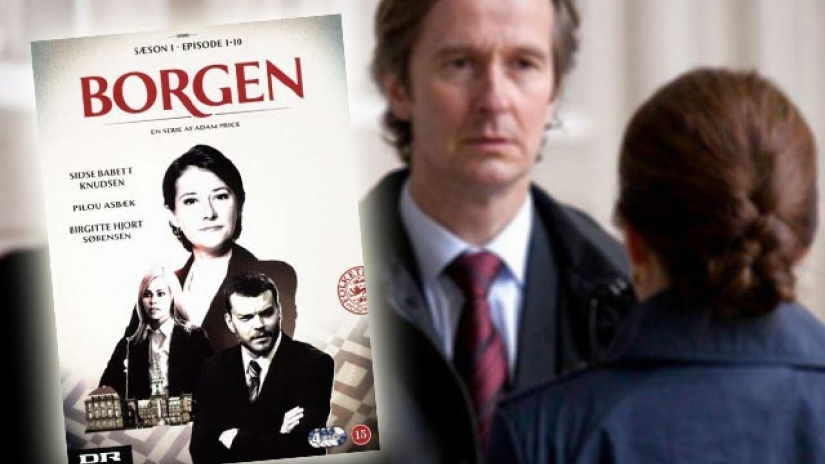
DR TV programmes, such as the widely-acclaimed crime series The Bridge (Broen / Bron – coproduced with Sweden’s Sveriges Television), the political drama Borgen or the police series The Killing (Forbrydelsen), to name the best-known series only, have won many international awards and nominations. DR collaborate with other public service broadcasters within the Nordvision regional partnership, which produces and distributes programmes in the region and abroad. The cut is likely to have an impact on Nordvision.
March: Switzerland votes against change as it votes to keep the licence fee-funded model for broadcasting services.