25 September 2018
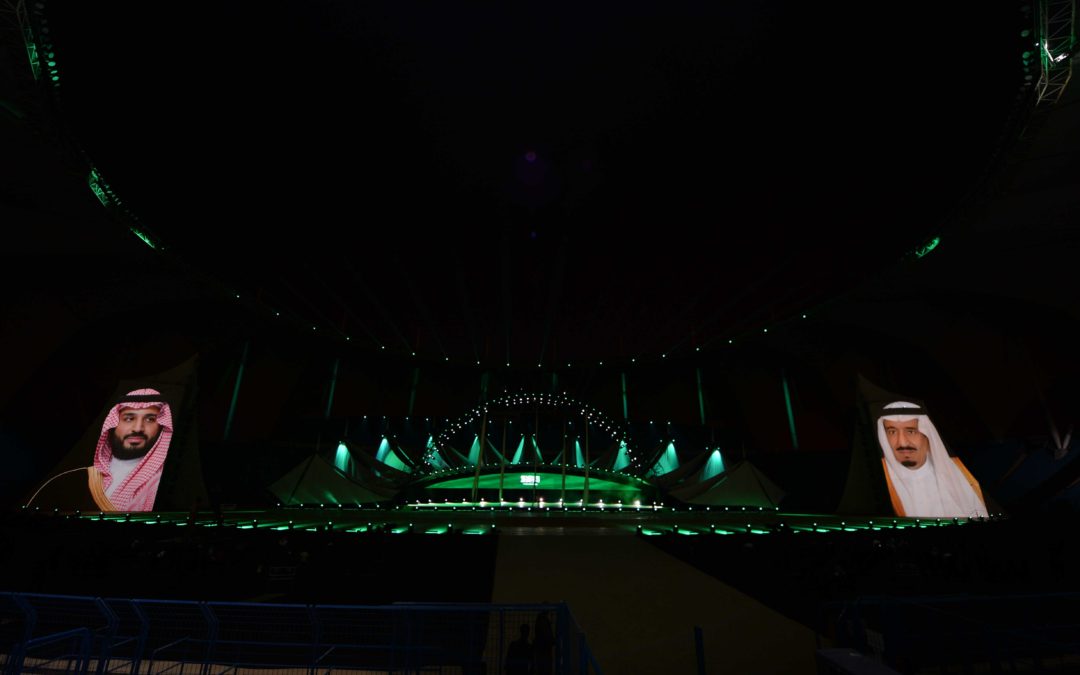
To mark Saudi National Day, the General Authority for Entertainment presented Cirque du Soleil in Riyadh, in one of the international performance company’s largest shows to date, and its first in the Kingdom of Saudi Arabia. The event, attended by 27,000 guests, was organised by MBC Group and broadcast live on MBC1.
Cirque du Soleil’s debut in the Kingdom broke the record for the largest number of attendees in a single circus performance. Taking place at the King Fahd International Stadium, the event was presented on a tailor-made 100 x 40-metre theatre that was designed and constructed especially for the occasion.
Intertwining storytelling with spectacular acrobatics, audiences witnessed a visual masterpiece that included aerial silk, suspended pole, rotating ladder, German wheel, fire manipulation and Trampowall performances, as well as unicycle tricks, contemporary and hip-hop dance, electric motorcycle stunts, and even a free-flying Hoverboard illusion.
Blending the latest in spectacular stagecraft, mesmerising special effects and enthralling fireworks, Cirque du Soleil was watched by over 200 million viewers worldwide, turning the Saudi National Day celebrations into a truly global event.
(Source: MBC press release)

23 September 2018
TV and radio services to be affected, widespread criticism
Following the decision (reported by the AIB on 24 April) by a majority of Danish parties to scrap the licence fee (currently £300 or €339) and to cut DR’s budget, the broadcaster’s director general, Maria Rørbye Rønn, presented the plan to implement the required cuts on 18 September.
Rønn warned that savings of this scale would result in Danmarks Radio producing and broadcasting fewer hours of Danish-language television.
Services and jobs cuts
The cuts will mean 375-400 job losses, including 25 managerial positions, she said.
DR will reduce the number of its TV channels from six to three. The main general interest channel DR1, will continue as it is, DR3, the innovative channel aimed at viewers in the 15-39 age group, and the children channel DR Ultra will become streaming services by 2020, while cultural channel DRK will be merged with DR2, the channel for breaking news, documentaries, debate, comedy and movies, according to a DR press release.
The radio stations P6 Beat, P7 Mix and P8 Jazz will also all close owing to the budget cuts reducing the number of radios from eight to five.
“The background (to this) is both the necessary cuts and ensuring that DR can place even more focus on conversion to digital. In terms of content, we will now focus even more on our strengths. All in all, these are relatively drastic changes, but we think we’re on the right path,” Rønn said.
High-value TV programmes met with international acclaim
DR TV programmes, such as the widely-acclaimed crime series The Bridge (Broen / Bron – coproduced with Sweden’s Sveriges Television), the political drama Borgen or the police series The Killing (Forbrydelsen), to name the best-known series only, have won many international awards and nominations. DR collaborates with other public service broadcasters within the Nordvision regional partnership, which produces and distributes programmes in the region and abroad. The cut is likely to have an impact on Nordvision.
Widespread criticism in Denmark and beyond
The Danish English-language newspaper The Local reported that “commentators in the Danish media industry, as well as opposition politicians, criticised the cuts after details of their implementation and associated job losses were announced. Commentators in the Danish media industry, as well as opposition politicians, condemned the cuts after details of their implementation and associated job losses were announced.
For its part, the European Broadcasting Union (EBU) Executive Board issued a statement expressing “concern over the Danish Government’s new public service contract with Danmarks Radio (Danish public radio and television) that will dramatically restrict the organization’s scope and range of programming and remit.
“The EBU Executive Board is concerned at political attempts to drastically narrow and alter the accepted broad remit of public service media,” the statement said.
“The 20 percent budget cuts imposed on DR will undoubtedly impact its ability as a national broadcaster to offer the same wide range of output to audiences across Denmark,” EBU Director General Noel Curran said.

19 September 2018
The 2018 International Broadcasting Convention (IBC), held in Amsterdam (13-18 September) attracted large numbers of visitors, exhibitors and speakers, like in previous years.
More than ever before, the broadcasting industry is in a state of flux. It went through major changes at all levels in recent years, on the business and technical sides in particular.
Technology
A trend observed in recent years is the growing reliance of the broadcasting industry on IT services.
These include a major transition to IP-based solutions for broadcast TV production and delivery. Another major development observed in many domains is the introduction of Artificial Intelligence (AI), which is itself closely tied to Machine Learning (ML).
AI and ML have made possible major improvements in Virtual Reality (VR), Augmented Reality (AR) and Mixed Reality (MR), important for games, but also essential now in visual broadcast production.
In addition, AI and ML are proving central to applications, such as speech to text for subtitling, archiving, data mining, improved protection of content against piracy and hacking, to name just a few.
Leveraging the power of cloud services for post-production, storage and security applications is set to magnify the potential of these technologies and of their applications in the media industry.
Business
From the business perspective, these new technologies and services represent challenges for established broadcasters, whilst opening up opportunities for new players, such as technology companies and platforms.
Many players aware of these challenges are looking at ways of cooperating on a wide range of projects to find business models that would benefit both sides.
The AIB will be reporting on some of these developments in the near future.

24 August 2018
BBC News Burmese has launched the Burmese edition of the BBC’s flagship digital technology programme, Click. The weekly programme is aired in Myanmar by the country’s largest TV network – the state broadcaster MRTV – and is available on demand on the BBC News Burmese website bbc.com/burmese and YouTube channel.
The weekly 10-minute edition of the BBC’s TV guide to the latest technology news is produced and presented by BBC News Burmese. Click brings latest reports on apps, gadgets and games, and on technological innovations from around the world.
BBC News Burmese Editor, Soe Win Than (Min Htet), says: “In addition to BBC radio content, MRTV will now broadcast our new TV programme which will inform viewers about the most important global and regional developments in the world of digital technologies, and about the technical know-how to help improve their daily lives. This is excellent news for the BBC’s presence in Myanmar and our collaboration with MRTV. I hope our audience will welcome this addition to their weekly evening TV schedule.”
MRTV rebroadcasts BBC News Burmese weekly radio programmes: the youth show, Mobigeno (Monday at 15.15 local time), the technology and digital innovations programme, CoolTech (Tuesday at 14.20), and the programme about innovative farming methods, San Thit Tehtwin Lai Myay Ta Kwin (Thursday at 08.45).
Director of MRTV, Moe Thuzar Aung, adds: “I am really glad that, thanks to our cooperation with the BBC’s Burmese service, our channel will bring the latest technology news around the world to our audiences.”
Click will be broadcast by MRTV at 18.15 local time on Fridays and will be repeated the following Mondays at 09.20. The programme will be available on demand on the website bbc.com/burmese and BBC News Burmese YouTube channel.
In addition to collaboration with MRTV, the BBC News Burmese Monday to Friday TV news programme is broadcast by Myanmar’s digital channel, Mizzima TV (20.45). The radio programmes, Global Newsbeat, Mobigeno and the English-learning series, The English We Speak, are aired by Myanmar’s FM network, Padamyar FM. Daily top headlines from the BBC News Burmese website are directly available to users of Yangon-based website, Frontier Myanmar. Selected stories appear on the Burmese-language index of Thailand-based news website, Khaosod.
Burmese-speaking audiences can access the BBC via Facebook (over 14m followers), as well as Twitter and YouTube.
BBC News Burmese is part of the BBC World Service.
(Source: BBC press release)
16 July 2018
BBC international services reach record audience
“Reflecting the United Kingdom, its culture and values to the world”
The BBC has just published its Annual Report and Accounts 2017/18. The 270-page document gives a detailed account of the BBC’s international services, radio, television, online and social media as well as their reach and their total international weekly audience which now exceeds 345 million for all services.
The success of these services is certainly the result of a long tradition anchored when the Empire Service of the BBC, precursor of the BBC World Service, was established in 1932 by the first director general of the BBC (1927-1938) John Reith.
As Gavyn Davies, Chairman of the BBC Board of Governors, explained in a 2003 speech, when, Reith launched the service “he had a remarkable insight. The BBC’s foreign services, he said, must not be used as a propaganda weapon to spread the views of the British government, but must be seen as an independent voice, seeking only to speak the truth to its listeners.”
The following are excerpts of the BBC 2017/2018 report that give details of the BBC’s international services activities and expansion in the past year. The report says that the BBC plays and essential role carrying the distinctive culture, voice and values of the UK to the world
BBC global reach, news offer more important than ever
“Once again, the past year has highlighted the fact that, in many parts of the world,” the report says, “the media is less free than it was ten years ago. There has been the continued growth of big state-sponsored news organisations and from news aggregated by digital platforms. Al Jazeera, China Central Television (CCTV) and RT (formerly Russia Today) can command vast resources and, while the services offered by these organisations can be of high quality production, they also reflect a particular world-view and the agenda of their backers. With the possibility of state services from less free countries influencing global debate and news provision, the value to democracy and liberty of the BBC’s global reach is higher than ever.”
One of the UK’s most important cultural exports
The former UN Secretary General Kofi Annan once described the BBC World Service as quite possibly “Britain’s greatest gift to the world in the 20th century.”
The report says that it “inspires and illuminates the lives of millions around the world, helping them make sense of the world they live in. (…) The BBC’s two commercially funded international news services, BBC World News and bbc.com, continue to provide consumers with news from one of the most trusted and reliable news providers in the world. Meanwhile, BBC Worldwide – now part of the newly merged BBC Studios – invests in, commercialises and showcases content from the BBC around the world, to build the reach and reputation of the BBC brand overseas, champion British creativity and at the same time deliver commercial returns to the BBC to invest in public service content.
Record international audience
“The BBC once again attracted record audiences internationally, with the latest figures, the Global Audience Measure, revealing a total weekly audience of 376 million [taking into account de-duplication, i.e. ensuring that a person who consumes multiple BBC services or platforms or on multiple devices, is not counted many times in the top-level totals.]
“This includes all international content. This year has been a remarkable one for the BBC World Service, as it saw us carry out our biggest expansion since the 1940s, thanks to a £85 million investment during the year from the UK Government. This expansion is enabling us to bring trusted news to more parts of the world, including those in which access to free and impartial information is severely limited,” the report says.
Now available in more than 40 languages, increased international impact
The BBC World Service is “now operating in more than 40 languages around the world, from Pidgin to Korean, with new Government investment to increase the international impact and reach of the BBC.” As part of the expansion the BBC has opened new and expanded bureaux “in locations such as Dhaka, Mumbai, Nairobi, Delhi, Seoul, Bangkok, Yangon, Tunis, Cairo, Beirut and Belgrade and employed more than 1,000 new staff across the world. (…) This not only enhances our coverage for audiences abroad but also gives our UK news audiences a more in-depth view of areas that have traditionally received less coverage.”
“Having more journalists on the ground also means that we’re able to cover more under-reported areas and improve our offer to UK audiences. The BBC World Service saw its audience grow from 269 million to 279 million.”
Safeguarding World Service for future generations
“We’re aiming our international news at a new generation of users, to safeguard the World Service for future generations,” the report says, adding “this means focusing on new formats and new audiences. It is clear, for instance, that shortwave radio listening has declined rapidly again this year, and research has shown that with the increased global availability of cheap smartphones, audiences continue to switch to digital platforms for news. BBC World Service continues to do well with younger audiences internationally – a quarter of our weekly global audience is aged between 15-24.
Online offer proving an international success
The BBC’s “global commercial news website, bbc.com, continued to bring both news and features to a huge international audience. The audience for bbc.com is growing within the USA, the world’s largest media market. We have restructured our business to merge BBC Advertising with BBC Global News Ltd, the commercial subsidiary which runs both BBC World News and bbc.com. This means that the new single integrated business can develop our news content commercially,” the report says.
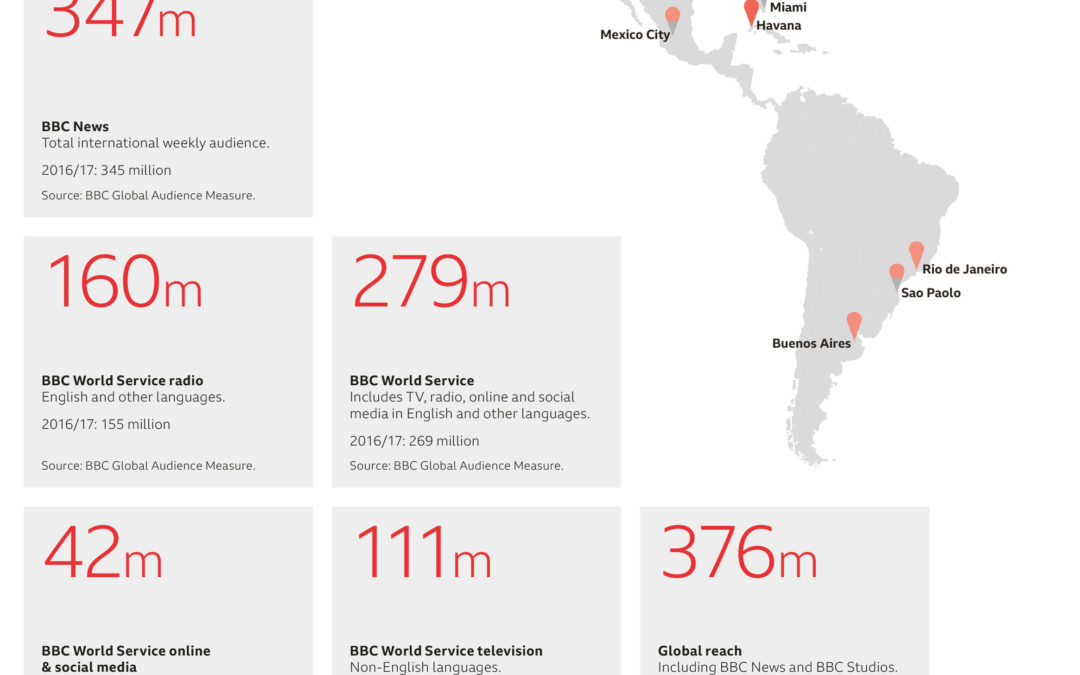
Global Audience Measure 2017/2018 (2016/2017) – details
347m: BBC News (Total international weekly audience – 2016/2017: 345m)
160m: BBC WS radio (English & other languages – 2016/2017: 155m)
279m: BBC WS (includes TV, radio online and social media in English and other languages – 2016/2017: 269m)
42m: BBC WS online and social media (2016/2017: 17.39m)
111m: BBC WS television non-English languages (2016/2017: 110m)
95m: BBC World News TV channel (English language global news channel 2016/2017: 99m)
37m: bbc.com (International English language) and social media
376m: Global reach, Including BBC News and BBC Studios
Note: The Global Audience Measure is an annual update of how many people are consuming the BBC weekly for all services in all countries across all platforms (television, radio, website and social media). Key to this is de-duplication i.e. ensuring that a person who consumes multiple BBC services or platforms or on multiple devices, is not counted many times in the top-level totals. For example, BBC World Service television, radio and online audience is less than the sum of its parts to ensure we do not count people more than once when looking at the total World Service audience.
59 % of foreign audience agree the BBC helps them to gain a more in-depth understanding of the news. Source: BBC Brand Tracker 2017 (not UK).
BBC is ranked No.1 for: Trust Independence Reliability (Source: BBC Brand Tracker 2017 (not UK).
