Intelsat S.A. (NYSE: I), the world’s leading provider of satellite services, along with iStreamPlanet, Newtec, and PSSI Global Services, LLC will demonstrate the evolution of true 4K UHDTV using HEVC compression and Content Distribution Networks (CDNs) with end-to-end video transmissions via satellite and the internet at the Las Vegas Convention Center in Las Vegas, Nevada during the 2015 NAB show. The demonstrations will take place at Intelsat’s booth located in the South Upper Hall, Booth SU3110.
At NAB, Intelsat will introduce IntelsatOne® Prism services, a new paradigm in media networking and content distribution, allowing customers to easily upgrade a legacy satellite-based network to a next generation, automated, hybrid, converged IP network. The team will demonstrate how media customers can manage multiple types of video content delivery and other IP applications in a single platform to optimize bandwidth and deliver high quality media content in a cost efficient, seamless manner, regardless of location.
The Evolution of True 4K UHDTV Distribution
4K UHDTV content provided by Discovery Communications will be transmitted from PSSI’s production vehicle located in Las Vegas. Using a playout server, a reference UHD HEVC Encoder and Newtec MDM6000 Satellite modem, the video feed will be uplinked in Ku-band to Galaxy 17, Intelsat’s premier sports and news contribution neighborhood, at 25 Mbps in a DVB-S2X modulated stream. The resulting 4:2:2, 10-bit 4K UHDTV signal at 60 frames per second stream will be downlinked and fed to the 4K UHDTV monitor in the Intelsat Booth (SU3110).
Maximum Flexibility – Simultaneous Content Distribution Network
Utilizing a similar configuration for the second live transmission, PSSI will uplink a 5 Mbps IP-based HD video stream to Intelsat’s Galaxy 17 satellite using Newtec’s efficient Mx-DMA return channel technology and an AVP3000 encoder, which will be downlinked at Intelsat’s teleport in Atlanta, Georgia and connected to the Newtec Dialog® 4IF hub, where the award-winning Newtec Dialog multiservice platform serves as the core of the IntelsatOne Prism services. The streaming will then be routed via the internet from Intelsat’s teleport to iStreamPlanet’s cloud-based Aventus® service for live media encoding, multiscreen packaging and publishing to the CDN. As the last step, the live streams will be delivered over the Internet to iPads for live viewing in the Intelsat stand.
IntelsatOne Prism will simultaneously coordinate several services and applications sharing the same space segment, while optimizing quality of service and offering simple, automated operations for customers. Leveraging the IntelsatOne Prism transmission management mechanisms and web user interface, the PSSI streams for both the 4K UHDTV and CDN demonstrations can also be controlled remotely and automatically via a laptop located in the Intelsat stand.
Supporting Quotes:
Peter Ostapiuk, Head of Media Product Management, Intelsat, said: “As an industry, we have proven that we are ready to support the commercialization of 4K UHDTV. However, in order for 4K UHDTV to gain widespread adoption, media programmers need high quality content and the ability to distribute that content across multiple devices in a simple and cost efficient manner. Intelsat and its technical solutions partners will demonstrate that with IntelsatOne® Prism services — which are based on the Newtec Dialog platform combined with HEVC compression technology, PSSI’s mobile production and transmission facilities and iStreamPlanet’s live, multiscreen media processing — we can deliver an immersive viewing experience from any geographical location to any media channel and any device. In addition, IntelsatOne Prism provides media customers what they need the most, the ability to manage multiple types of video content delivery and other IP applications through a single platform so they can optimize their bandwidth usage and streamline their operations.”
“Today’s viewers expect a high quality video experience across all of their screens,” said Jennifer Baisch, Vice President of Marketing for iStreamPlanet. “iStreamPlanet is committed to teaming up with industry leaders such as Intelsat, combining technologies and services to provide reliable, scalable, end-to-end multiscreen solutions to meet the growing demand for live video, from any corner of the globe to any device.”
Thomas Van den Driessche, Chief Commercial Officer at Newtec, said: “The evolving 4K and content exchange ecosystem will benefit from the hybrid IntelsatOne Prism services showcased in these demonstrations at NAB Show 2015. With Newtec Dialog at the core of IntelsatOne Prism, we are pleased to play a key role in providing a flexible, scalable and efficient solution. The Newtec Dialog platform, with its multiservice broadcast applications, demonstrates the capabilities of distribution and contribution of 4K content, both live and non-linear. It is equipped with the most efficient, open transmission scheme for that purpose – DVB-S2X – as well as the patented and award-winning Mx-DMA technology, which provides the optimal contribution back to the studios.”
“The combination of PSSI and IntelsatOne Prism will enable us to mobilize and deliver a powerful combination of data connectivity, media processing and digital content delivery on a single platform,” stated PSSI Chief Executive Officer Rob Lamb. “PSSI satellite trucks can operate as a mobile media gateway providing direct access to a complete range of multimedia services that can be rapidly provisioned through our fleet and scaled on-demand. Our new capabilities solve first and last mile connectivity challenges and sourcing variables by bringing the network on location. From data connectivity to 4K UHDTV distribution to video backhaul, we can now provide our customers with a single access point into a global satellite and terrestrial fiber and IP network. These initiatives augment what is already the largest and most versatile fleet of satellite uplink trucks, flyaway units and production/uplink hybrids in the industry. PSSI/Strategic Television is proud to be at the forefront of full-service, point-to-point-and-multipoint transmission and communication platforms for our domestic and international clients.”
NAB Show attendees are invited to join a guided presentation demonstrating the capabilities of the 4K UHDTV and content exchange ecosystem partners. This will take place at the Intelsat Stand at SU 3110 on Tuesday, 14 April at 11:00 a.m. PDT (UTC/GMT-7).
This month, Zee, India’s biggest pay TV channel, celebrated its 20th birthday in the UK and Europe with a gala event in London, which featured appearances by the likes of Bollywood superstar Shah Rukh Khan. But the evening was not only a celebration of the past, but a look to the future. Zee used the evening as the platform to launch Zee’s new free-to-air channel &TV (AndTV).
During the evening, AIB had to opportunity for a one on one with one of the most influential players in Indian television, the MD and CEO of Zee, Punit Goenka.
Can you tell us a bit about your time at Zee?
My family owns the business. It’s a publicly listed business, but we are the majority shareholder, and I run this business on behalf of the family. I’ve been in this part of the business, for ten years.
I started off with running the Zee flagship channel for the network, then moved on to running all the channels for the group. And finally took over as the CEO and MD in 2008. And have been doing that ever since.
(l to r) Zee executives Rajesh Iyer, Punit Goenka, Neeraj Dhingra & Parul Goel at the press conference launching &TV
I’m sure you’ve seen a lot of changes in those ten years. Is it the same channel as it was it first began?
It’s very different from how it was. Zee has been in the UK and Europe for 20 years, and almost 23 years in India. What started from only a two-hour broadcast per day in the first years, is today 34 services running 24/7. We are no longer just a television company, we are also now moving all our content onto the internet space. We produce a lot of our own content now, rather than just acquiring it.
We now reach 179 countries, at last count, and we have gone away from just the Indian languages to include foreign languages too. We do content in Arabic, in Russian, in Bahasa for Indonesia and Malaysia, in Thai, and we just launched an English-language service in South Africa. So it’s no longer an Indian company. I think it has transformed into a global company. We have over 715 million viewers globally and counting.
How has becoming a global channel changed Zee’s strategy?
Now, because we have spread out in so many markets, the company has grown significantly in terms of size, in terms of number of people. And we have to do a lot more content than we used to do. We create about 600 hours of content on a weekly basis. That’s really a lot of content. It’s actually a factory, if you look at it from that perspective. And we do it in so many languages, apart from the Indian languages – we do it for six local languages in India also.
How has the digital shift affected Zee and how you produce content?
In India and for South Asian markets it’s still slow. It’s not moved as fast as we’ve seen here in the UK. But what we believe is that it’s the platform of delivery that’s changing, and while the delivery mechanism may change via the Internet, content companies will still have to exist and create quality content and make sure that quality content is available to viewers. And that’s what we are transforming ourselves to allow.
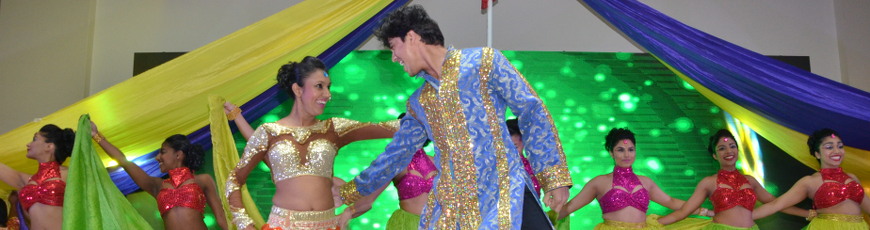
The &TV launch featured entertainment by the Shiamak Davar Dance Troupe
As the channel expands, are you still primarily targeting a South Asian audience?
In this market, we’ve not gone into local languages yet – English or any other language in European language, except for Russia. But we are studying some markets, like Germany, where we do think there is a market for getting into local language content. But we are still in the research phase.
Are you looking to tailor content for those different markets?
Absolutely. The content that goes into each of these markets is researched and tailored for that market. Storylines and films are selected based on how they will work in those markets. For example, in Arabic, our research showed that the local woman there really lacks romance in her life, so the romantic movies really work well in the kingdom of Saudi Arabia. That all comes from extensive research, and that’s how we’ve tailor-made the content for those markets.
What need is your newest channel, &TV, fulfilling?
Zee, being a brand that has been in existence for so long in India, has a certain loyal viewership base, and the best word to define them is they are the ‘traditionalists’. They are families – three generations of family living together. India is still largely composed of single-television homes. And the infrastructure is still not good enough for people to start consuming content on devices on a regular basis. So the kind of content we can do on Zee TV is very traditional. Whenever we tried to experiment with edgy content on Zee TV, our audience not responded.
So the need was felt that there’s a new audience base that’s been born in the last twenty years and they are looking for experimental new content. So we needed a new brand that is not Zee, and that’s how the ‘&’ franchise came about.
We first launched it with a movie channel, which showed a lot of edgy cinema. And once that was successful, we’ve moved into the entertainment sector as well. There is certainly a lot difference from what you see on Zee TV.
Was Zee’s more traditional programming in danger of losing young audiences?
Yes, younger audiences and the male audiences, who are not really attracted to the female soaps and drama. The need was felt for another brand to be created, where we can do a lot more contemporary and edgy content.
Bollywood star Shah Rukh Khan at the UK launch of &TV
What kind of content is there on the new channel?
We have everything from historicals to suggestive sex comedy to mafia-based family drama. We have game shows. And it’s all original content, produced in India. Some of the formats we’ve sourced from the overseas markets – like The Voice, Killer Karake and Who’s Asking?
What about news?
Given the regulatory scheme in India, this company cannot own news channels, because there is a restriction of 26% foreign direct investment in news. So we have a sister company that runs news businesses for us. That’s called Zee Media Corporation. Because we are majority owned by foreign direct investment, we are not legally allowed to do news.
How do you feel about the twentieth birthday celebration of Zee TV in the UK?
It’s a celebration for us. It’s a milestone that we’ve achieved in this market. But we feel that this market needs to grow further, so we are bringing the &TV franchise here to the UK.
While Zee TV will continue to play in the pay subscriber base game, &TV will go compete in the free-to-air market, with the rest of the competition, and we hope that it will be as successful as Zee TV has been to grow the market and grow our shares.
Reuters has partnered with ITN Source to make historical archive footage more accessible to producers and viewers around the world. The digitisation of the Reuters video archive is making hundreds of thousands of rare and largely unseen news clips digitally available for preview and licensing on itnsource.com.
To date, over 115,000 Reuters clips have been digitised and published on itnsource.com, expanding the available Reuters digital archive to nearly half a million clips and counting. The project is set to finish in 2016.
Footage being digitised consists of the Reuters News syndication service from 1957 to 2006 and earlier cinema newsreels from 1910 to 1959, including the Gaumont, Paramount and Universal collections. Material from 2006 onwards is already available in digital format.
ITN Source’s experienced researchers have prioritised the digitisation of material relevant to upcoming anniversaries and events, such as the 40th anniversary of the fall of Saigon and the 75th anniversary of the end of World War II – featuring a substantial collection of post-war Winston Churchill footage – in addition to material in response to specific customer requests.
Highlights of the most recently digitised Reuters material are available for viewing and are updated on a regular basis as new material is digitised and uploaded.
Ashley Byford-Bates, Global Head of Reuters Pictures and Archive, said, “Having our assets in digital format is critical. It gives broadcasters, production houses and online publishers a real opportunity to explore, discover and see the footage. With over 30,000 hours of content preserved, we can now focus on the really exciting task of making the unique Reuters collection available for new programmes, projects and audiences.”
“The Reuters archive is incredibly popular and we are delighted to play our part in making this fantastic collection far more accessible to our clients around the world,” said Andy Williams, Managing Director at ITN Source.
As part of this programme, ITN Source has also re-catalogued and published a collection of interesting and quirky clips from the early 2000s called “Reuters Life!”. This collection features international coverage of the environment, entertainment, lifestyle, arts and culture in an amusing and light-hearted style.
One year after its Baghdad bureau chief was slain, Radio Free Europe/Radio Liberty (RFE/RL) has launched the Muhammad Bdaiwi Memorial Journalism Prize to pay tribute to his career by recognizing the best examples of radio journalism in Iraq.
“In this way, our colleague’s contribution to journalism will be remembered, and his life-long commitment to strengthening Iraq’s independent media and building a more democratic society will continue,” said Nenad Pejic, RFE/RL editor in chief.
The prize will recognize distinguished local radio reporting that supports the values of pluralism and human rights in Iraq. It will be administered in cooperation with the College of Mass Communication at the University of Baghdad, where Bdaiwi was an associate professor of journalism.
The prize was announced during a March 23 ceremony on the anniversary of Bdaiwi’s death
The new prize was announced during a March 23 ceremony at the University of Baghdad marking the first anniversary of Bdaiwi’s death.
Recalling Bdaiwi, whom he knew as a graduate student and with whom he worked at several media outlets after the fall of Saddam Hussein’s regime, the Dean of the College of Mass Communication, Dr. Hashim Hassan Al-Tamimi, said, “[Bdaiwi] devoted his whole life to his work…His life was a constant struggle on a professional and humanitarian level.” During the ceremony, he announced that an auditorium at the College would be renamed in Bdaiwi’s honor.
Hadi Marae, who directs Iraq’s Journalistic Freedoms Observatory, a Baghdad-based media monitoring group, said that establishing a press competition in Bdaiwi’s name demonstrates the importance and perseverance of Iraqi journalists, and expressed the hope that other news organizations would follow RFE/RL’s example.
On March 22, 2014, Dr. Muhammad Bdaiwi Owaid Al-Shammari, who was known on the air as Hasan Rashid, was shot and killed at a checkpoint in the Jadriyah neighborhood of Baghdad while on his way to work at the Baghdad bureau of Radio Free Iraq, RFE/RL’s Iraq Service. His killer, a member of the Iraqi presidential guard, was tried and sentenced to 20 years in prison.
The BBC Presss Office issued the following statement today from BBC Director-General, Tony Hall and investigation findings from Ken MacQuarrie.
Statement from Tony Hall
It is with great regret that I have told Jeremy Clarkson today that the BBC will not be renewing his contract. It is not a decision I have taken lightly. I have done so only after a very careful consideration of the facts and after personally meeting both Jeremy and Oisin Tymon.
I am grateful to Ken MacQuarrie for the thorough way he has conducted an investigation of the incident on 4th March. Given the obvious and very genuine public interest in this I am publishing the findings of his report. I take no pleasure in doing so. I am only making them public so people can better understand the background. I know how popular the programme is and I also know that this decision will divide opinion. The main facts are not disputed by those involved.
I want to make three points.
First – The BBC is a broad church. Our strength in many ways lies in that diversity. We need distinctive and different voices but they cannot come at any price. Common to all at the BBC have to be standards of decency and respect. I cannot condone what has happened on this occasion. A member of staff – who is a completely innocent party – took himself to Accident and Emergency after a physical altercation accompanied by sustained and prolonged verbal abuse of an extreme nature. For me a line has been crossed. There cannot be one rule for one and one rule for another dictated by either rank, or public relations and commercial considerations.
Second – This has obviously been difficult for everyone involved but in particular for Oisin. I want to make clear that no blame attaches to him for this incident. He has behaved with huge integrity throughout. As a senior producer at the BBC he will continue to have an important role within the organisation in the future.
Third – Obviously none of us wanted to find ourselves in this position. This decision should in no way detract from the extraordinary contribution that Jeremy Clarkson has made to the BBC. I have always personally been a great fan of his work and Top Gear. Jeremy is a huge talent. He may be leaving the BBC but I am sure he will continue to entertain, challenge and amuse audiences for many years to come.
The BBC must now look to renew Top Gear for 2016. This will be a big challenge and there is no point in pretending otherwise. I have asked Kim Shillinglaw to look at how best we might take this forward over the coming months. I have also asked her to look at how we put out the last programmes in the current series.
Investigation findings – Ken MacQuarrie
On 9 March 2015, Jeremy Clarkson reported to BBC management that he had been involved in a physical and verbal incident with Oisin Tymon, the producer of Top Gear, at the Simonstone Hall Hotel, North Yorkshire, whilst working on location. The incident had occurred on 4 March 2015 and Jeremy Clarkson was suspended on 10 March, pending investigation.
I was asked to undertake an investigation to establish the facts of what occurred. In conducting my investigation, in line with the BBC’s usual practice, I interviewed a number of witnesses and others connected with the incident. Accounts were agreed, based on my interviews, with each participant.
Having conducted these interviews and considered the evidence presented, I conclude the following: on 4 March 2015 Oisin Tymon was subject to an unprovoked physical and verbal attack by Jeremy Clarkson. During the physical attack Oisin Tymon was struck, resulting in swelling and bleeding to his lip. The verbal abuse was sustained over a longer period, both at the time of the physical attack and subsequently.
Specific facts I have found as part of my investigation are as follows:
earlier on 4 March, studio recording of Top Gear had taken place in Surrey and the presenters had travelled that same evening to the location shoot in North Yorkshire;
the incident occurred on a patio area of the Simonstone Hall Hotel, where Oisin Tymon was working on location for Top Gear;
the physical attack lasted around 30 seconds and was halted by the intervention of a witness;
it is the case that Oisin Tymon offered no retaliation;
the verbal abuse was directed at Oisin Tymon on more than one occasion – both during the attack and subsequently inside the hotel – and contained the strongest expletives and threats to sack him. The abuse was at such volume as to be heard in the dining room, and the shouting was audible in a hotel bedroom;
derogatory and abusive language, relating to Oisin Tymon and other members of the Top Gear team, continued to be used by Jeremy Clarkson inside the hotel, in the presence of others, for a sustained period of time;
it is clear that Oisin Tymon was shocked and distressed by the incident, and believed that he had lost his job;
following the attack, I understand that Oisin Tymon drove to a nearby A&E department for examination;
over the subsequent days, Jeremy Clarkson made a number of attempts to apologise to Oisin Tymon by way of text, email and in person; and
it is the case that Jeremy Clarkson reported the incident to BBC management.
It was not disputed by Jeremy Clarkson or any witness that Oisin Tymon was the victim of an unprovoked physical and verbal attack. It is also clear to me that Oisin Tymon is an important creative member of the Top Gear team who is well-valued and respected. He has suffered significant personal distress as a result of this incident, through no fault of his own.