GEO TV Editor-in-Chief makes urgent appeal to UN over his politically motivated and arbitrary detention

GEO TV Editor-in-Chief makes urgent appeal to UN over his politically motivated and arbitrary detention

GEO TV Editor-in-Chief makes urgent appeal to UN over his politically motivated and arbitrary detention

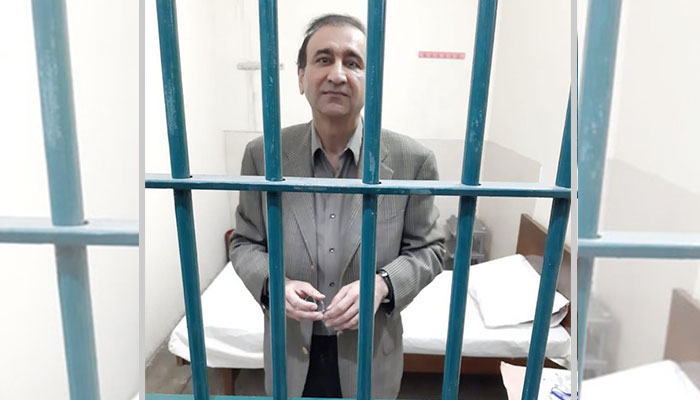
The arrest and detention of Mir Shakil-ur-Rahman, Group Chief Executive, editor-in-chief, and principal shareholder of Pakistan’s largest media group, Jang Media Group, is politically motivated, arbitrary and unlawful, the United Nations has heard.

Today, an urgent appeal has been lodged on behalf of Mir Shakil-ur-Rahman with the UN Working Group on Arbitrary Detention, and a second complaint has been made to the UN Special Rapporteur on the Promotion and Protection of the Right to Freedom of Opinion and Expression. These urgent appeals call on the United Nations experts to take action to ensure that the Government of Pakistan and the National Accountability Bureau (NAB) complies with their obligations under international law, and that Mir Shakil-ur-Rahman be released immediately.

Mir Shakil-ur-Rahman was arrested on 12 March by the NAB in Pakistan in a case concerning a property transaction that dates back 34 years to 1986. He has been imprisoned since, in unsafe and unhygienic conditions and without meaningful and regular access to his lawyers. Jang Media Group owns Geo TV as well as some of Pakistan’s largest newspapers. Mr Shakil-ur-Rahman’s arrest and detention come following many attacks upon and targeting of him, Jang Media Group and its journalists by the Government of Pakistan and the NAB, and a deteriorating climate for media freedom in Pakistan.

Commenting on the arrest, a Jang Group spokesperson said:

“In the past 18 months, the NAB sent our reporters, producers and editors, directly and indirectly, over a dozen notices, threatening shutdown of our channels, due to the Jang/ Geo Group’s reporting and its programmes about the NAB. In its defence, the NAB has in writing said that it is a constitutionally-protected institution that can’t be criticised.”

The international counsel team for Mr Shakil-ur-Rahman, Caoilfhionn Gallagher QC, Tatyana Eatwell and Jennifer Robinson of Doughty Street Chambers, London, said:

“Mr Shakil-ur-Rahman’s arrest and imprisonment – on spurious charges dating from transactions in 1986, over three decades ago – raise grave concerns. This not only violates our client’s rights to freedom from arbitrary detention and a fair trial, but this is part of a wider pattern. This is a targeted and concerted attack upon our client’s freedom of expression rights and freedom of the media in Pakistan, weaponising NAB procedures to shut down critics of the Government. His detention is arbitrary and the authorities in Pakistan must comply with their international law obligations and release him forthwith.”

Simon Spanswick, Chief Executive of the Association for International Broadcasting (AIB), added,

The Association for International Broadcasting and its Members are deeply concerned that Mir Shakil-ur-Rahman, the head of one of Pakistan’s major media groups, has been detained in contravention of both Pakistan and international law. Due process appears not to have been followed in this case and we call on the Pakistan authorities to immediately release him. We are further concerned that the Pakistan government has for the past two years been attempting to restrict access to Geo TV channels across the country, in contravention of the channels’ licences and carriage agreements. This is a blatant attempt to reduce media freedom in Pakistan that this Association deplores.”

UN Special Rapporteurs condemn harassment of BBC Persian staff

UN Special Rapporteurs condemn harassment of BBC Persian staff

UN Special Rapporteurs condemn harassment of BBC Persian staff

Four UN Special Rapporteurs have issued an unprecedented joint statement condemning the harassment of BBC Persian staff and their families.

The statement issued on 11 March 2020 at the UNHRC in Geneva states:

“Journalists working for the BBC Persian Service and other Farsi-language news outlets outside Iran have faced threats, criminal investigations, unlawful surveillance, freezing of assets, defamation and harassment by Iranian authorities. Several journalists have also been targeted for going public about the harassment and seeking protection from the UN.

“Their families residing in Iran have faced harassment and intimidation by Iranian authorities. In some cases, family members were deprived of their liberty and held in degrading conditions, and ordered to tell their relatives to stop working for the BBC.

“Reports also indicate a pattern of gender-based harassment, targeting women journalists since 2009, and including the dissemination of false stories, spreading of rumours and slander, usually with highly misogynistic contents and threats of sexual violence.

“These allegations are extremely concerning and if confirmed, would indicate that the Iranian authorities are prepared to use force extra-territorially, in violation of international law. Harassment, surveillance, death threats against journalists, within and outside domestic boundaries violate international human rights law, including the right to physical integrity, the right to life and the right to freedom of expression.

“When these acts are conducted extra-territorially, as with BBC Persian Services, these acts violate international law regulating the use of force in times of peace. These ultimately constitute serious threats to global security and thus demand strong reactions on the part of the Governments of the countries where BBC Persian Service journalists reside.

“We reiterate our earlier calls to the Iranian Government to cease the intimidation, harassment and threats, including death threats, against BBC and other journalists working outside Iran for Farsi-language news outlets, as well as reprisals against their family members in Iran, which may constitute multiple violations of Iran’s international human rights obligations under international law.

“We call on the States to immediately take action in implementing safeguards to protect the integrity of journalists, their families and their profession.

“The human rights experts urged all States where these journalists are residing, such as the United Kingdom, to protect their personal integrity, and that of their families and their profession. Governments must uphold their responsibility to protect and duty to warn. Governments must respect and ensure the right to life and to reasonably foreseeable threats and situations that can result in loss of life.”

The four Special Rapporteurs are UN experts on extrajudicial, summary or arbitrary executions; the promotion and protection of the right to freedom of opinion and expression; human rights in Iran and human rights defenders. They are:

(1) Special Rapporteur on extrajudicial, summary or arbitrary executions – Agnès Callamard
(2) Special Rapporteur on the promotion and protection of the right to freedom of opinion and expression – David Kaye
(3) Special Rapporteur on the situation of human rights defenders – Michel Forst
(4) Special Rapporteur on the situation of human rights in the Islamic Republic of Iran – Javaid Rehman

In another significant development, BBC Director General Tony Hall issued an appeal to Mr Ali Bagheri Kani, the recently appointed deputy of International Affairs of the Judicial System of Iran and Secretary of the High Council for Human Rights.

In a video message, Tony Hall said: “We made an urgent appeal to the UN in 2017 about the collective punishment of BBC Persian journalists and their families by the Iranian authorities. Since then, we have gained wide support from the EU, the UN and many countries that defend free expression. We appreciate their backing. We hope that the appointment of Ali Bagheri Kani as the new head of High Council for Human Rights in Iran can open a new chapter in relations between the Iranian authorities and the BBC.

“Two years ago we offered to talk directly with the Iranian government in a constructive way to find a new way forward. Mr Bagheri Kani could go some way to address the concerns of the international community if he is willing to accept this offer in a positive spirit, without conditions. I very much hope he does.”

The joint statement by four Special Rapporteurs follows a recent escalation in harassment of BBC Persian staff and their families which has coincided with a crackdown on dissent within Iran and featured express threats being made by state officials to the safety of BBC Persian journalists outside Iran. The UN experts are concerned at reports of serious threats, including death threats, against journalists between January and February 2020.

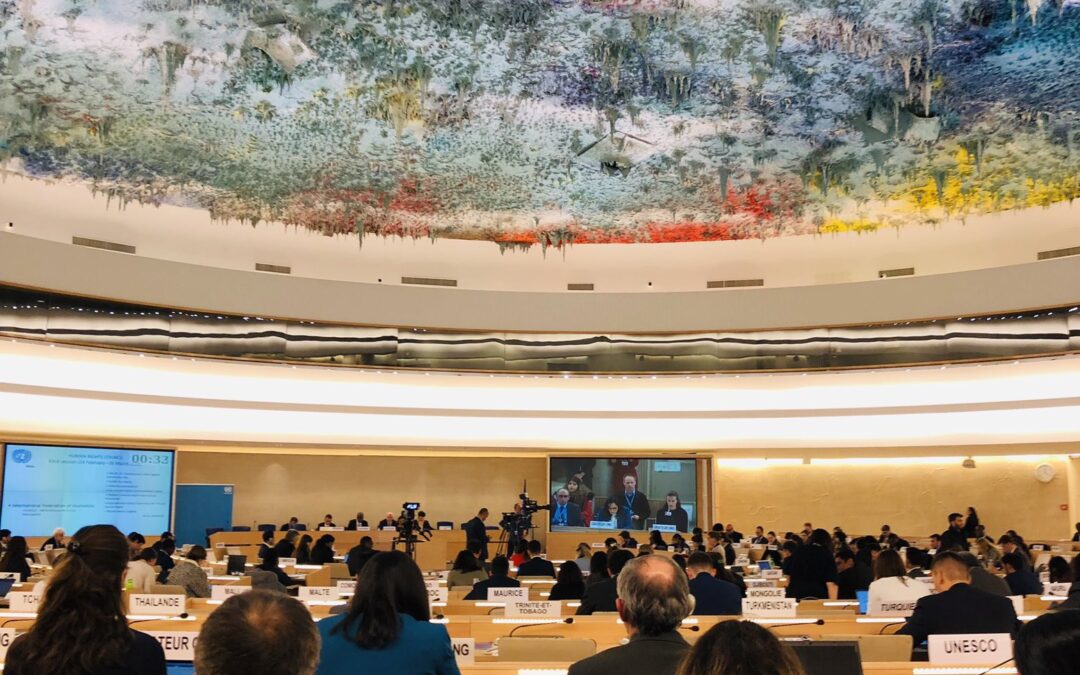
BBC Persian journalist and NUJ member Rana Rahimpour addressed the UNHRC in Geneva on 9 March (pictured above, courtesy Doughty Street Chambers). She told delegates she had received a message threatening that she, her children and her husband would be assassinated within a month. Threats were also addressed to her elderly parents based in the Islamic Republic of Iran, with a warning that they were “within reach”. The message also said that Ms. Rahimpour will be the first employee of the BBC to be killed, and, after her assassination, it will be the turn of other BBC employees.

Women journalists have been regular targets of the Iranian authorities since 2009. Attacks are carried out through the dissemination of false stories, rumours and slander, usually with highly misogynistic content. The threats received by women also tend to include references to sexual violence. As well as threats to BBC Persian staff and their families, similar intimidation has reportedly been extended to other international media organisations, journalists and their families.

Seamus Dooley, NUJ assistant general secretary, said: “The personal testimony of BBC Persian journalists is shocking to hear. Our members working at the BBC and other Persian media outlets have been facing very serious threats to their personal safety, their colleagues and their families, simply for doing their job. It is particularly shameful for the Iranian authorities to target journalists’ children and elderly relatives. The NUJ continues to build a global coalition in support of those affected and we will keep campaigning until the harassment stops.”

BBC Persian employees and their families in Iran have been harassed and intimidated as a direct result of their association with their work at the BBC since 2009. In 2017, Iran introduced a legal injunction preventing BBC Persian staff, former staff, and some contributors, from selling or buying property – in effect freezing all their assets. In July 2017, the Iranian government started criminal investigations into the activities of journalists and other staff working for BBC Persian, alleging their work constituted a crime against Iran’s national security. The injunction continues to deprive them of their human rights under principles enshrined in the Iranian Constitution and punishes their extended families.

The BBC has been engaging with various international institutions since 2017 as a result of the harassment. The legal and advocacy campaign has gained wide support and attention at the UN, European parliament and numerous nation states.

Caoilfhionn Gallagher QC and Jennifer Robinson, international counsel for the BBC World Service at Doughty Street, say: “Iran’s systematic targeting and harassment of BBC Persian staff and their families has long undermined freedom of expression, attacking journalists for their reporting on Iran and aiming to prevent Iranians receiving independent and impartial news on events in Iran and from around the world.

“These new threats against BBC Persian are deeply disturbing and must be condemned in the strongest terms. They strike at the most basic rights of the journalists and their families, including their rights to life and security. Too many journalists are killed each year because of their work. For this reason, states must take measures to prevent and protect against threats like those made against BBC Persian to ensure that journalists can do their jobs without fear.”

Final call for journalism fellowship applications: UN Ocean Conference 2020

Final call for journalism fellowship applications: UN Ocean Conference 2020

Final call for journalism fellowship applications: UN Ocean Conference 2020

As a part of the Ocean Media Initiative carried out by Internews’ Earth Journalism Network (EJN), there is a Fellowship programme for journalists interested in covering the upcoming United Nations Ocean Conference in Lisbon, Portugal, in June 2020.

The UN Ocean Conference 2020 is focused on supporting the implementation of Sustainable Development Goal 14 (SDG14), which is to “Conserve and sustainably use the oceans, seas and marine resources for sustainable development.” This year’s conference will be focused on how science and innovation can be used to scale up action on ocean conservation. This will be the second UN conference focused on SDG14, with the last event held in 2017.

Selected Fellows will be required to attend the entire length of the conference in Lisbon from 2-6 June. Fellows will also benefit from two days of orientation and special briefings prior to the conference.

EJN will cover non-refundable economy-class airfare, accommodation, meals and transportation costs of selected Fellows. We will also facilitate the press accreditation process and provide any other support relating to the trip. Please note that the process of obtaining any necessary visas is the Fellow’s individual responsibility. Visa costs can be reimbursed, however.

Specially designed activities, including orientation sessions, will explore the key issues to be addressed at the ocean conference. Selected Fellows will also have the opportunity to join a field trip related to the conference themes, attend daily breakfast briefings and interviews with high-level officials. They will also receive editorial support from senior journalists with experience in covering these types of events.

This Fellowship is made possible by funding provided by the Calouste Gulbenkian Foundation.

Requirements

Selected participants must be professional journalists or represent an established media house. Please note that applications are open to journalists from any country, but we expect to select:

  • 4 Fellows from a Portuguese-speaking country;
  • 1 Fellow to be from the UK;
  • The remaining Fellows to be from a country in the Global South;

Applicants must also:

  • Be available to arrive in Lisbon on May 30 so they can attend orientation and stay until June 7; 
  • Commit to participate in all Fellowship activities;
  • Produce published stories as a result of their participation in this Fellowship. While we don’t require a letter from your editor supporting your application, we will give preference to those who can show an indication that their work will appear in a media outlet.

More information online at https://earthjournalism.net/opportunities/un-ocean-conference-2020-fellowships where there is also an “apply here” link. Closing date is 7 March at 0900 GMT.

BBC makes unprecedented Human Rights Appeal to UN

BBC makes unprecedented Human Rights Appeal to UN

For the first time in its history, the BBC is making an appeal to the United Nations in Geneva to protect the human rights of BBC journalists and their families. This unprecedented move comes in response to years of persecution and harassment by the Iranian authorities, which escalated in 2017.  

Tony Hall, BBC Director General, said: “The BBC is taking the unprecedented step of appealing to the United Nations because our own attempts to persuade the Iranian authorities to end their harassment have been completely ignored. In fact, during the past nine years, the collective punishment of BBC Persian Service journalists and their families has worsened. This is not just about the BBC – we are not the only media organisation to have been harassed or forced to compromise when dealing with Iran. In truth, this story is much wider: it is a story about fundamental human rights. We are now asking the community of nations at the UN to support the BBC and uphold the right to freedom of expression.” 

Represented by Caoilfhionn Gallagher QC and Jennifer Robinson of Doughty Street Chambers, BBC World Service filed an urgent appeal to UN Special Rapporteurs David Kaye and Asma Jahangir on behalf of BBC Persian staff in October 2017. This week BBC journalists will, for the first time ever, address the Human Rights Council session to call upon member states to take action to protect BBC staff and to ensure their ability to report freely.

Working with the International Federation of Journalists (IFJ), the BBC has organised a series of events during the 37th session of the UN Human Rights Council in Geneva this week about BBC Persian. These activities include a press conference on Monday 12 March and a side event on Thursday 15 March. BBC representatives will address the Human Rights Council as IFJ spokespeople. 

Jeremy Dear, Deputy General Secretary of the International Federation of Journalists, said: “For many years Iranian journalists have suffered; been forced into hiding, fled into exile, been arrested, jailed and subjected to routine harassment, violence and intimidation. Iranians now increasingly turn to the international media to find out what is happening in their own country. Targeting family members in Iran in an attempt to silence journalists working in London must be stopped; the international community must act now.”  

BBC Persian Service journalists in London and their families in Iran have been systematically targeted since the BBC’s satellite television service was launched in 2009. In 2017 the harassment escalated when the Iranian authorities commenced a criminal investigation, alleging BBC Persian Service journalists’ work was a crime against Iran’s national security. This was accompanied by an asset-freezing injunction citing 152 named individuals, comprising mainly of current and former BBC Persian staff, and this injunction prevented journalists and their families from buying or selling their homes and other property in Iran. 

Other measures include the arbitrary arrest and detention of family members in Iran, the confiscation of passports and travel bans preventing people leaving Iran, ongoing surveillance of journalists and their families, and the spread of fake and defamatory news targeting individuals especially women journalists.  

On Monday 12 March in Geneva, the late UN Special Rapporteur for Human Rights in Iran, Asma Jahangir’s report will be tabled and discussed at the Human Rights Council. The report states: 

“In the course of her missions, the Special Rapporteur also met individuals working for the Persian Service of the British Broadcasting Corporation. They described how they and their families in the Islamic Republic of Iran had been harassed by the authorities, and threatened if they continued to work for the Service. Some were arbitrarily arrested, detained, and subjected to travel bans. In August 2017, a court in Tehran issued an injunction banning 152 members of staff, former employees, and contributors from carrying out financial transactions in the country on account of “conspiracy against national security”. Until the time of writing, the injunction has not been lifted and harassment has continued. The Special Rapporteur was disturbed after hearing the accounts of the staff members, observing that many preferred to talk individually and in strict privacy. It has been also reported that some staff members have been photographed while in London to impress upon their families that their relative was being watched. The level of fear that Iranians have whether inside the country or outside of it can be illustrated by the fact that the staff members have endured such intimidation for over twelve months. In October 2017, Special Procedure mandate holders issued a statement calling upon the Islamic Republic of Iran to cease all legal action against the staff and their families, and to cease the use of repressive legislation against independent journalism.”  

At the time of the asset-freezing injunction, the Association for International Broadcasting lodged a complaint with the Iranian Ambassador in London. The AIB received no acknowledgement or response to the complaint.

Voting has started

It seems as though we have been waiting a long time for voting to start in the People’s Choice category, “Best Coverage of Climate Change”. We launched the 2010 AIBs, international media excellence awards, on 12th April 2010 and were excited to announce our two new categories – one for “Best Children’s Factual Programme/Series” and the other the People’s Choice.

The People’s Choice is a radical departure for the AIB, since it will be the first time that an award has been judged by online viewers rather than a panel of distinguished broadcasters. We had lots of questions to consider before launching it: “Would broadcasters want to submit their work to be judged by online viewers?”, “Would we have enough entries?”, “Would we attract a big enough online audience?”. But we felt that with the increasing convergence of broadcast and online media it was important to reflect this with an award that involved the online community and the new ways that broadcasters need to engage with their audience and obtain direct feedback. We also felt that the chosen subject for 2010, climate change, attracts such wide interest and even controversy, that viewers will be drawn to watch the short list and make their own choice.

The first set of questions, about broadcasters’ involvement, has been satisfactorily answered with a high quality field of entries from which it was difficult to chose the short list. The resulting short list contains strong entries from major broadcasters such as the BBC, CNN and Sky, as well as important contributions from China (Phoenix Satellite TV) and the United Nations – not forgetting the Belgian entry from VRT.

Now we are excited that a small selected group are trying out our system in a “Premiere” viewing of the entries and that general voting will begin next Monday. We will be building up the campaign to involve the largest possible number of viewers from all over the world during the next month.

If you are not part of the Premiere viewing that is currently going on, why not instead have a look at some of the interesting entries that did not quite make the short list? Click here to view them.