UN raises ‘grave concern’ with Iran over harassment of BBC News Persian staff

UN raises ‘grave concern’ with Iran over harassment of BBC News Persian staff
UN raises ‘grave concern’ with Iran over harassment of BBC News Persian staff

The United Nations have raised concerns with Iran over the ongoing harassment of BBC News Persian staff, in a formal communication requesting Iran’s response and explanation. The UN communication comes after the BBC filed an urgent appeal to the UN in February 2022 against Iran’s ongoing harassment of BBC News Persian journalists. This includes online violence and gendered attacks faced by women journalists as well as increased financial pressure from an ongoing asset freeze, which operates as a blunt financial sanction against BBC News Persian journalists and their extended families.

The UN communication was sent to Iran on 28 May 2022 and has now been published along with Iran’s response.

The UN experts expressed their “grave concern over the continuation of reported harassment and intimidation of the BBC News Persian staff and their family members, which appears to be aimed at preventing them from continuing their journalistic activities with BBC News Persian.”

The communication was sent by four UN specialist experts who work on arbitrary detention, freedom of speech, violence against women and Iran. It set out the pattern of harassment that BBC journalists have suffered over the past decade, including “the systematic attacks, including harassment, asset freezing, serious threats, and defamation campaigns implemented by the authorities against BBC News Persian journalists”. The UN experts also raised concern about the surveillance of journalists and the harassment of their journalistic sources in Iran, the interrogation of family members of BBC journalists, and the pressure placed on BBC journalists ‘to leave their jobs’ – all of which may have a ‘chilling effect’ on journalism. 

According to the UN experts, these measures “show a pattern and practice of employing these measures by the authorities of the Islamic Republic of Iran to hinder journalists from carrying out their work”. 

The BBC filed a new UN complaint earlier this year which focused on online harms and threats directed at women journalists working at BBC News Persian. The UN experts said they were “particularly concerned at the gendered physical and psychological threats and attacks against women journalists of BBC News Persian including death and rape threats online”.

They further stated: “Given the importance of an online presence for the exercise of contemporary journalism, online violence undermines women journalists’ ability to fully participate in the profession.”

In Iran’s response to the UN experts, it seeks to justify its treatment of BBC journalists by falsely claiming their journalism is aimed at ‘the overthrow of the Islamic Republic’, complains of ‘hostile’ coverage which ‘tarnishes’ the regime, and falsely asserts that BBC reporting has ‘incited riots’.

The UN experts made a number of specific requests for information about the status of the asset freeze and an explanation of the justification and legal basis for it, as well as a request that Iran provide “information about the legal and factual basis for interrogating the families of journalists working abroad” and how it is compatible with Iran’s international human-rights obligations. They also requested specific measures that Iran is taking “to protect women journalists, including in the digital space and against online threats”. Iran’s response failed to answer these requests.

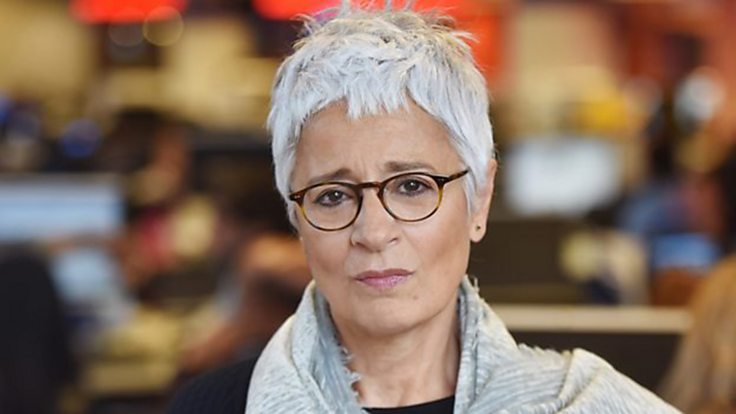
Liliane Landor, Director of BBC World Service (pictured) says: “We are grateful to the United Nations for raising our grave concerns about the treatment of our BBC News Persian journalists. We reject Iran’s attempt to justify its behaviour – the sanctions and harassment against our colleagues and their families must stop.”

Caoilfhionn Gallagher QC and Jennifer Robinson of Doughty Street Chambers, counsel for the BBC World Service, said: “Iran’s aggressive, defensive response to the UN experts provides a revealing insight into how it considers independent journalism: a threat to its power, which must be silenced. Iran’s words confirm the accuracy and urgency of the grave concerns raised by the UN. The international community must now hold Iran to account and take steps to ensure that our brave clients from BBC News Persian are no longer targeted and harassed simply for doing their jobs – simply for being journalists.”

Michelle Stanistreet, National Union of Journalists General Secretary, said: “The NUJ thanks the UN for taking up the cases of our journalists and their families at BBC News Persian, who have been subjected to a horrific policy of abuse from the Iranian authorities, with women being made the target of dirty tricks and false stories often of a sexual nature. Iran’s response has been deeply shocking. BBC News Persian journalists uphold the best of journalistic standards in their reporting of the situation in Iran. The UN must follow up on the refusal of the Iranian government to drop its freezing of assets and again seek assurances to guarantee it will stop the targeted attacks on journalists and their families.”

The UN experts also warned Iran that they intend to raise public concern about the treatment of BBC News Persian staff, stating “the wider public should be alerted” to Iran’s conduct towards journalists.

Since 2017, the BBC World Service has filed a number of UN complaints over the treatment of BBC News Persian staff and their families, represented by Caoilfhionn Gallagher QC and Jennifer Robinson at Doughty Street Chambers and supported by the National Union of Journalists (NUJ) and the International Federation of Journalists (IFJ).

Notes for Editors

  1. The UN communication was sent by four experts:
  • Mumba Malila, Vice-Chair of the Working Group on Arbitrary Detention;
  • Irene Khan, Special Rapporteur on the promotion and protection of the right to freedom of opinion and expression;
  • Javaid Rehman, Special Rapporteur on the situation of human rights in the Islamic Republic of Iran; and
  • Reem Alsalem, Special Rapporteur on violence against women, its causes and consequences.
  1. The UN communication to Iran is accessible here: https://spcommreports.ohchr.org/TMResultsBase/DownLoadPublicCommunicationFile?gId=27277
  2. The Islamic Republic of Iran government response is accessible here: https://spcommreports.ohchr.org/TMResultsBase/DownLoadFile?gId=37044
  3. UN procedures on communications to governments are available here: https://www.ohchr.org/en/special-procedures-human-rights-council/what-are-communications. After UN communications are made, the relevant government has 60 days to respond and only after this is the complaint made public.

[Source: BBC press release]

UN releases podcast with Julia Roberts

UN releases podcast with Julia Roberts

UN releases podcast with Julia Roberts

Project Everyone has released a podcast looking at the world in 2020 on behalf of the United Nations and the Sustainable Development Goals.

Hosted by Julia Roberts and created by the United Nations on its 75th Anniversary, Nations United tells the story of the world as it is, as it was, and as it could be.

It features unique contributions from education advocate Malala Yousafzai, UN Goodwill Ambassadors Don Cheadle and Michelle Yeoh, UNESCO Special Envoy for Peace, Forest Whitaker, actor and women’s rights activist Thandie Newton OBE, UN Secretary-General António Guterres and UN Deputy Secretary-General Amina Mohammed.

Alongside that there are exclusive performances from Burna Boy, and a UN performance from Beyoncé.

The podcast is available for use by broadcasters anywhere in the world, not only for digital platform release but for use in linear broadcasting, too.

http://podfollow.com/nations-united-urgent-solutions-for-urgent-times

UN launches Pause campaign to halt disinformation

UN launches Pause campaign to halt disinformation

UN launches Pause campaign to halt disinformation

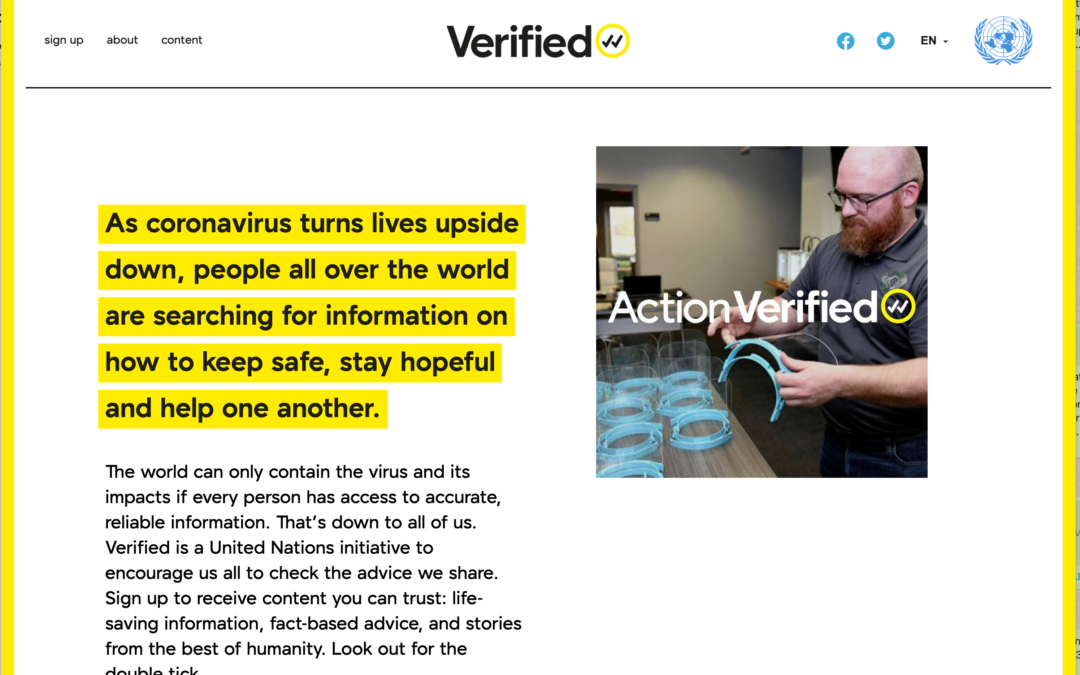
The United Nations has launched a new initiative to foster behaviour change and counter the growing threat of misinformation online. The campaign, called Pause, asks digital users to take the time to think about what they share before posting it online.

“Misinformation is spreading faster than the virus itself, and is seriously disrupting public health efforts by dangerously distorting sound scientific guidance. It is designed to exploit our emotions and biases at a time of heightened fear,” said UN Secretary-General António Guterres. “But there are ways users can learn to recognize bad information and slow the spread. We are aiming to have the phrase, ‘Pause, take care before you share,’ become a new public norm.”

A range of media companies around the world, including AIB Members Al Jazeera, Deutsche Welle and France Médias Monde, are distributing Pause content on TV channels, online and via SMS.

Major social media platforms, including Facebook, Twitter, Google (YouTube) and TikTok, have also committed to promoting Pause, while indicating a willingness to scale up their ongoing efforts to suppress the circulation of misinformation.
“It is encouraging to see steps already taken by social media platforms, such as swiftly removing misinformation surrounding COVID-19, flagging harmful content, questioning  sharing intentions and also promoting sound health advice, including from the World Health Organization (WHO),” said Melissa Fleming, UN Under-Secretary-General for Global Communications.

“Just as social distancing slows the spread of the virus, behaviour changes around sharing will go a long way to slow the spread of misinformation. But it can only be meaningfully halted if there is no place for misinformation on social media platforms.”

Pause draws on research from psychologists, neuroscientists and behavioural scientists whose studies indicate that pausing to reflect before sharing can significantly help reduce the spread of unverified and misleading information. The campaign will challenge people to break the habit of sharing shocking or emotive content impulsively and without questioning its accuracy.

The campaign, launched on World Social Media Day (30 June), is part of a larger UN initiative called Verified aimed at increasing the volume and reach of trusted, engaging and accurate information, including with the help of more than 10,000 information volunteers who have already signed on to the effort.

Following its launch in May, Verified has received strong support from governments. In mid-June, more than 130 UN Member States issued a statement on the need to address the “infodemic” related to COVID-19, while welcoming the UN’s pandemic response and the Verified initiative.

Verified is a collaboration between the UN Department of Global Communications and Purpose, one of the world’s leading social mobilisation organisations, in partnership with UN agencies and country teams as well as influencers, civil society and businesses.

UN plans Pause: Take Care Before You Share “spike” day

UN plans Pause: Take Care Before You Share “spike” day

UN plans Pause: Take Care Before You Share “spike” day

As part of the United Nations COVID-19 Communications Response Initiative, the Department of Global Communications is planning a spike day/moment for the VERIFIED campaign on 30 June.

The spike day will push one central message “Pause: Take Care Before You Share”. Research shows that a significant way to reduce misinformation is by creating a culture of pausing, even for a few seconds, to reflect on the content before one shares it.

The design of the Pause: Take Care Before You Share campaign is to permit as much ownership as possible by those participating. While there are central assets available, we want to encourage you to adopt the language of the campaign and bring your own creativity and style to the messaging.

Ideas for engagement:

1. Provide advertising space such as pre-rolls or banner adverts for UN content
2. Commission journalists to write about the challenge of misinformation
3. Share the message “Pause. Take care before you share.” in your own brand identity on owned media channels

For more information, please contact Robb Skinner at skinner@un.org.

The AIB is a Member of the UN SDG Media Compact.

UN SDG Media Compact reaches 100 members

UN SDG Media Compact reaches 100 members

UN SDG Media Compact reaches 100 members

Growing alliance of news and entertainment companies brings focus on socio-economic impact of COVID-19 crisis to its two-billion-strong audience

The SDG Media Compact, an alliance of news and entertainment companies convened by the United Nations to drive coverage and mobilise action for the Sustainable Development Goals (SDGs) and of which the Association for International Broadcasting is part, has welcomed its 100th member.

From large broadcasters and established print media, to news agencies, radio stations and newer digital publishers, the SDG Media Compact spans 160 countries on five continents, reaching a combined audience of about two billion people through well over one hundred outlets owned by Compact members. 

“Media play a crucial role in countering misinformation and galvanising action for a sustainable recovery from the COVID-19 crisis based on science, solidarity and our common roadmap, the Sustainable Development Goals,” said Melissa Fleming, UN Under-Secretary-General for Global Communications. “We are proud to have one hundred SDG Media Compact members from across the globe, committed to covering the critical issues of our time and driving progress toward a healthier and more peaceful world.”

The Sustainable Development Goals (SDGs), adopted by world leaders in 2015, are a universal call to action to end poverty, protect the planet and improve the lives and prospects of everyone by 2030. UN expert voices, data, reports and stories are regularly shared with SDG Media Compact members, inspiring coverage of the Goals without interfering in editorial freedom. As part of the UN’s new Verified initiative, Compact members will also be receiving trusted and accurate content about COVID-19 to counter misinformation and flood the internet and airwaves with content on science, solutions and solidarity.

For Sky Group, Europe’s leading media and entertainment company, being part of the SDG Media Compact means acting on the big global issues that matter. “We’ve aligned our strategy with the Sustainable Development Goals because they provide clear purpose to ensure business drives the change that is crucial to improving our world,” said Jeremy Darroch, Sky Group’s CEO. 

Shanghai Media Group, one of the newest members, joined the Compact to be part of a global alliance working toward common goals. “It is our sincere wish to work closely with global media organisations to jointly build a community of shared future for mankind,” said Chairwoman Jianjun Wang.

For ATTN:, a digital publisher based in the United States, “partnering with the United Nations and having the ability to tap into their expert voices and data helps us ensure that our storytelling is well-sourced and informational, giving human interest stories the power to have real impact,” said Charlie Goldensohn, Senior Strategist at ATTN:.

“In a digital world full of misinformation and fake news, credibility is vital, and that is what we have greatly gained through our partnership with the SDG Media Compact and the rich editorial content shared,” said Maikem Emmanuela Manzie on behalf of Ndefcam radio in Cameroon. “The free flow of information on current issues, especially on COVID-19, has helped in building our stories on how the community can better fight this new virus.” 

Many members have already played a crucial role in countering misinformation, disseminating science-based information to fight the virus, and covering the socio-economic impacts of COVID-19 in the context of the broader sustainable development agenda. 

SBS Australia examined how and why conspiracy theories related to the coronavirus are spreading so quickly. Sky News debunked the conspiracy theory linking 5G radio antennas to the coronavirus. Noticias Positivas reported on the issue of fake news related to the pandemic. ATTN: launched a digital literacy series focused on helping young people distinguish fact from fiction on COVID-related content. And the Asahi Shimbun explained why antagonising the World Health Organization won’t bring the world closer to containing the virus.

On the socio-economic front, Euronews, in an interview with the UN Secretary-General, called attention to the need for global solidarity for the world to emerge stronger from the crisis. CGTN published a number of pieces calling for debt relief for the poorest nations. The Nikkei reported on the need for mental health services as an essential part of the COVID-19 response. And Prensa Latina disseminated the Secretary-General’s call to protect the well-being of children.

On environmental matters, the Jakarta Post was among the outlets that amplified the UN Secretary-General’s call for a green recovery from the pandemic, SBS looked at how COVID-19 could be a chance to green our economies, In Depth News explained how ecosystems and human health intersect, and Scientific American reported on the crisis’ impact on CO2 emissions and implications for a green recovery. 

Looking at the gender dimensions, the Mainichi amplified the UN Secretary-General’s call to address the pandemic’s consequences for women and girls. Devex, in an interview with UN Women, highlighted the outsized impacts of the crisis on women’s work, health, and livelihoods. And Sky aired the UN Secretary-General’s message urging governments to prioritise the prevention and redress of violence against women in their COVID response plans.

About the SDG Media Compact

Launched by the UN Secretary-General with 31 founding members in September 2018, the SDG Media Compact seeks to inspire media and entertainment companies around the world to leverage their resources and creative talent to advance the Sustainable Development Goals. It currently includes 100 members from Africa, Asia, the Americas, Australia, Europe and the Middle East. By disseminating facts, human stories and solutions, the Compact is a powerful driver for advocacy, action and accountability on the Sustainable Development Goals.

More information, including the full list of members: www.un.org/sustainabledevelopment/sdg-media-compact-about