
RFE/RL suspends operations in Russia

RFE/RL suspends operations in Russia

RFE/RL suspends operations in Russia

Radio Free Europe/Radio Liberty (RFE/RL) has suspended its operations in Russia after local tax authorities initiated bankruptcy proceedings against RFE/RL’s Russian entity on March 4 and police intensified pressure on its journalists. These Kremlin attacks on RFE/RL’s ability to operate in Russia are the culmination of a years-long pressure campaign against RFE/RL, which has maintained a physical presence in Russia since 1991 when it established its Moscow bureau at the invitation of then-President Boris Yeltsin.

Also on March 4, Russian President Vladimir Putin signed a law that could subject any journalist who deviates from the Kremlin’s talking points on the Ukraine war to a 15-year prison sentence. Because RFE/RL journalists continue to tell the truth about Russia’s catastrophic invasion of its neighbour, the company plans to report about these developments from outside of Russia.

Said RFE/RL President & CEO Jamie Fly, “It is with the deepest regret that I announce the suspension of our physical operations in Moscow today. This is not a decision that RFE/RL has taken of its own accord, but one that has been forced upon us by the Putin regime’s assault on the truth. Following years of threats, intimidation and harassment of our journalists, the Kremlin, desperate to prevent Russian citizens from knowing the truth about its illegal war in Ukraine, is now branding honest journalists as traitors to the Russian state. We will continue to expand our reporting for Russian audiences and will use every platform possible to reach them at a time when they need our journalism more than ever. Despite this bleak moment, we know from our organisation’s 70-year history that one day, perhaps sooner than many think, we will be able to reopen a bureau in Russia. Time is on the side of liberty, even in Vladimir Putin’s Russia.”

Over the last week, nine of RFE/RL’s Russian language websites were blocked after RFE/RL refused to comply with the Russian government’s demands to delete information about Russia’s invasion of Ukraine. Overnight on March 3-4, Russian authorities blocked access within Russia to websites run by RFE/RL’s Russian, Tatar-Bashkir, and North Caucasus services, including the Russian-language North.Realities, Siberia.Realities, Idel.Realities, and Caucasus.Realities sites. On February 28, Russia blocked access to two other RFE/RL websites, including Current Time, the 24/7 digital and TV network led by RFE/RL in cooperation with VOA.

Since invading Ukraine, Russia has blocked a number of Russian-language websites producing news content from abroad, including Meduza, BBC, Deutsche Welle and Voice of America. The Kremlin has also blocked access to Facebook and Twitter.

The technical cause of the bankruptcy of RFE/RL’s Russian entity is its longstanding refusal to comply with Russia’s unlawful demand that every piece of RFE/RL’s Russian-language content—every video, every article, every tweet—be accompanied by a state-mandated warning that RFE/RL is a “foreign agent.” In the past year, Russia’s media regulator Roskomnadzor has issued 1,040 violations against RFE/RL that will result in fines of more than $13.4 million for its refusal to submit to this content-labeling regime. In addition, 18 RFE/RL journalists have been designated as individual “foreign agents.” On February 9, RFE/RL filed its final written submission with the European Court of Human Rights (ECtHR), asking for a hearing to consider the merits of the legal case it filed in May 2021 challenging Russia’s “foreign agent” laws.

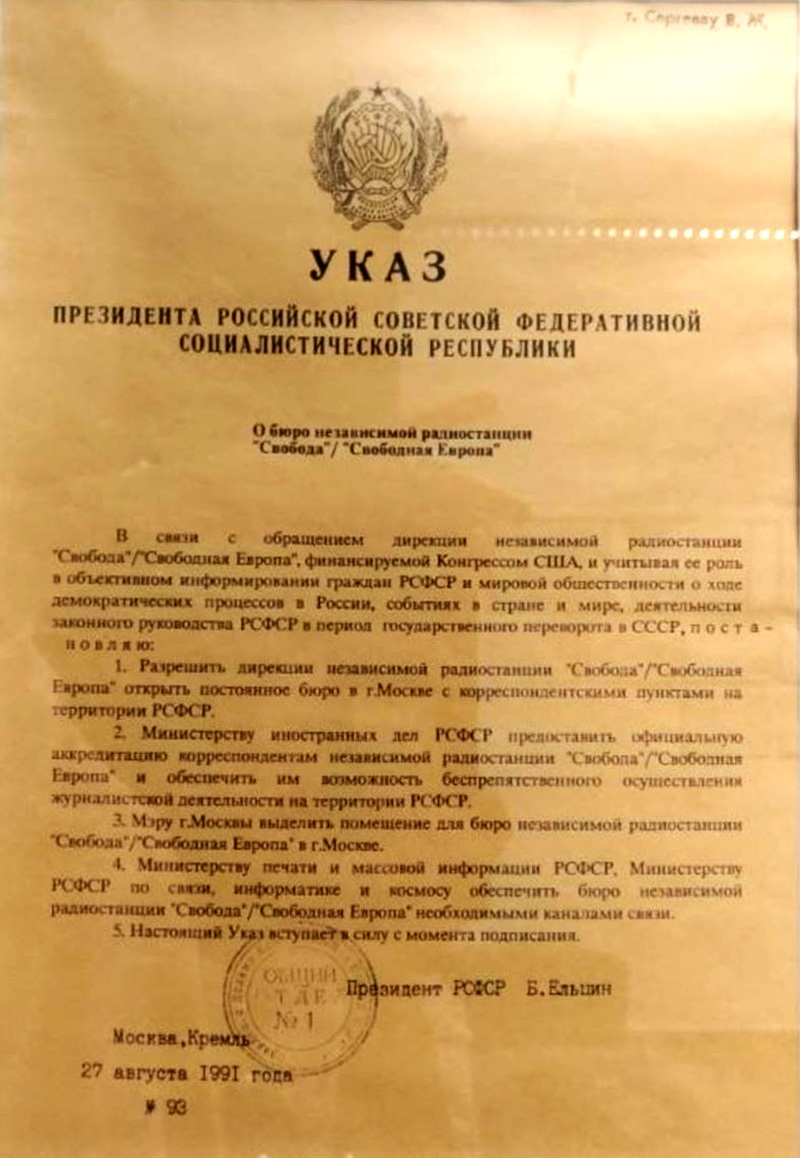
RFE/RL has been broadcasting to Russian audiences since March 1, 1953, when the first programs of “Radio Liberation” were directed at audiences in the Soviet Union. Between November 1988 and August 1991, as Soviet leader Mikhail Gorbachev’s “glasnost” policies took hold, the Russian Service built up a network of as many as 400 people across the U.S.S.R. and over 40 people in Moscow. On August 27, 1991, Russian Federation President Boris Yeltsin issued a decree giving RFE/RL accreditation and allowing it to open a bureau in Moscow; the decree was revoked by Russian President Vladimir Putin in 2002.

RFE/RL’s Russian Service is a multi-platform alternative to Russian state-controlled media, providing audiences in the Russian Federation with informed and accurate news, analysis, and opinion. The Russian Service’s websites, including its regional reporting units Siberia.Realities and Northern.Realities, earned a monthly average of 12.7 million visits and 20.6 million page views in 2021, while 297 million Russian Service videos were viewed on YouTube, Facebook, and Instagram.

RFE/RL’s Tatar-Bashkir Service is the only major international news provider reporting in the Tatar and Bashkir languages to audiences in the Russian Federation’s multiethnic, Muslim-majority Volga-Ural region. Since 1953, the Service, known locally as Radio Azatliq, and its Russian-language reporting unit Idel.Realities, have provided an important and innovative alternative to government-controlled media.

RFE/RL’s North Caucasus Service is one of the few independent media outlets reporting in this predominantly Muslim region of the Russian Federation. Producing content in Chechen and Russian via its Caucasus.Realities unit, the service reports the news in one of the most violent and dangerous regions in the world.

Current Time is a 24/7 Russian-language digital and TV network led by RFE/RL in cooperation with VOA. In addition to reporting uncensored news, it is the largest provider of independent, Russian-language films to its audiences. Despite rising pressure on Current Time from the Russian government, Current Time videos were viewed over 1.3 billion times on YouTube, Facebook, and Instagram/IGTV in FY2021.
 

USAGM condemns Kremlin’s increasing censorship and responds to surge in demand for reporting from its networks

USAGM condemns Kremlin’s increasing censorship and responds to surge in demand for reporting from its networks

USAGM condemns Kremlin’s increasing censorship and responds to surge in demand for reporting from its networks

Despite the Russian government’s attempted censorship of Voice of America (VOA) and Radio Free Europe/Radio Liberty (RFE/RL), there has been a surge in demand for their content, including their collaborative 24/7 Russian-language channel Current Time. In response, USAGM is expanding program delivery and access with the addition of more affiliate stations in and around Russia and the help of the Open Technology Fund’s tools and resources to circumvent internet censorship.

“It is clear that by restricting access to RFE/RL and VOA’s fact-based reporting, the Kremlin hopes to keep its own citizens in the dark and to hide the truth,” said Kelu Chao, USAGM’s Acting CEO. “The people of Russia deserve to know the facts about their government’s attacks on Ukraine and how the world is reacting. USAGM will continue to use its resources to bring unbiased information to light at this crucial time.”

RFE/RL President Jamie Fly said, “RFE/RL journalists in Russia have been unfairly slurred as ‘foreign agents,’ detained, and now their accurate reporting about an unpopular war is being blocked. RFE/RL remains committed to delivering objective reporting from inside of Russia for the Russian people despite these outrageous attempts to censor the truth.”

Acting VOA Director Yolanda López said, “The recent threat by the Russian media regulator Roskomnadzor to block VOA and other independent media outlets now is a reality for many in our audience there. Our viewers and listeners in Russia deserve access to our factual news content at this critical time, not only about the ongoing war in Ukraine, but also about all vital global events that impact their lives and actions. VOA will continue to promote and support tools and resources that will allow our audiences to bypass any blocking efforts imposed on our sites in Russia. Our journalists will continue their reporting, an example of free press in action.”

Some radio, digital, and direct-to-home satellite transmissions continue to reach Russian audiences, and demand for VOA and RFE/RL’s coverage is intensifying. For example, between February 24 and March 3, Current Time videos were viewed more than 240 million times across digital platforms. In addition, since Russia’s invasion, demand for Current Time content has increased dramatically among broadcast partners in Russia, Ukraine, Moldova, Latvia, Estonia, and Bulgaria. With the increase over last week, there are 261 affiliates now distributing Current Time content. Between February 26 and March 5, Current Time videos have been viewed on Facebook 76 million times, while VOA’s Russian Service and RFE/RL’s Russian Service videos were each viewed about 8 million times.

From February 23 to March 2, VOA’s Russian Service reported nearly 17 million video views on social platforms, a 159% increase from the week before, while website traffic soared 146%. From February 23 to March 1, audiences viewed RFE/RL videos 436 million times on Facebook, 305 million times on YouTube, and 83 million times on Instagram – reflecting increases of 265%, 406%, and 185%, respectively, over the previous week.

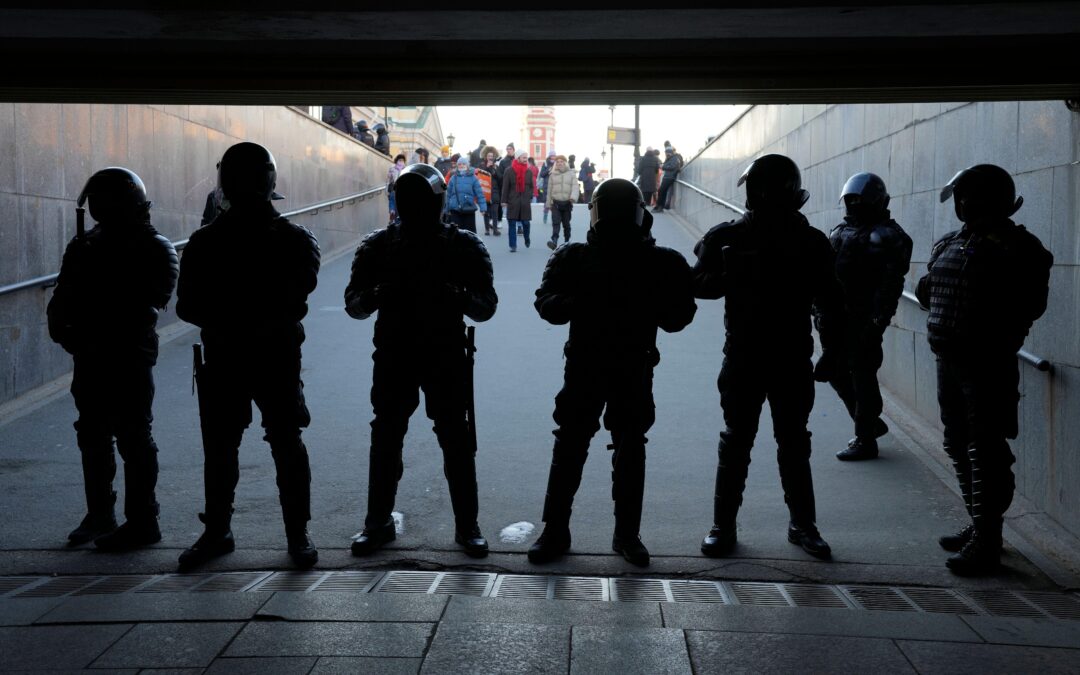
[Source: USAGM press release; Image: AP Photo/Dmitri Lovetsky/Associated Press/Alamy Stock Photo]

BBC temporarily suspends work of journalists in Russia

BBC temporarily suspends work of journalists in Russia

BBC temporarily suspends work of journalists in Russia

In an unprecedented move, the BBC has announced that it is temporarily suspending the work of its journalists in Russia. 

It follows the approval of a law in the lower chamber of the Russian parliament that allows the imposition of jail sentences up to 15 years for those convicted of spreading “fake” information.

Reacting to new legislation passed by the Russian authorities, BBC Director-General Tim Davie says:

“This legislation appears to criminalise the process of independent journalism. It leaves us no other option than to temporarily suspend the work of all BBC News journalists and their support staff within the Russian Federation while we assess the full implications of this unwelcome development.

“Our BBC News service in Russian will continue to operate from outside Russia.

“The safety of our staff is paramount and we are not prepared to expose them to the risk of criminal prosecution simply for doing their jobs. I’d like to pay tribute to all of them, for their bravery, determination and professionalism.

“We remain committed to making accurate, independent information available to audiences around the world, including the millions of Russians who use our news services. Our journalists in Ukraine and around the world will continue to report on the invasion of Ukraine.”

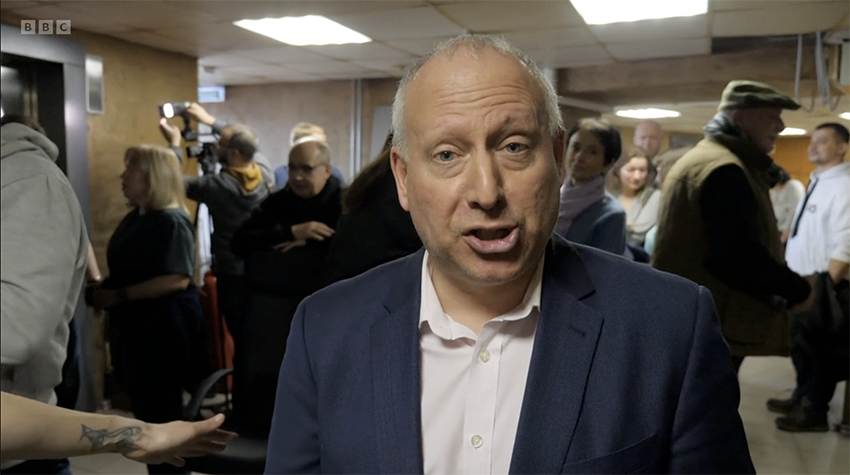
Picture: BBC Moscow correspondent Steve Rosenberg reporting on the closure of Ekho Moskvy radio

Russians and Ukrainians beat blockages to access RFE/RL

Russians and Ukrainians beat blockages to access RFE/RL

Russians and Ukrainians beat blockages to access RFE/RL

Radio Free Europe/Radio Liberty (RFE/RL) has condemned the blocking of access within Russia to websites run by its Russian, Tatar-Bashkir, and North Caucasus services, including the Russian-language North.Realities, Siberia.Realities, Idel.Realities, and Caucasus.Realities sites. Access to the sites was blocked after RFE/RL refused to comply with demands to delete information about Russia’s invasion of Ukraine from Russian state media-monitoring agency Roskomnadzor.

RFE/RL President Jamie Fly said: “Putin is feeding Russians a steady diet of lies about the scope and costs of the war in Ukraine. RFE/RL refuses to censor our content at this critical moment for our Russian audiences. They deserve the truth and we will continue to provide them with factual information about their government’s actions and the consequences that they must now endure.”

A number of other Russian-language websites producing news content from outside of Russia were also blocked today, including the Latvia-based meduza.io, BBC, Deutsche Welle and Voice of America (VOA). Access was blocked on February 28 to the websites of RFE/RL’s Crimea.Realities and the Current Time digital and TV network led by RFE/RL in cooperation with VOA.

Since Russia began its invasion, Russian and Ukrainian audiences have been flocking to RFE/RL and its several Russian-language content platforms. On the first day of the invasion (February 24), 527% more Ukrainians and 275% more Russians viewed RFE/RL videos via You Tube. Across all digital platforms, Current Time has earned more than 240 million video views since the invasion, reflecting a nearly tenfold increase over the network’s average pre-war number of weekly video views. Page views by audiences in Russia to RFE/RL websites have nearly doubled in the week since the invasion to just over 2 million, while views to RFE/RL videos on YouTube grew by nearly five times to almost 15 million.

During the period February 23-March 1, audiences viewed RFE/RL videos 436.4 million times on Facebook, 305.4 million times on YouTube, and 83.2 million times on Instagram – reflecting increases of 265 percent, 406 percent, and 185 percent, respectively, over the previous week.

This surge in audience numbers is indicative of a region-wide demand for reliable and factual information, which RFE/RL provides through its network of reporters offering perspectives from Ukrainians and Russians affected by the war.

RFE/RL is also working with the U.S. Agency for Global Media (USAGM) to further expand its reach by providing its content to media outlets around the world. RFE/RL and Current Time continue to field numerous requests for their content and program distribution from news outlets in Bulgaria, Canada, Estonia, Latvia, Lithuania, Moldova and Romania, among others.

Audiences around the world are following RFE/RL’s reporting on the physical and human toll of the war. As the Kremlin and state media have refrained from disclosing details of the casualties Russia has incurred in its invasion of Ukraine, RFE/RL spoke to mothers of Russian soldiers who were shocked to learn their sons were fighting in Ukraine, after being told they were on training exercises.

Since before the war began, RFE/RL has been preparing for the eventuality that the Kremlin would act on its threats. RFE/RL’s Russian, North Caucasus, and Tatar-Bashkir services and Idel.Realities, Caucasus.Realities, Crimea.Realities, North.Realities, Siberia.Realities, and Current Time websites have been educating their audiences about how to continue to access their reporting in the event that their websites are blocked. Mirror sites – complete copies of each website located at a different online address – have been set up for all of the blocked websites, and their content can also be accessed using virtual public network (VPN) clients such as nThlink. Each of the affected websites also has a robust presence on popular social media platforms such as Telegram, YouTube, Twitter, Facebook, Instagram, TikTok and VKontakte, and offer mobile applications via Google Play and Apple’s App Store, which include a built-in VPN.

Current Time is a 24/7 Russian-language digital and TV network led by RFE/RL in cooperation with VOA. In addition to reporting uncensored news, it is the largest provider of independent, Russian-language films to its audiences. Broadcasters interested in picking up Current Time programming should contact Adam Gartner of USAGM’s Eurasia Marketing Office at atgartne@usagm.gov.

About RFE/RL
RFE/RL relies on its networks of local reporters to provide accurate news and information to more than 37 million people every week in 27 languages and 23 countries where media freedom is restricted, or where a professional press has not fully developed. Its videos were viewed 7 billion times on Facebook, YouTube, and Instagram/IGTV in FY2021. RFE/RL is an editorially independent media company funded by a grant from the U.S. Congress through the U.S. Agency for Global Media.


Germany and Russia go head to head over broadcasters

Germany and Russia go head to head over broadcasters

Germany and Russia go head to head over broadcasters

Germany and Russia have traded blows over the two countries’ international broadcasters.

 
On Wednesday 2 February 2022, the German Commission on Licensing and Supervision (ZAK) decreed that RT must cease broadcasting German-language programmes saying it “does not have the necessary broadcasting licence”.
 
RT DE – the Berlin-based German-language division of RT (formerly Russia Today) acquired a licence from the Serbian media regulator on 17 December 2021. Both Germany and Serbia are signatories to the European Convention on Transfrontier Television. Licences granted by one ECTT member state provide the legal grounds for transmission and reception of a licensed service in another ECTT-ratified state. However, Germany says that since the programmes are produced in Germany and not Serbia, the licence does not provide the right for the channel to be received in the country. RT has said that it will challenge this in the German courts.
 
The following day, 3 February, the Ministry of Foreign Affairs of the Russian Federation issued a statement announcing that it is closing the operations of Germany’s international broadcaster DW in the country (headquarters in Bonn pictured).
 
The statement reads:
As part of the response measures announced on February 2 in response to the unfriendly actions of the Federal Republic of Germany to ban satellite and other broadcasting of the German-language television channel RT DE, the Russian side intends to implement the first stage of response measures:
– closure of the correspondent office of the German television and radio company Deutsche Welle in the Russian Federation;
– cancellation of accreditation of all employees of the Russian Bureau of Deutsche Welle;
– termination of satellite and other broadcasting of the Deutsche Welle television and radio company on the territory of the Russian Federation;
– initiation by the competent authorities of the Russian Federation of the procedure for considering the issue of recognising Deutsche Welle as a foreign mass media outlet acting as a foreign agent;
– launching the process of forming a list of representatives of state and public structures of Germany involved in restricting the broadcasting of RT DE and otherwise putting pressure on the Russian media operator, who will be banned from entering the territory of the Russian Federation. The list is not expected to be published.
Information on the next steps in the response will be published in a timely manner.”
 

DW has issued a press statement about the Russian move. It quotes DW Director-General Peter Limbourg as saying: “The measures by the authorities in Russia are completely incomprehensible and a total overreaction,

“We have been made into a kind of pawn, which the media must often endure in autocracies. We formally protest against this absurd reaction by the Russian government and we will take legal action against the announced measures. Until we are officially presented with the measures, we will continue reporting from our office in Moscow. Even if we ultimately do have to close it, our reporting about Russia will remain unchanged. In fact, we would increase our coverage.”

According to the press statement, Deutsche Welle has held a broadcast license in Russia since 2005 for its DW English and DW German TV channels. The current licenses issued by Russia’s media authorities are valid until 2025 for DW English and until 2027 for DW German.

DW English is broadcast in Russia via the ASTRA-5B satellite. DW German is broadcast using the ASTRA-4A satellite. In line with the binding conditions of the license, the DW German TV channel has a window for Russian-language programming in its schedule. This programming consists of DW magazines adapted into Russian (a total of 18 hours per week: 2 hours per day, Mon.-Fri. and 4 hours per day, Sat.-Sun.). Several cable TV distributors in Russia also run the Russian-language programming of DW German. They are Rostelecom, Tricolor, Beeline, ER-Telecom, MTS and NetByNet.


Picture: The Foreign Ministry in Moscow