6 March 2019
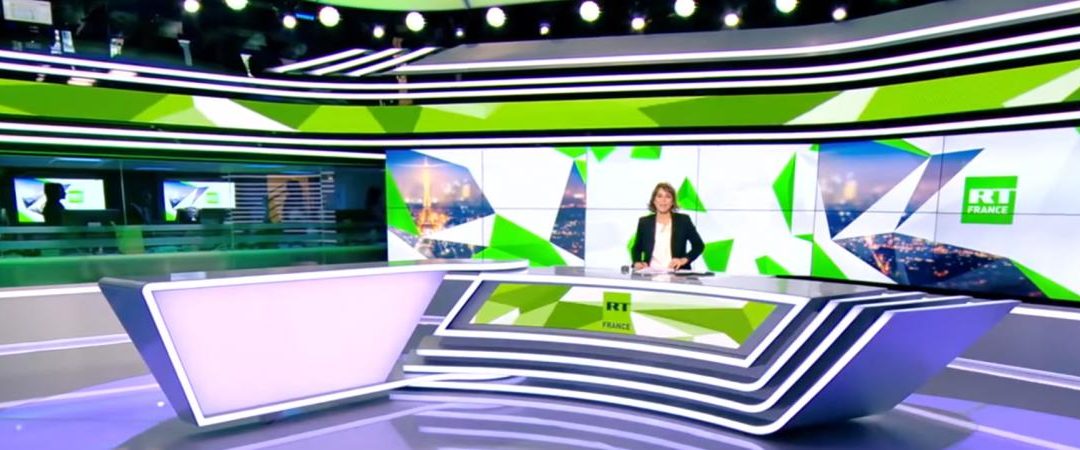
RT has expanded its distribution partnership with Yahlive, a joint venture between SES and Yahsat, an Emirati satellite operator based in Abu Dhabi. RT France, the French-language news channel of the RT group based in the Paris media district of Boulogne-Billancourt, completes Yahlive’s bouquet of television channels. RT France will be available in HD for more than 10 million households in Algeria, Tunisia and Morocco for the next three years.
 “We are happy to be featured on Yahlive and contribute to the diversity of their offering,” said Xenia Fedorova, President of RT France (pictured). “This expanded distribution positions us even more as the reference information channel that offers the region’s Francophone audience a wide range of stories and different perspectives on the news. Our audiences in Algeria, Morocco and Tunisia, in particular, have an appetite for the diversity of sources of information, and that’s what we want to bring them.”
A long-time partner of Yahlive, the RT group has also renewed in 2018 its partnership with the satellite transmission company to continue broadcasting RT International HD and RT Arabic HD originally signed in 2012.
Ammar Baranbo, Chief Operating Officer at Yahlive, commented: “We are excited to extend our long-term partnership and cooperation with RT and look forward to continuing to bring key regional and international stories to our audiences in the Middle East and North Africa. This partnership is a reflection of the technical excellence provided by Yahsat’s Al Yah1 satellite which allows us to deliver high-quality content based on our customers transmission needs, with the best possible signal quality.”

18 January 2019
Following a ruling by UK media regulator Ofcom about programming on the English-language international broadcaster RT, the Moscow-based channel is to seek a judicial review. A statement by the broadcaster said: “Ofcom investigated ten RT programmes, and decided that seven were in breach; we firmly believe that none were [sic] in breach. RT is left with no choice other than to seek judicial review of the matter.”
Ofcom published the findings of its investigations on 20 December 2018, covering programmes broadcast in the aftermath of the attack on Sergei Skripal and his daughter in early 2018. Ofcom’s report said:
This document sets out Ofcom’s Decisions in relation to the above ten programmes, which were broadcast on RT over a period of approximately seven weeks between 17 March 2018 and 4 May 2018, in the wake of the poisoning of Sergei Skripal and his daughter Yulia in Salisbury on 4 March 2018.
The licence for the RT service is held by Autonomous Non-profit Organisation TV-Novosti (“TV Novosti” or “the Licensee”). Ofcom was alerted to these programmes by a combination of complaints from viewers and Ofcom’s own monitoring.
Ofcom considered that the programmes raised issues warranting investigation under the due impartiality rules set out in Section Five of the Ofcom Broadcasting Code (“the Code”). As required under our published procedures, we wrote to the Licensee on 18 April 2018 and 14 May 2018, requesting its comments under the relevant rules of the Code.
TV Novosti provided its written representations on 6 and 20 June 2018. Ofcom prepared Preliminary Views in relation to each of the ten programmes, which we sent to the Licensee on 13 September 2018. The Licensee provided its written representations on 22 November 2018 and its oral representations on 5 December 2018.
In accordance with our published procedures, having watched all the programmes and taken careful account of all the relevant information, including the individual facts of each case and the various representations made by TV Novosti, Ofcom has decided that the following programmes are in breach of the Code for the reasons set out in full in each corresponding decision:
• Sputnik, RT, 17 March 2018, 19:30;
• Sputnik, RT, 7 April 2018, 19:30;
• Crosstalk, RT, 13 April 2018, 20:30;
• Crosstalk, RT, 16 April 2018, 20:30;
• Crosstalk, RT, 20 April 2018, 08:30;
• News, RT, 18 March 2018, 08:00; and
• News, RT, 26 April 2018, 08:00.
In addition, and for the reasons set out in full in each case, we have decided that the following three programmes are not in breach of the Code:
• Worlds Apart, RT, 1 April 2018, 23:30;
• News, RT, 30 March 2018, 18:00; and
• News, RT, 4 May 2018, 08:00.
At the Preliminary View stage, Ofcom considered that one (News, 30 March 2018) of the ten programmes was not in breach of Section Five of the Code. However, following careful consideration of the Licensee’s written and oral representations, we decided that a further two programmes (Worlds Apart, 1 April 2018 and News, 4 May 2018) were also not in breach of Section Five of the Code.
RT’s statement continues:
“Ofcom required that RT devote yet more of its time to presenting the same mainstream viewpoints of other broadcasters, instead of delivering the alternative perspectives our viewers have come to rely on. These alternative viewpoints are essential to a well-informed public debate.
“In doing so, the regulator breached a key right of broadcasters, and more importantly of audiences. We are now placing the matter in the hands of the courts.”

29 June 2018
The Association for International Broadcasting has expressed its disappointment at the decision of the Ukrainian authorities to deny entry into the country to RT journalist Paula Slier.
Slier, a veteran South African journalist, founded and runs her own international news agency, Newshound Media, and has been RT Middle East bureau chief since 2005. Slier flew to Kiev from Vienna to take part in an OSCE expert conference, “Strengthening media freedom and pluralism in Ukraine during times of conflict in and around the country”.
A spokesman for Ukraine’s State Border Service said that Slier was refused admission after a five-year ban on her entry to Ukraine, as a person who poses a threat to the country, was introduced in 2016.
The same day Ukraine Border Service personnel denied entry to Yevgeny Primakov, a journalist for Russia’s Rossiya 24 TV channel and aide to the head of the State Duma, Russia’s lower house of parliament.
“The AIB is disappointed that Paula Slier should have been refused permission to enter Ukraine to cover a media freedom conference,” said Simon Spanswick, AIB chief executive. “There is a certain irony that a correspondent who has worked across Europe, the Middle East and Afghanistan bringing stories to viewers around the world should have been denied entry to report on an important OSCE event. This Association asks the Ukrainian authorities to reconsider their decision.”
OSCE Representative on Freedom of the Media Harlem Désir, recalling the organisation’s April 2014 communiqué on the “denial of entry of journalists from one OSCE participating State to another” tweeted: “I regret that journalists working for Russian media – Evgeny Primakov & Paula Slier – were reportedly denied entry to Ukraine. I reiterate that all OSCE participating states should facilitate free travel for journalists across the region.”
1 March 2018
Members of the Association for International Broadcasting have elected a new Executive Committee for the two years from 1 March 2018. The AIB Executive Committee provides governance and oversight of the activities of the Association and helps to define the strategic direction of the not-for-profit organisation.
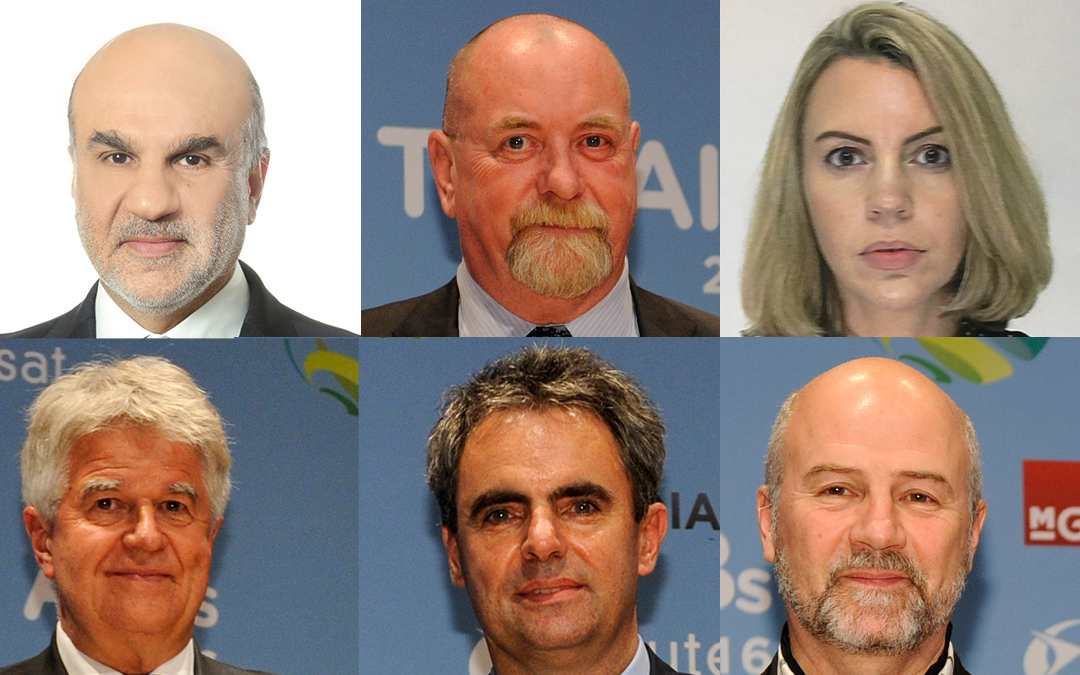
11 senior executives of AIB Member companies stood for election, of which six were existing Executive Committee members who offered themselves for re-election. After votes were counted from the 48% turnout of AIB Members eligible to vote, those elected to the Executive Committee are (pictured above from top left):
- Abdulla Al-Najjar, Al Jazeera Media Network
- John Maguire, FMM
- Anastasia Ellis, Bloomberg
- Klaus Bergmann, DW
- Simon Kendall, BBC World Service
- Alexey Nikolov, RT
“The field of candidates in this year’s election for the AIB’s Executive Committee was immensely strong,”says AIB chief executive Simon Spanswick. “I’m delighted that the Association for International Broadcasting’s Members have elected such a strong Executive Committee, and one that brings together a range of expertise and knowledge from major global broadcasters that will help steer the Association in the rapidly-changing media marketplace. My colleagues and I at the AIB Secretariat look forward to working closely with the Executive Committee as the Association continues to expand both its work and its membership.”
The AIB Executive Committee holds office for a two-year period. Members of this new Committee will hold office from 1 March 2018 until 29 February 2020.