BBC files urgent complaint to UN against Iranian harassment against BBC News Persian staff

BBC files urgent complaint to UN against Iranian harassment against BBC News Persian staff

BBC files urgent complaint to UN against Iranian harassment against BBC News Persian staff

Escalating security concerns see BBC file urgent complaint to UN against Iran’s ongoing harassment of BBC News Persian journalists and their families

The BBC has today filed an urgent complaint against Iran with the United Nations over ongoing harassment and sanctions against BBC News Persian journalists and their families in Iran. The urgent complaint is made amid escalating security concerns after a year in which Iran has conducted unlawful, extra-territorial operations against journalists and dissidents.

The urgent complaint comes as Liliane Landor, Senior Controller of BBC International News and Director of World Service, and Rozita Lotfi, Head of BBC News Persian, today address the Third Global Conference for Media Freedom being held in Tallinn, hosted by the Estonian Ministry of Foreign Affairs.

For more than a decade Iran has targeted BBC News Persian journalists and their families. Journalists have not been able to return to Iran for fear of arrest, while family members have been subjected to travel bans, interrogated and arbitrarily detained.

Based on interviews with staff members about incidents in the last year, including since the new Iranian President Ebrahim Raisi took office, the new UN complaint filed today reveals a concerning increase in harassment and security risk. The BBC has reported to the UN:

  • Increased security concerns for BBC News Persian journalists in the light of extra-territorial threats, including in the UK and in third countries;
  • Increased harassment of family members in Iran;
  • Increased financial pressure from the ongoing asset freeze, which operates as a blunt financial sanction against BBC News Persian journalists and their extended families;
  • Increased intelligence and counter-intelligence activity aimed at undermining the professional reputation of BBC News Persian and its journalists;
  • Increased and continued online attacks and online violence, particularly directed at women journalists;
  • The BBC has requested urgent action from UN experts, that the matter be communicated to Iran and that the protection of BBC News Persian journalists be raised at the UN Human Rights Council.

Liliane Landor, Senior Controller of BBC News International Services and Director of World Service said: “We appeal to the UN and the international community to continue to condemn Iran for their unacceptable treatment of our BBC News Persian colleagues. There have been escalating actions and threats, including an asset freeze which penalises the journalists and their families, online harassment, gendered attacks on women journalists and death threats. It must stop. The BBC will continue to speak up for its journalists who should be free to carry out their jobs without fear of threats or intimidation towards them or their families in Iran.”

Caoilfhionn Gallagher QC and Jennifer Robinson (Doughty Street Chambers), Counsel for BBC World Service, said: “We know from Iran’s past actions that it is willing to take cross-border and deadly action to silence its critics, and that it perceives independent journalism about Iran as a risk to their power. Our clients from BBC News Persian receive threats of death and violence simply for doing their jobs – simply for being journalists. We call on the United Nations experts and the Human Rights Council to take swift, robust action to hold Iran to account and ensure that BBC News Persian journalists can report without fear.”

The NUJ’s national broadcasting organiser, Paul Siegert, said: “It is a sad state of affairs that in 2022 these kind of attacks and abuse against individuals are still an ongoing problem. Journalists and their families are being threatened just because of the job they do. It has to stop. Our members will not be silenced and will not stop doing their jobs. We once again call on the Iranian government to put a halt to this unacceptable behaviour.”

US seizes Iranian, Middle Eastern broadcaster websites

US seizes Iranian, Middle Eastern broadcaster websites

US seizes Iranian, Middle Eastern broadcaster websites

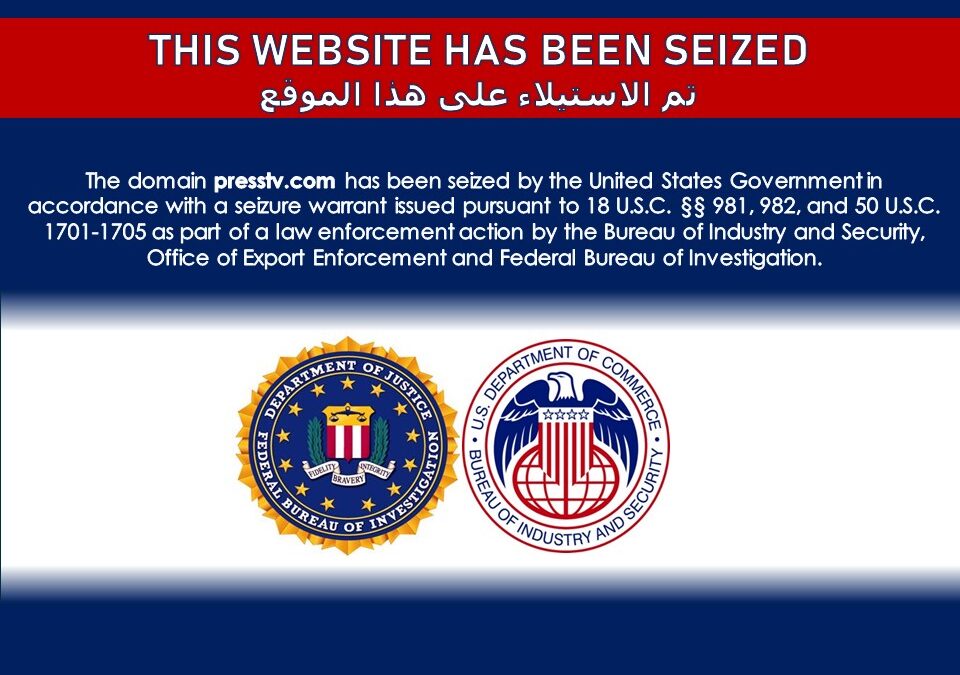
The US government has moved to seize the websites of Iranian and other Middle Eastern broadcasters and media companies that are hosted on domains owned by American companies. The US government says that the hosting is in violation of sanctions.
 
Each of the sites carries a large image (pictured) saying the it has been seized.
 
The sites include English-language Tehran-based channel Press TV, which within hours of the seizure migrated from presstv.com to an Iranian-hosted site presstv.ir.
 
The sites of Arabic language Al-Alam TV and Al-Kawthar run by Iran’s state broadcaster IRIB were also seized.
 
In addition, the websites of a number of Arabic-language TV channels broadcasting to Iraq have also been seized.
 
On 2 July, Press TV published a story attacking the US moves, claiming it is an “outrageous attack on foreign press”.
Iran continues to harass BBC News Persian staff; raised at UNHRC event

Iran continues to harass BBC News Persian staff; raised at UNHRC event

Iran continues to harass BBC News Persian staff; raised at UNHRC event

Iran’s escalating harassment of BBC News Persian journalists discussed at BBC and UN Human Rights Council virtual event

BBC World Service co-hosted a virtual “side-event” to coincide with the 47th session of the United Nations Human Rights Council (UNHRC) on 24 June. It was designed to raise concerns about the escalating cross-border harassment and threats from Iran towards BBC News Persian journalists and other Persian-language media. Alongside the BBC, the event was co-hosted by the International Federation of Journalists, National Union of Journalists and Doughty Street Chambers.

The virtual event was chaired by Deputy General Secretary at International Federation of Journalists, Jeremy Dear.

Speaking at the event, Ambassador Rita French, UK’s Deputy Permanent Representative to the United Nations in Geneva and International Ambassador for Human Rights, said: “It remains our desire to see Iran change tack, cease this abhorrent persecution against journalists and their families, and adhere to its international human-rights obligations. Until they do, the UK will continue to hold them to account, and seek to ensure media freedom is defended everywhere.”

Estonia will chair this year’s conference of the Media Freedom Coalition.  Ambassador Minna-Liina Lind, Estonian Ambassador at Large for Human Rights and Migration, said: “We really want to have some concrete deliverables from the conference hosted in Tallinn in December 2021.”  

Also on the panel was BBC News Persian journalist Kasra Naji who spoke about the campaign of vilification, threats and persecution endured by himself, his colleagues and their families, and BBC’s World Affairs Editor, John Simpson, who warned of the danger, that these policies that already have been in place for four years, will continue and intensify under Iran’s newly elected president Ebrahim Raisi, and called to protect and guard the BBC’s Persian service.

For many years, Iran has conducted a campaign of harassment and intimidation towards BBC News Persian journalists and their families in Iran. This has included death threats towards BBC journalists and their families in London, family members in Iran being brought in for interrogation and threats being made of cross-border operations to put BBC journalists in prison, online harassment and gendered attacks on women journalists, and a judiciary-imposed asset freeze on all assets of BBC News Persian staff in Iran. In some cases, family members were deprived of their liberty and held in degrading conditions, and ordered to tell their relatives to stop working for the BBC.

In response to this, the BBC initiated its first ever UN complaint in 2017 in relation to the protection of BBC journalists and has continued to engage with UN Special Mechanisms since. Concern has been raised about Iran’s treatment of BBC News Persian by the UN Secretary-General and successive UN Special Rapporteurs.

In March 2020, a group of UN experts made a joint statement condemning Iran’s harassment of BBC, raising concern of indications that:

… the Iranian authorities are prepared to use force extra-territorially, in violation of international law. Harassment, surveillance, death threats against journalists, within and outside domestic boundaries violate international human right law, including the right to physical integrity, the right to life and the right to freedom of expression.

The UN experts said that Iran’s acts towards BBC News Persian “violate international law regulating the use of force in times of peace” and “ultimately constitute serious threats to global security and thus demand strong reactions on the part of the Governments”.

In the past year, matters have escalated. Journalists and others perceived to be critics of the Iranian authorities have been abducted from other countries and returned to Iran, to be imprisoned and (in at least one case) to face the death penalty. Iran’s asset freeze has extended beyond BBC News Persian staff to some other international Persian-language outlets. Death threats have been made towards BBC News Persian staff in London, leading to police involvement and protection.

Tim Davie, BBC Director-General, said: “The treatment of the BBC News Persian journalists and their families by the Iranian authorities runs counter to the basic principles of human rights.  Our total support for our journalists doing their job is as strong as our determination to never succumb to these pressures and we demand that they stop.”

Caoilfhionn Gallagher QC and Jennifer Robinson, counsel for BBC World Service, said: “This week, the newly elected President of Iran has claimed he is a ‘defender of human rights’.  But the Iranian authorities’ cruel harassment and intimidation of BBC News Persian staff and their families violates the human rights of journalists and their families. Iran’s cross-border targeting of journalists is aimed at silencing voices Iranians are entitled to hear and also breaches the rights of the wider public. This is a sustained, pernicious attack on human rights by Iran. We urge UN experts to take action on this issue. The international community must condemn this in the strongest terms, and immediately take action to protect the integrity of journalists, their families and their profession.”

Simon Spanswick, chief executive of the Association for International Broadcasting, joined the event. During the session, he said:

I believe that it is essential that we harness not only diplomatic channels but also the media industry itself in calling out the Iranian authorities and their attempts to silence BBC Persian, Iran International and others. We need to encourage other media organisations to use the platforms they have – both on air, and at industry events – to ensure that the issue is kept at the forefront of people’s minds. At the AIB, we’re happy to use our events to tell this important story.”

BBC News Persian is a multimedia news and current-affairs service, with a weekly audience of around 18.3m (2020), delivering accurate and impartial news, information and analysis from a global perspective to Persian-speakers around the world. Available online via the websitebbc.com/persian, on TV and radio, BBC News Persian also connects with audiences on social media: Facebook, Instagram, Telegram and Twitter. BBC News Persian is part of BBC World Service.

Watch the latest video about the harassment of BBC Persian staff:

UN Special Rapporteurs condemn harassment of BBC Persian staff

UN Special Rapporteurs condemn harassment of BBC Persian staff

UN Special Rapporteurs condemn harassment of BBC Persian staff

Four UN Special Rapporteurs have issued an unprecedented joint statement condemning the harassment of BBC Persian staff and their families.

The statement issued on 11 March 2020 at the UNHRC in Geneva states:

“Journalists working for the BBC Persian Service and other Farsi-language news outlets outside Iran have faced threats, criminal investigations, unlawful surveillance, freezing of assets, defamation and harassment by Iranian authorities. Several journalists have also been targeted for going public about the harassment and seeking protection from the UN.

“Their families residing in Iran have faced harassment and intimidation by Iranian authorities. In some cases, family members were deprived of their liberty and held in degrading conditions, and ordered to tell their relatives to stop working for the BBC.

“Reports also indicate a pattern of gender-based harassment, targeting women journalists since 2009, and including the dissemination of false stories, spreading of rumours and slander, usually with highly misogynistic contents and threats of sexual violence.

“These allegations are extremely concerning and if confirmed, would indicate that the Iranian authorities are prepared to use force extra-territorially, in violation of international law. Harassment, surveillance, death threats against journalists, within and outside domestic boundaries violate international human rights law, including the right to physical integrity, the right to life and the right to freedom of expression.

“When these acts are conducted extra-territorially, as with BBC Persian Services, these acts violate international law regulating the use of force in times of peace. These ultimately constitute serious threats to global security and thus demand strong reactions on the part of the Governments of the countries where BBC Persian Service journalists reside.

“We reiterate our earlier calls to the Iranian Government to cease the intimidation, harassment and threats, including death threats, against BBC and other journalists working outside Iran for Farsi-language news outlets, as well as reprisals against their family members in Iran, which may constitute multiple violations of Iran’s international human rights obligations under international law.

“We call on the States to immediately take action in implementing safeguards to protect the integrity of journalists, their families and their profession.

“The human rights experts urged all States where these journalists are residing, such as the United Kingdom, to protect their personal integrity, and that of their families and their profession. Governments must uphold their responsibility to protect and duty to warn. Governments must respect and ensure the right to life and to reasonably foreseeable threats and situations that can result in loss of life.”

The four Special Rapporteurs are UN experts on extrajudicial, summary or arbitrary executions; the promotion and protection of the right to freedom of opinion and expression; human rights in Iran and human rights defenders. They are:

(1) Special Rapporteur on extrajudicial, summary or arbitrary executions – Agnès Callamard
(2) Special Rapporteur on the promotion and protection of the right to freedom of opinion and expression – David Kaye
(3) Special Rapporteur on the situation of human rights defenders – Michel Forst
(4) Special Rapporteur on the situation of human rights in the Islamic Republic of Iran – Javaid Rehman

In another significant development, BBC Director General Tony Hall issued an appeal to Mr Ali Bagheri Kani, the recently appointed deputy of International Affairs of the Judicial System of Iran and Secretary of the High Council for Human Rights.

In a video message, Tony Hall said: “We made an urgent appeal to the UN in 2017 about the collective punishment of BBC Persian journalists and their families by the Iranian authorities. Since then, we have gained wide support from the EU, the UN and many countries that defend free expression. We appreciate their backing. We hope that the appointment of Ali Bagheri Kani as the new head of High Council for Human Rights in Iran can open a new chapter in relations between the Iranian authorities and the BBC.

“Two years ago we offered to talk directly with the Iranian government in a constructive way to find a new way forward. Mr Bagheri Kani could go some way to address the concerns of the international community if he is willing to accept this offer in a positive spirit, without conditions. I very much hope he does.”

The joint statement by four Special Rapporteurs follows a recent escalation in harassment of BBC Persian staff and their families which has coincided with a crackdown on dissent within Iran and featured express threats being made by state officials to the safety of BBC Persian journalists outside Iran. The UN experts are concerned at reports of serious threats, including death threats, against journalists between January and February 2020.

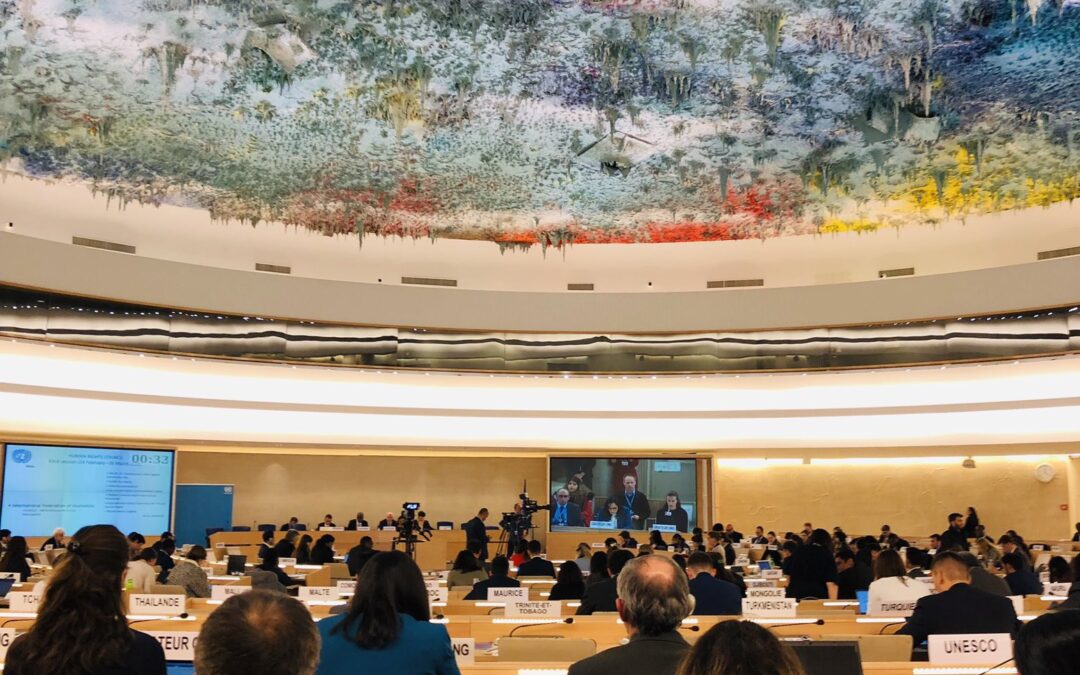
BBC Persian journalist and NUJ member Rana Rahimpour addressed the UNHRC in Geneva on 9 March (pictured above, courtesy Doughty Street Chambers). She told delegates she had received a message threatening that she, her children and her husband would be assassinated within a month. Threats were also addressed to her elderly parents based in the Islamic Republic of Iran, with a warning that they were “within reach”. The message also said that Ms. Rahimpour will be the first employee of the BBC to be killed, and, after her assassination, it will be the turn of other BBC employees.

Women journalists have been regular targets of the Iranian authorities since 2009. Attacks are carried out through the dissemination of false stories, rumours and slander, usually with highly misogynistic content. The threats received by women also tend to include references to sexual violence. As well as threats to BBC Persian staff and their families, similar intimidation has reportedly been extended to other international media organisations, journalists and their families.

Seamus Dooley, NUJ assistant general secretary, said: “The personal testimony of BBC Persian journalists is shocking to hear. Our members working at the BBC and other Persian media outlets have been facing very serious threats to their personal safety, their colleagues and their families, simply for doing their job. It is particularly shameful for the Iranian authorities to target journalists’ children and elderly relatives. The NUJ continues to build a global coalition in support of those affected and we will keep campaigning until the harassment stops.”

BBC Persian employees and their families in Iran have been harassed and intimidated as a direct result of their association with their work at the BBC since 2009. In 2017, Iran introduced a legal injunction preventing BBC Persian staff, former staff, and some contributors, from selling or buying property – in effect freezing all their assets. In July 2017, the Iranian government started criminal investigations into the activities of journalists and other staff working for BBC Persian, alleging their work constituted a crime against Iran’s national security. The injunction continues to deprive them of their human rights under principles enshrined in the Iranian Constitution and punishes their extended families.

The BBC has been engaging with various international institutions since 2017 as a result of the harassment. The legal and advocacy campaign has gained wide support and attention at the UN, European parliament and numerous nation states.

Caoilfhionn Gallagher QC and Jennifer Robinson, international counsel for the BBC World Service at Doughty Street, say: “Iran’s systematic targeting and harassment of BBC Persian staff and their families has long undermined freedom of expression, attacking journalists for their reporting on Iran and aiming to prevent Iranians receiving independent and impartial news on events in Iran and from around the world.

“These new threats against BBC Persian are deeply disturbing and must be condemned in the strongest terms. They strike at the most basic rights of the journalists and their families, including their rights to life and security. Too many journalists are killed each year because of their work. For this reason, states must take measures to prevent and protect against threats like those made against BBC Persian to ensure that journalists can do their jobs without fear.”


Media Freedom and the AIB – a topical example

Media Freedom and the AIB – a topical example

Media Freedom and the AIB – a topical example

One of the AIB’s primary tasks is to support journalists and journalism under threat. This means responding rapidly to issues as they arise, and then continuing to monitor and provide assistance over many months and, in some cases, years as geo-political issues that affect our members play out. We use our global voice and the collective strength of our members to support essential journalism as well as to fight for media freedom.

Iran is a case in point. We are supporting the BBC Persian Service whose staff have endured attacks by the Iranian authorities both inside Iran and abroad. We have now had to widen our support to Iran International who also came under concerted attack in 2019.

The past few weeks have seen increased tension in the country and the wider region following the US killing of Major General Qasem Soleiman, significant protests across Iran against the rise in fuel prices and the shooting down of Ukraine Airlines flight 752. There have been further protests over the killing of Iran’s own citizens by its security services. The Iranian leadership has been unpopular for some time with a sizable part of the Iranian people and has committed atrocities against its own people, such as the indiscriminate shooting of protesters. It has found itself the target of the US President. The authorities in Tehran are struggling to cope with what has been described by some commentators as an existential threat to the country’s current regime.

The response of the authorities has included the intimidation of the country’s domestic media – as totalitarian regimes tend to do in time of crisis – along with attempts to influence the narrative of the media reporting on and to Iran from abroad.

This situation means the AIB needs to shine a spotlight on how our members and journalists on the ground are being affected.

These attacks are not new. In November, at the height of the fuel price protests, the Iranian authorities targeted UK-based Iran International in a repeat of tactics they are using against BBC Persian. Staff at Iran International were hit with asset freezes that affect not only them but their families too. At the same time, the Iran International satellite signal was jammed by Iran as it attempted to silence news and information being broadcast into the country. The AIB responded to these attacks on Iran International and its staff, as it has done with the attacks on BBC Persian and its staff.

At the time of the protests, the Iranian Ministry of Intelligence issued a statement announcing that it considers any cooperation with the “hostile” UK-based Iran International TV as “an act of terror”. The statement added that all the “rioters who acted under Iran International’s command” had been arrested.

In December, an individual was detained in Iran’s Khuzestan province for allegedly sending information to Iran International. The channel, along with other Western broadcasters’ Persian-language services, is not permitted to have its own reporters in the country and relies heavily on reports from citizen journalists in Iran. BBC Monitoring reported that the Mehr news agency said that the unnamed individual was arrested at midnight on 25 December.

The oil-rich province of Khuzestan, which has a large population of ethnic Arabs, experienced some of the worst violence during the unrest. Dozens were killed in the city of Mahshahr as the Counter-terrorism Special Force (NOPO) rounded up the protesters and shot them.

Amnesty International puts the death toll during the November protests in Iran at 304 quoting “reliable sources”, adding that thousands more, including a large number of teenagers, were detained and tortured by security forces. Meanwhile, Reuters estimated the death toll at around 1,500, citing three anonymous officials at the Interior Ministry. Iran dismissed these figures as “not credible” while refusing to produce its own at the direction of the Supreme National Security Council.

Iranian state TV acknowledged the deaths of a number of protesters in Mahshahr, but described them as “armed members of separatist groups”.

The pressure on foreign media increased on 9 January when Hesamodin Ashna, an advisor to President Rouhani, tweeted “The Persian-language media outlets are hereby warned to refrain from engaging in the psychological war related to the Ukrainian aircraft and cooperating with anti-Iranian rebels.

This was a clear threat aimed at journalists outside Iran, and it provided evidence of the Iranian government’s continued campaign against international media outlets. According to Iran Wire, Iranians responded angrily to Ashena’s Tweet, with a satirist’s joke widely shared on Twitter: “Send your plainclothes agents to Twitter to wrap up the protests in two days!”

It was two days after Ashna’s Tweet that the Iranian authorities admitted what Western leaders had said was likely – that it was an Iranian missile that brought down Ukraine Airways 752 shortly after take-off from Tehran airport.

The Iranian authorities now had a dilemma: how best to deal with this uncomfortable situation without compromising on their hardline approach to foreign media and the international community.

Iran’s international English-language TV channel, Press TV, in a report on 13 January headlined: Iran administration denies spreading misinformtion [sic] on plane crash, saying: “The discrepancy between the initial accounts and the subsequent investigations gave rise to a wave of public anger, with some accusing government officials of seeking to cover up the truth.

Speaking at a press conference in Tehran on 13 January, Ali Rabiei, the administration’s spokesman, said, “As a matter of fact, we did not lie. Lying means conscious and deliberate falsification of the truth. Such a thing never took place.””

Admission by Press TV of the “public anger” against the government is unusual. Its coverage of the November protests against the increase in fuel prices placed the blame for much of the unrest firmly at the door of “completely trained” personnel – in other words, people who had been put in place by foreign governments.

There was a further development on 12 January when presenters on Iranian state run IRIB resigned. The Guardian newspaper reported: “At least two presenters working for the Iranian state broadcaster IRIB have announced they have quit their jobs, with a third saying she quit some time ago after having told lies on behalf of the state for 13 years.

“Gelare Jabbari apologised in an Instagram post, writing: “It was very hard for me to believe that our people have been killed. Forgive me that I got to know this late. And forgive me for the 13 years I told you lies.”.

So, what does the confusion at the heart of the Iranian regime mean for Persian-language international media? Attacking foreign media is likely to continue unabated, since pushing the blame for the various crises in Iran helps to deflect blame from the current government. The big question is: will the Iranian people accept the continued misinformation and disinformation that flows from the country’s domestic, state-controlled media, or will they start to seek ever more news and information from international sources? Unrest may grow and protests against the regime may increase in number and frequency. This will, in all likelihood, result in increased pressure on the international foreign media as the Iranian Government tries to maintain power.

For the Iran, the pressure that is being applied by major international broadcasters and other organisations through the United Nations may produce greater results in this changed climate resulting from the shooting down of flight 752. This in itself is good for the staff of Persian-language broadcasters who will see increased international support. Whether this results in a reduction in the targeted attacks on them and their families remains to be seen.

While our members and journalism in general are under attack, the Association for International Broadcasting will continue to work on behalf of those who face the immense challenges in reporting about, and broadcasting to, Iran’s 81 million population. We hope that in the near future we will see positive changes occurring that allow Iran’s citizens to understand the world and their own government more easily and in greater depth.

They deserve media freedom.

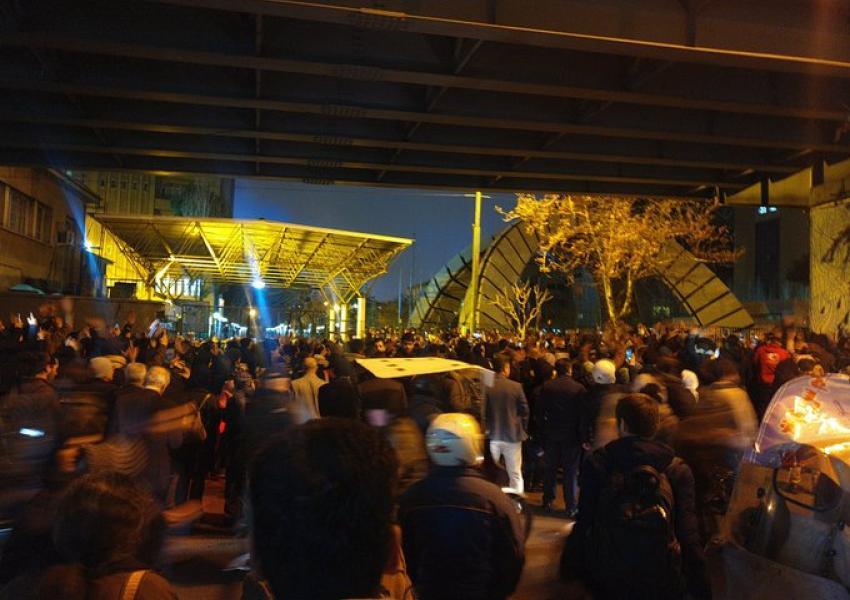
Image: UGC/social media via Radio Farda