BBC launches emergency lifeline radio programme for Iran

BBC launches emergency lifeline radio programme for Iran
BBC launches emergency lifeline radio programme for Iran

BBC World Service has launched a temporary emergency lifeline radio programme for Iran in response to the ongoing turmoil in the country, and the unprecedented crackdown on protests.

To complement the existing BBC News Persian video and digital services, the radio programme will be available on medium wave and shortwave across Iran to increase the population’s access to news and information. To broaden its offer and availability of programming, the BBC World Service has also made some of its TV content available on medium wave radio.

Since 8 January, the Iranian people have been subject to an internet blackout. Prior to this, BBC News Persian’s digital services saw their biggest reach in a year with their platforms reaching more than 33 million people.

The short-term programme will cover the latest news and developments in Iran and will place events inside the country within their wider regional and international context. It will feature voices from inside Iran alongside clear, informed analysis of the most recent political, social, and economic developments shaping the situation in the country.

The programme will air daily for 30 minutes across medium and shortwave frequencies from 4.30pm GMT / 8pm Iran Standard Time. The temporary programme has been granted resource from existing funds until the end of March 2026.

Fiona Crack, Interim Global Director, BBC News, says: “A key role of the BBC World Service is to step up in times of crisis to provide news and information for our audiences in greatest need. BBC News Persian reaches one in four adults in Iran, which is an astonishing feat considering their reporting is banned in the country.

“The team have been essential in telling the urgent story of the Iranian people to audiences around the world, and our new radio programme will give the Iranian people more ways to access independent and impartial news.”

Tarik Kafala, Interim Regional Director, Middle East and North Africa, says: “BBC News Persian have worked tirelessly to deliver journalism throughout this period of unrest as the demand for trusted news has soared in Iran. The teams have supplied extended TV hours in Iran and an increased offer on digital platforms for the Iranian people. They have reported for UK audiences across bulletins, live pages and on forensic journalism with BBC Verify.”

BBC World Service has a history of launching emergency services in times of crisis. In April 2025, BBC News Burmese started providing audio and video content on a satellite channel in the aftermath of Myanmar earthquake.

In December 2024, following the fall of the Assad regime, BBC World Service set up an enhanced audio channel on FM and medium wave for the people of Syria. This follows the emergency radio service for Gaza in November 2023 and for Sudan in May 2023 amid conflict.

In February 2022, the BBC News Ukraine service extended TV bulletins following the invasion of the country.

Where to find the programme:

  • The live programme will be available at 4.30pm GMT (8pm Iran Time) on 702kHz medium wave and 9465kHz short wave
  • The programme will be repeated at 6pm GMT (9.30pm Iran time) on 702kHz mediumwave and 5935kHz shortwave
  • A visualised version of the programme will be broadcast on BBC Persian TV at 6pm GMT (9.30pm Iran time)
NHK WORLD-JAPAN Radio begins shortwave for Iran

NHK WORLD-JAPAN Radio begins shortwave for Iran

NHK WORLD-JAPAN Radio begins shortwave for Iran

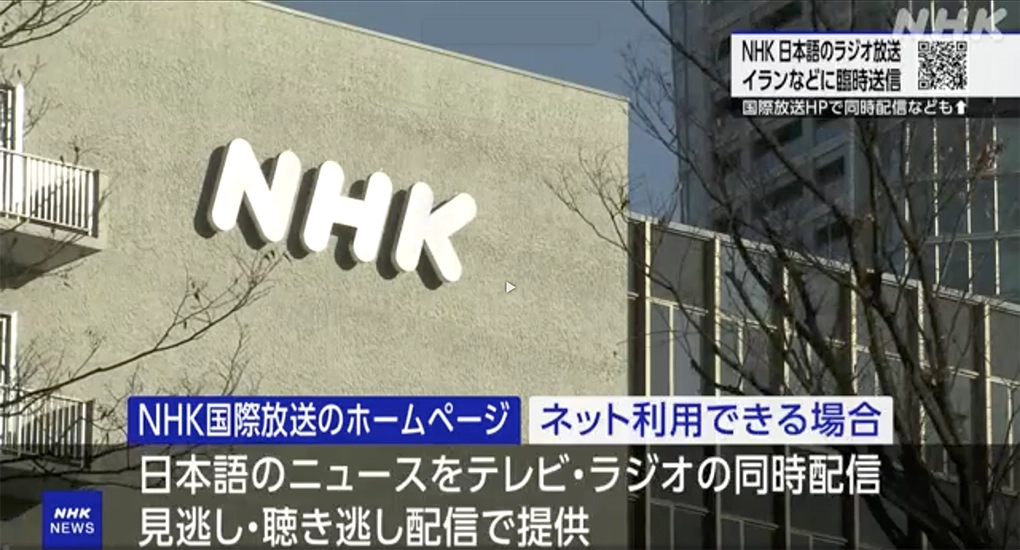
In light of recent developments in the situation in Iran, NHK has begun temporary shortwave transmissions of its Japanese language international radio service, NHK WORLD-JAPAN Radio. NHK’s mission as an international public service media has led to this initiative to provide essential information to Japanese nationals residing in or travelling in the region.

Following the attacks on Iran by the United States and Israel, Internet connectivity and international telephone services in the region have become unstable resulting in limited access to information in Japanese. In response NHK has begun temporary shortwave transmissions of its Japanese language international radio service to provide essential information to Japanese nationals in the area the broadcast started at 11:30 AM Japan time (0230 GMT) on 1 March.

NHK normally broadcast six hours of shortwave programming every day to the Middle East. However, in view of the current situation the broadcast schedule has been expanded to provide a continuous 24-hour service. In addition to content from NHK Radio 1, the broadcasts will include safety and security information for those in the region.

For those in neighbouring countries or other areas where Internet access remains available NHK also provides Japanese language news on the NHK world Japan website, along with simultaneous and on demand streaming of its television and radio programmes.

The transmission schedule is:

Transmissions from the Yamata Transmitting Station (Japan)

The transmission schedule is:

Transmissions from the Yamata Transmitting Station (Japan)

Time (JST) Frequency

01:00–02:00

11915 kHz

02:00–04:00

11670 kHz

04:00–06:00

9665 kHz

06:00–08:00

11675 kHz

08:00–10:00

11660 kHz

10:00–14:00

17560 kHz

14:00–18:00

9700 kHz

18:00–22:00

9740 kHz

22:00–23:00

11685 kHz

23:00–01:00

9450 kHz


Transmissions from the France Relay Station (Issoudun)

Time (JST) Frequency

02:00–04:00

11800 kHz

12:00–14:00

6150 kHz

Japan Standard Time is nine hours ahead of GMT/UTC.

BBC launches emergency lifeline radio programme for Iran

BBC launches emergency lifeline radio programme for Iran

BBC launches emergency lifeline radio programme for Iran

BBC World Service has launched a temporary emergency lifeline radio programme for Iran in response to the ongoing turmoil in the country, and the unprecedented crackdown on protests.  

To complement the existing BBC News Persian video and digital services, the radio programme will be available on mediumwave and shortwave across Iran to increase the population’s access to news and information. To broaden its offer and availability of programming, the BBC World Service has also made some of its TV content available on mediumwave radio. 

Since 8 January, the Iranian people have been subject to an internet blackout. Prior to this, BBC News Persian’s digital services saw their biggest reach in a year with their platforms reaching more than 33 million people. 

The short-term programme will cover the latest news and developments in Iran and will place events inside the country within their wider regional and international context. It will feature voices from inside Iran alongside clear, informed analysis of the most recent political, social, and economic developments shaping the situation in the country.

The programme will air daily for 30 minutes across medium and shortwave frequencies from 16:30 GMT / 20:00 Iran Standard Time. The temporary programme has been granted resource from existing funds until the end of March 2026. 

Fiona Crack, Interim Global Director, BBC News, says: “A key role of the BBC World Service is to step up in times of crisis to provide news and information for our audiences in greatest need. BBC News Persian reaches one in four adults in Iran, which is an astonishing feat considering their reporting is banned in the country. 

“The team have been essential in telling the urgent story of the Iranian people to audiences around the world, and our new radio programme will give the Iranian people more ways to access independent and impartial news.”

Tarik Kafala, Interim Regional Director, Middle East and North Africa, says: “BBC News Persian have worked tirelessly to deliver journalism throughout this period of unrest as the demand for trusted news has soared in Iran. The teams have supplied extended TV hours in Iran and an increased offer on digital platforms for the Iranian people. They have reported for UK audiences across bulletins, live pages and on forensic journalism with BBC Verify.” 

The BBC World Service has a history of launching emergency services in times of crisis. In April 2025, BBC News Burmese started providing audio and video content on a satellite channel in the aftermath of Myanmar earthquake. 

In April 2024, following the fall of the Assad regime, the BBC World Service set up an enhanced audio channel on FM and mediumwave for the people of Syria. This follows the emergency radio service for Gaza in November 2024 and for Sudan in May 2023 amid conflict.  

 In February 2022, the BBC News Ukraine service extended TV bulletins following the invasion of the country.

Where to find the programme – 

The live programme will be available at 16:30 GMT (20:00 Iran Time) on 702kHz medium wave and 9465kHz short wave

The programme will be repeated at 18:00 GMT (21:30 Iran time) on 702kHz mediumwave and 5395kHz shortwave

A visualised version of the programme will be broadcast on BBC Persian TV at 18:00 GMT (21:30 Iran time)


BBC asks UN to condemn Iran allegations

BBC asks UN to condemn Iran allegations

BBC asks UN to condemn Iran allegations

In a formal filing to the United Nations over the targeting of BBC News Persian staff and their families, the BBC World Service has expressed deep concern over Iran’s new and extreme language used in relation to BBC News Persian. It has urged the UN experts to condemn Iran’s conduct towards the BBC and Iran’s attempts to frame independent journalism as a form of “terrorism” and “warfare”.

In September 2025, Iran responded to the UN urgent appeal filed in June by the BBC World Service where the BBC raised concern with the escalation of harassment, targeting and threats towards the BBC News Persian staff – and their families in Iran – in the wake of the service’s reporting on the Iran-Israel conflict. The BBC also had urged the UN to take action after the publication of the report by the Intelligence and Security Committee of the UK Parliament in July this year about Iran’s transnational repression. The “Iran” report confirmed that in the previous 12-18 months there was an escalation of physical threats and consistent targeting of the UK-based Persian-language media organisations, whom Iran perceives as “deeply undermining of the Iranian regime”; that BBC News Persian was a “prominent target” of transnational repression from Iran; and that there was a “high risk of physical attacks” in the UK.

In its response to the UN, Iran justified its ongoing, unlawful actions towards BBC journalists. Using extreme language regarding the BBC for the first time in an official filing with the UN, Iran accused BBC News Persian in “media warfare”, “trying to target the security of the country by influencing the beliefs, culture, politics and behaviour of society”. Making unfounded allegations against BBC News Persian and its reporting, Iran called on the UN rapporteurs to “evaluate” the work of Western media such as the BBC as “media terrorism”. Iran’s response also marks the first time its government has officially acknowledged that legal action has been taken against BBC News Persian staff in Iran. Before this admission, attempts to obtain information on this from the judiciary in Iran have failed.

Tarik Kafala, Middle East and North Africa Regional Director, BBC World Service, said: “The extreme, highly alarming language the Islamic Republic of Iran has used in an official government filings with the UN demonstrates the Iranian authorities’ attitude towards independent journalism and our reporting of the country. We are deeply concerned that, instead of putting an end to the harassment and threats to our staff and their families in Iran, with this language Iran signals new forms of targeting them, now justifying their persecution with counter-terrorism and national security laws. We condemn these actions.”

Laura Davison, NUJ general secretary, added: “The UN must condemn the escalating intimidation and persecution of media workers by the Iranian state. Journalists at BBC Persian are paying a huge personal price simply for doing their job. It takes enormous courage and the deepest sense of duty for a journalist to continue pursuing the truth in the face of relentless state repression. The NUJ stands in solidarity with journalists under threat and demands an end to the Iranian state’s campaign against press freedom and journalists’ rights.”

Counsel for the BBC World Service has today filed with the UN a submission, expressing alarm over the extreme language used by the Islamic Republic of Iran in relation to the BBC’s reporting and over Iran’s attempt to justify the ongoing unlawful actions towards BBC staff and their families. The submission urges the UN experts to condemn Iran’s conduct towards the BBC and Iran’s attempts to frame independent journalism as a form of terrorism and warfare. The BBC calls on the UN experts to request further information from Iran about the legal action against the BBC. It urges them to directly raise concern with Iran about efforts to characterise BBC journalism as “media terrorism” or “soft war” and about abusing national security and counter-terrorism laws to target and harass journalists and their families.

The BBC World Service has engaged with the UN over the protection of its Iranian journalists and their families since 2017, after Iran launched a national security criminal investigation into 152 BBC staff and former staff, along with an asset freeze against all of their assets in Iran, including those owned jointly with family members. Since then, a number of BBC News Persian journalists have been convicted in absentia in Iran for their reporting.

BBC News Persian is part of the BBC World Service. 

As conflict grows, so do audiences to threatened US international broadcasters

As conflict grows, so do audiences to threatened US international broadcasters

As conflict grows, so do audiences to threatened US international broadcasters

US-funded media organisations Radio Free Europe/Radio Liberty (RFE/RL) and Middle East Broadcasting Networks (MBN) are bringing millions of people in Iran and across the Middle East real-time, 24/7 news coverage of the war between Israel and Iran.

As fighting began over the weekend, Iranians surged to RFE/RL’s Persian-language Service, Radio Farda, for responsible news and information. On Friday 13 June, Farda’s extremely popular Instagram profile attracted 62.5 million video views, a spike of 344%, and traffic to its website rose by 77% compared to its 30-day average. Farda is increasing its coverage to include ten-minute audio news bulletins at the top of the hour 24/7 to meet the needs of our audiences.

Even before the war began, more than 6.6 million Iranians, ten percent of the adult population, accessed Farda each week to get news that was not produced by the state-controlled propaganda networks.

Farda also provides the outside world a valuable and unparalleled look inside the Islamic Republic. This report features listeners from Tehran describing the intensity of the Israeli attacks on the country’s nuclear facilities.

Across the Arab Middle East and North Africa, where news is often state-controlled and anti-American, MBN’s Alhurra.com and social media platforms are covering the Israel-Iran hostilities for millions of Arabic speakers. They featured exclusive interviews with high-level figures such as former U.S. State Department Spokesman and Iran expert Alan Eyre and former Israeli National Security Advisor Eyal Hulata.

A segment with Hulata, “Why Israeli Jets Didn’t Use Saudi Airspace,” attracted more than 53,000 views in less than 40 minutes. Another clip, “How Israel Targeted Iranian Leaders Simultaneously,” also garnered strong audience engagement.

This coverage comes as the United States Agency for Global Media (USAGM) attempts to shutter RFE/RL and MBN by unlawfully cancelling their grant agreements.

As a result, MBN has been forced to terminate 90 percent of its staff and RFE/RL has furloughed some staff and reduced programming. USAGM shut down a transmitter it owns in Kuwait that Farda could use to reach the people of Iran. It has since been reactivated for use by Voice of America (VOA) for only 15 minutes a day after USAGM executives called VOA’s Persian Service back to work on short notice to cover the hostilities and give voice to U.S. officials and experts.

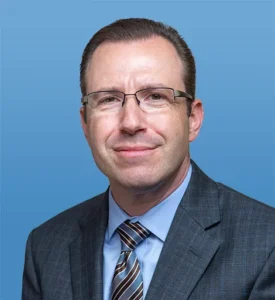
Ilan Berman, a leading Iran analyst who serves on the boards of RFE/RL and MBN (pictured), said:

“This is the most decisive moment in modern Iranian history since the Islamic Republic’s founding in 1979. America needs to seize it to talk directly to the Iranian people – to educate, to inspire and to tell them that a different future could lie ahead. The more we can do that, the better.

“I’m glad RFE/RL and MBN are still functioning, albeit at diminished capacity. The current conflict with the tyrannical rulers of Iran underscores the need for American voices to counter the lies and disinformation of U.S. adversaries. These tools can’t be allowed to disappear.”

Berman was the Trump administration’s transition team leader at USAGM before new leadership arrived earlier this year.