25 May 2017
The BBC is reaching a record weekly audience of 372m around the world, a rise of 7 per cent year on year, new audience figures published on 25 May 2017 reveal.
These figures – the Global Audience Measure (GAM) – show how many individuals the BBC reached weekly with its news and entertainment content in the year 2016/17.
The data show the BBC’s weekly global news audience has risen by 8 per cent to 346m, with TV, audio and social media driving the increase.
The BBC World Service has seen an increase of 9 per cent since last year, taking its total audience to 269m.
Global News Ltd, which comprises BBC World News television and BBC.com, now has an audience of 121m, an increase of 12 per cent, with weekly BBC World News TV viewers rising to 99m.
World Service English has seen another significant rise, with an audience of 75m around the world, a 14 per cent increase. This has been driven both by syndication and by the growth of digital audio, including internet audio and podcasts. The number of listeners accessing World Service English through internet audio has shot up by 147 per cent to 21m.
The GAM figures show the BBC is on track to achieve the target set by the Director General of a 500m weekly audience by 2022, the BBC’s centenary year.
 Francesca Unsworth, Director of the BBC World Service Group, says: “In a turbulent year for international news, with mounting concern about fake news and social media filter bubbles, more people than ever before are turning to the BBC for reliable, impartial information they can trust.
“We will shortly launch the first new language services in the biggest expansion of the World Service since the 1940s. Today’s audience figures show the need for the BBC is greater than ever.”
 Tim Davie, Director of Global and CEO of BBC Worldwide, says: “It is encouraging to see that BBC branded services continue to be the trusted go-to platforms for audiences across the globe.”
- Facebook is by far the biggest source of the BBC’s social media reach globally, but there are regional variations – in Iran alone BBC reaches 1.4m people on the encrypted messaging app Telegram, from a total BBC audience of 12.6m in that country.
- The top ten markets for the BBC’s international news services are Nigeria (36m), USA (34m), India (28m), Bangladesh (16m), Egypt (15m), Pakistan (13m), Iran (13m), Tanzania (10m), Indonesia (7.6m), and Canada (7.5m), where the BBC significantly boosted its presence last year.
- BBC radio saw a 12 per cent uplift in audience figures in the USA during an eventful election year – taking weekly reach to 14.6m people
12 May 2017
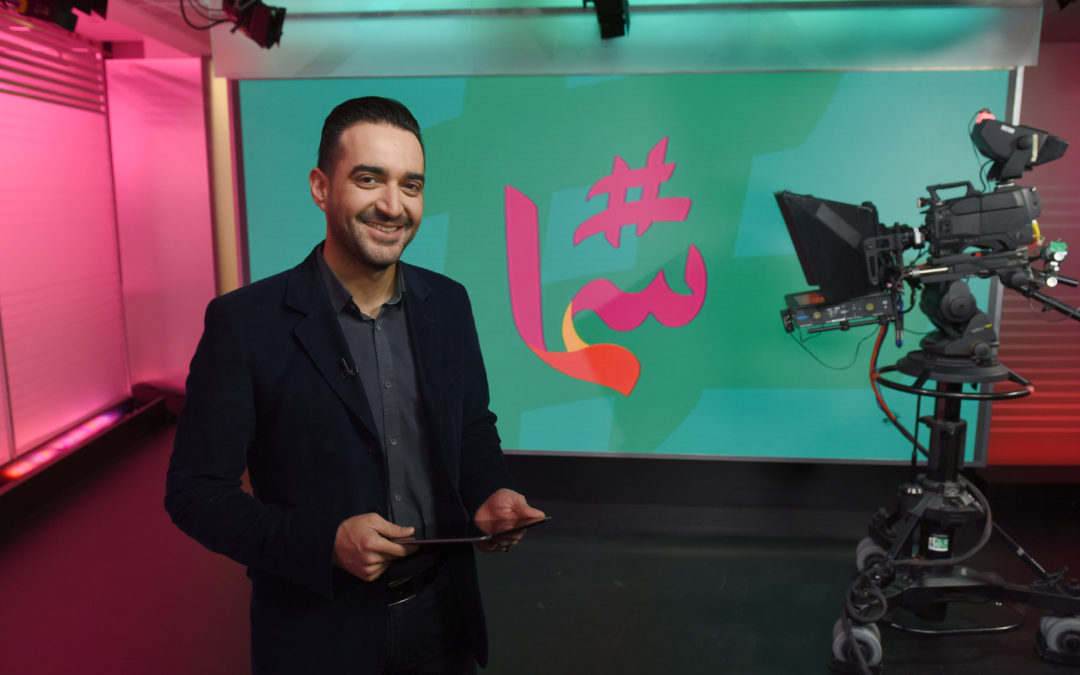
In the run-up to the elections in Iran, BBC Persian is launching its digital-first TV programme. From Saturday, 13 May, #Shoma invites audiences across platforms to share their opinions and stories.
Saturday to Wednesday live interactive programme, #Shoma (“#You”) delivers innovative and creative ways to engage with the audience on TV, the website and via social media, bringing an even greater variety of stories to the BBC Persian output. It will specifically target young digital audiences and women as well as wider TV audiences.
In addition to coverage of the daily news, #Shoma also reflects stories trending in BBC Persian’s target market across its social-media platforms: Facebook, Twitter, Instagram and Telegram messenger service. It will engage audiences in discussions about what matters to Persian-speaking viewers and listeners in Iran and across the globe.
#Shoma will be live on TV (and streamed via BBC Persian website), from Saturday 13 May at 15.00 GMT (19.30 Tehran Time, 20.30 Kabul Time, 11.00 ET), Saturday to Wednesday. It adds to the BBC Persian early evening broadcast mix of news and features.
Presenter of #Shoma, Ehsan Amertousi, sees the new programme as an exciting opportunity to deepen BBC Persian’s engagement with its audience: “In the run-up to the elections in Iran, it’s really important we give our audience the chance to share their opinions on the issues that really matter to them. Regardless of where or who you are, how old you are, #Shoma will be the place to come and tell us what is happening in your life and what you want for the future.”
The programme’s Editor, Leyla Khodabakhshi, says that #Shoma will give the audience the chance to participate and shape part of BBC Persian’s daily news agenda: “Combining the informality of social with the sense of drama often only TV programmes can bring, and delivered and shared on digital platforms, #Shoma is designed to reflect how our audience today wants to interact with us. This is a great opportunity for them to be at the heart of the BBC Persian output, and I’m so pleased we’re launching just before the election, so we can bring voters and commentators together as our audience debates the important issues.”
#Shoma can be reached via:
Tel: +44 2077650078; +44 2077650077 SMS: +44 7860063333 Twitter: @bbcshoma Instagram and Telegram: @bbcpersian, send message via @bbcshoma Facebook: /bbcpersian
BBC Persian is part of the BBC World Service.
18 January 2017
Content from BBC Ukrainian is now available to the users of the popular Ukrainian news website, Novoye Vremya, as it now carries news stories from the website bbc.ua, in Ukrainian and Russian, in text and video.
Novoye Vremya (nv.ua) is the website of the Ukrainian weekly social and political news magazine of the same name. It now displays the BBC Ukrainian reporting and analysis of international and regional news relevant to Ukrainian audiences, including the BBC’s coverage of business, art, entertainment and sport.
BBC Ukrainian Editor, Nina Kuryata says: “We welcome the collaboration with Novoye Vremya, a widely respected Ukrainian publication. This new partnership will help us showcase to a new audience relevant and engaging content from bbc.ua.”
Chief Project Manager, nv.ua, Oleg Lysenko, adds: “We want to provide our readers with high-quality and timely information. Our cooperation with BBC Ukrainian – with which we share high journalistic standards, objectivity and impartiality – will deliver just that.”
BBC Ukrainian is part of BBC World Service.
(Source: BBC World Service press release)
16 November 2016
The BBC’s Thai language service launched today the website – bbcthai.com – to expand on its presence in social media and further strengthen BBC’s news and current-affairs offer to Thai-speaking audience, in Thailand and around the world.
BBC Thai was created in July 2014 as a Facebook service in response to the military coup in Thailand, and is now is in the unique position of moving from being a social only offer to engaging with users directly on a BBC platform.
Via its social-media and new online presence, BBC Thai aims at attracting a digitally savvy and young audience, while continuing to be a source of impartial and independent news for a country were the media still faces restrictions.
The development is a result of the funding boost for the BBC World Service announced by the UK Government last year and is part of the World Service’s biggest expansion since the 1940s. Along with national, regional and international politics, bbcthai.com will cover business, culture, health, technology, science and entertainment – as well as women’s issues and social affairs. It offers free content from BBC Learning English.
During the past two years BBC Thai Facebook page has generated over 1.3 million interactions a month and has 1.65 million fans (November 2016), mostly in Thailand. BBC Thai also uses Facebook Live, Google Hangouts, YouTube and other social media to reach its audience.
BBC Thai has expanded its team in London and its Bangkok office, to enhance its ability to produce original digital content. Its newly appointed Editor, veteran Thai journalist and broadcaster Nopporn Wong-Anan, will lead the teams. He said:
“I am excited and proud to be part of the digital transformation of BBC Thai as it has moved from being a social-only service to its own new platform, bbcthai.com. Via this new, mobile-first website we will serve Thai-speakers looking for independent, accurate and balanced news, information and analysis, for which the BBC is known. BBC Thai’s presence on the social-media scene will continue to expand.”
The service will also bring innovative formats to engage its audience and has partnered up with BBC’s task-forces that drive the organisation’s digital innovation – BBC Connected Studio and BBC News Labs. The team explored themes of participation and interaction with the local Thai creative industry in Bangkok and Chiang Mai this summer.
BBC Thai is part of BBC World Service. (Source: BBC press release)
16 November 2016
The BBC World Service has announced its biggest expansion since the 1940s, in a move designed to bring its independent journalism to millions more people around the world, including in places where media freedom is under threat.
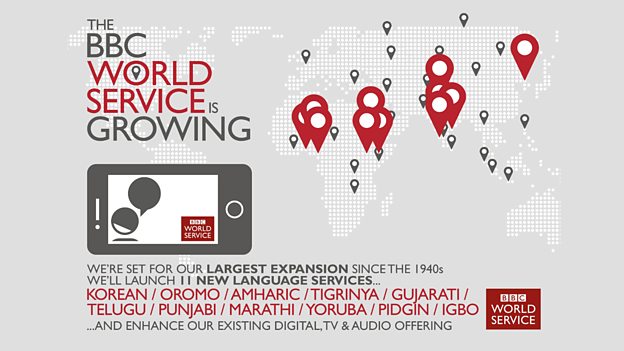 The BBC World Service will also expand its digital services to offer more mobile and video content, a greater social media presence, and new ways of reaching its audience around the globe.
The BBC World Service will launch 11 new services in Afaan Oromo, Amharic, Gujarati, Igbo, Korean, Marathi, Pidgin, Punjabi, Telugu, Tigrinya, and Yoruba. This means the BBC World Service will be available in 40 languages including English. The expansion will also mean more journalists on the ground in locations across the world.
The expansion includes plans for the BBC to:
- Produce extended news bulletins in Russian, with regionalised versions for surrounding countries, a relaunched website, new digital formats and more journalists on the ground
- Enhance its television services across Africa, including over 30 new TV programmes for partner broadcasters across sub-Saharan Africa
- Enhance the BBC Arabic offer by delivering new regional programming across the Arab world
- Broadcast short-wave and medium-wave radio programmes aimed at audiences in the Korean peninsula, supplemented by digital content online and on social media
- Invest in World Service English, with new programmes, more original journalism, and a broader agenda
- Continue with the digital transformation of the BBC World Service, including new TV news bulletins, so that all 40 languages will eventually have a video offer
- Use its global presence to provide an even greater focus on analysis and explanation, or ‘slow news’, helping audiences to make sense of the world by explaining the ‘why’ as well as the ‘what’.
Tony Hall, Director-General of the BBC, said: “This is a historic day for the BBC, as we announce the biggest expansion of the World Service since the 1940s. The BBC World Service is a jewel in the crown – for the BBC and for Britain.
“As we move towards our centenary, my vision is of a confident, outward-looking BBC which brings the best of our independent, impartial journalism and world-class entertainment to half a billion people around the world. Today is a key step towards that aim.”
Francesca Unsworth, BBC World Service Director, said: “Through war, revolution and global change, people around the world have relied on the World Service for independent, trusted, impartial news. As an independent broadcaster, we remain as relevant as ever in the 21st century, when in many places there is not more free expression, but less.
“Today’s announcement is about transforming the World Service by investing for the future. We must follow our audience, who consume the news in changing ways; an increasing number of people are watching the World Service on TV, and many services are now digital-only. We will be able to speed up our digital transformation, especially for younger audiences, and we will continue to invest in video news bulletins. What will not change is our commitment to independent, impartial journalism.”
The BBC World Service will focus particularly on increasing audience reach with younger people and women.
The BBC’s Director-General has set a target for the BBC to reach 500m people worldwide by its centenary in 2022.
This expansion is a result of the funding boost for the BBC World Service announced by the UK Government last year. Further details of the new services will be announced in due course. The first new services are expected to launch in 2017.
