In Memoriam — Kevin Klose and Ted Turner

In Memoriam — Kevin Klose and Ted Turner

In Memoriam — Kevin Klose and Ted Turner

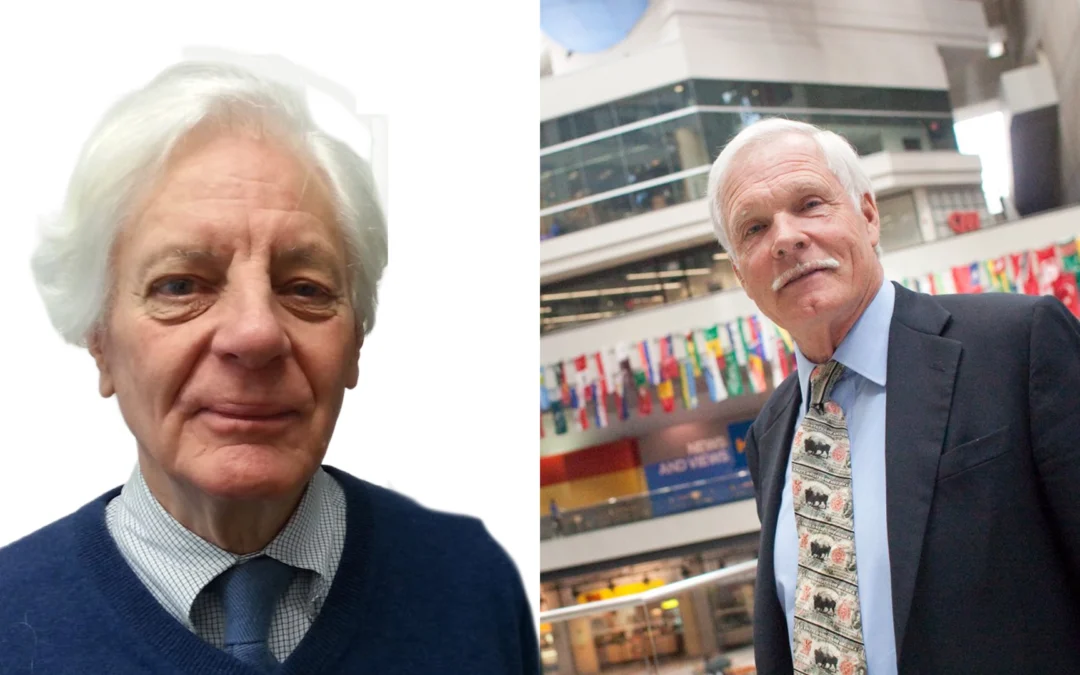
The international broadcasting community is marking the loss of two figures whose influence helped shape the modern global media landscape: Kevin Klose and Ted Turner.

Kevin Klose, who died in April 2026, was widely respected for his leadership of Radio Free Europe/Radio Liberty (RFE/RL), an organisation central to the provision of independent news in societies where media freedom has often been constrained. Klose served as president and CEO during pivotal periods, including after the Cold War and again in later years when geopolitical tensions renewed the importance of trusted, fact-based international broadcasting. His career also spanned journalism and academia, including senior roles at National Public Radio, where he helped strengthen editorial standards and institutional resilience. Colleagues consistently highlighted his commitment to journalistic integrity and his belief in broadcasting as a public good.

Just weeks later, the industry was also mourning the death of Ted Turner, the visionary entrepreneur who founded CNN. Turner’s creation of the world’s first 24-hour television news channel in 1980 fundamentally altered the rhythm and expectations of news consumption. By making live, continuous coverage a global norm, CNN reshaped both audience behaviour and editorial practice, setting a template that broadcasters worldwide would follow. Turner’s broader media ventures, including the expansion of cable television and his role in building global media brands, left an enduring commercial and cultural legacy.

While their careers unfolded in different contexts – Klose within publicly funded international broadcasting and Turner within commercial media innovation – both shared a belief in the power of information to connect societies and influence global understanding. Each, in his own way, expanded the reach and relevance of broadcast journalism across borders.

Their deaths come at a moment when the media industry is confronting profound structural change, from digital disruption to shifting geopolitical pressures. The legacies of Klose and Turner serve as a reminder of the enduring importance of credible journalism, international perspective, and the institutions that sustain them.

BBC steps up fight against media clampdowns around the world

BBC steps up fight against media clampdowns around the world

BBC steps up fight against media clampdowns around the world

As media freedom faces starker declines in countries around the world, the BBC World Service has unveiled how services are adapting to reach audiences and the extreme measures individuals outside of the BBC take to access critical news and information.

According to the 2026 World Press Freedom Index from Reporters Without Borders (RSF), press freedom is at the lowest point in the last quarter of a century.

As the world is marking World Press Freedom Day (3 May), the BBC speaks to someone involved in smuggling technology and services into Iran to access media, and highlights the difficulties faced in accessing BBC news in some countries.

Fiona Crack, Global Director, BBC News, says:

“We know that democratic values are under threat globally and this pressure goes hand-in-hand with the reduction in press freedom. Draconian actions taken by authorities around the world stop journalists doing their job and withhold information from people, increasing international instability and uncertainty. The BBC World Service is determined to provide for audiences who need us most and to find new ways of reaching them.” 

The BBC World Service is fighting reductions in media freedom by providing for audiences in innovative and diverse ways combatting some of the restrictions put on populations and BBC staff.

Iran

In Iran, amid nationwide internet shutdowns, a clandestine network smuggling Starlink satellite technology into the country has emerged.

The BBC World Service has spoken to “Sahand”, not his real name, who says he has sent over a dozen contraband items to enable internet access into the country since January. 

“If even one extra person is able to access the internet, I think it’s successful and it’s worth it,” says Sahand.

The Starlink devices Sahand sends to Iran are one of the most reliable ways of bypassing the shutdown.

Last year, the Iranian government passed legislation that made using, buying or selling Starlink devices punishable by up to two years in prison.

Sahand says the consequences could be severe if caught. “If I was identified by the Iranian regime, they might make those I’m in touch with in Iran pay the price,” he says.

Many Iranians bypass restrictions by using virtual private networks (VPNs) to access the internet to share and access independent information. 

BBC News Persian has the largest audience of any international media inside Iran. At the start of the 2026 protests, BBC News Persian was reaching 27.5 million people each week on Instagram, almost half the adult internet population of Iran. Following the internet shutdown, audiences in the country fell sharply.

BBC News Persian responded to the internet shutdown by launching a temporary emergency lifeline radio programme and establishing a weekly newsletter. The team have also extended their television news coverage, offering increased live news to meet the demand for information during the war.

Staff who work for BBC News Persian are threatened, harassed and abused for their reporting. Last year saw an alarming increase in the harassment with family members in Iran being taken in for repeated interrogation and their passports confiscated.

Russia

Since the start of the full-scale invasion of Ukraine, access to BBC News Russian in Russia has been severely restricted and the service’s website and most social media platforms are blocked. This action initially saw an audience drop of 95% across Russia. The numbers have since recovered significantly as the service works dynamically to reach their audiences, finding alternative platforms.

Like Iranians, audiences in Russia now use VPNs to access BBC content on the BBC News Russian website and on social platforms like Telegram, YouTube and Instagram.

BBC News Russian podcasts were banned on all platforms in Russia in 2022 and in response, they moved to YouTube. Since the Russian authorities’ subsequent intentional slowdown of YouTube in 2024, podcast output has also been made available on a dedicated Substack page.

BBC News Russian journalists also produce a weekday newsletter with mirror links to enable access to BBC content without the need for a VPN.

For many, their work has personal consequences. Several members of BBC News Russian staff have been labelled ‘Foreign Agents’ by Russia and are now at risk of criminal prosecution.

Belarus

In Belarus, there was an unprecedented post-election media crackdown in 2020.

According to the independent Belarusian Association of Journalists (BAJ), 22 media workers are currently in prison. In the past six years, almost all independent publications and their social media pages have been blocked, banned and even declared extremist, effectively making it a crime for audiences inside Belarus to engage with them. 

BBC News Russian journalists are no longer able to operate in Belarus.

The extremism designation has been imposed on BBC News Russian content, and all BBC sites have been blocked. As of March 2026, it is illegal for people in Belarus to share BBC News Russian content.

BBC News Russian are pivoting to social media to ensure audiences in Belarus continue to have access to independent news from the BBC. 

United Kingdom becomes co-chair of the Media Freedom Coalition

United Kingdom becomes co-chair of the Media Freedom Coalition

United Kingdom becomes co-chair of the Media Freedom Coalition

The United Kingdom has been announced as the new co-chair of the Media Freedom Coalition (MFC), a global partnership of 51 countries working together to promote press freedom at home and abroad. 

The United Kingdom will officially take over the co-chair role on 1st March 2026 and will serve as co-chair for a two-year term alongside Finland, which became co-chair in July 2025.  The UK succeeds Germany, which has been MFC co-chair since January 2024.  

The UK, alongside Canada, co-founded the Coalition in 2019 and then served as inaugural co-chair until late 2021. Over four years later, the UK returns as co-chair with the Coalition having expanded its membership, range of activities, and impact. Through the Media Freedom Coalition, member countries work together in partnership with civil society and legal experts to support MFC members and other countries to strengthen media freedom globally and in their jurisdictions, including through reforming laws to better protect journalists and media workers. 

The UK would like to place on record its thanks to Germany as joint co-chairs in helping the coalition step up its response to the multiple issues threatening global public interest media today. While co-chair, the UK will work alongside Finland to guide an MFC that partners with members and interested countries, to strengthen approaches to media freedom. 

To do so, it will utilise the coalition’s collective expertise to help nations find ways to support a viable public interest media, navigate the opportunities and risks that stem from new technology, and tackle the specific challenges facing women journalists. 

The UK will also seek to raise the coalition’s profile, expand and strengthen its work by including new voices, strengthen the sharing of expertise, and support timely, effective advocacy. 

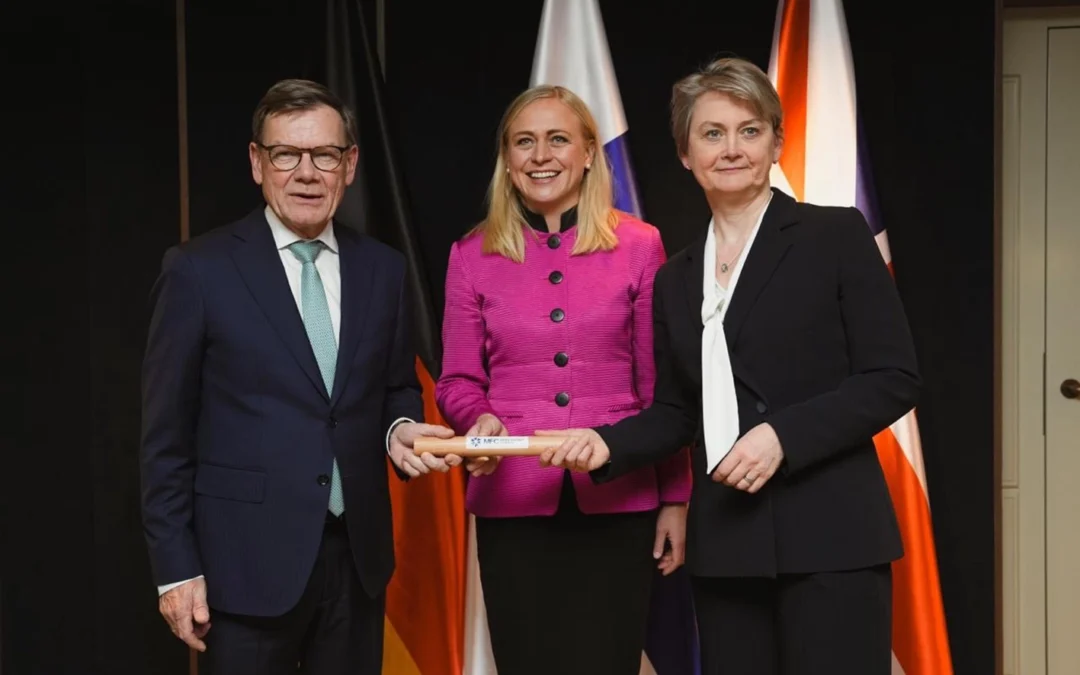
The British Foreign Secretary, Yvette Cooper, formally accepted the co-chairship from her German counterpart Johann Wadephul, Federal Minister for Foreign Affairs, at the Munich Security Conference.   

The Minister for Foreign Affairs of Finland, Elina Valtonen was also present for the handover.  

The Coalition’s 2024 annual report highlighted that the MFC has acted on 22 cases of journalists at risk during 2024, while embassies of MFC members had spoken out on a further 15 cases. The report also highlighted 123 actions by MFC member embassies around the world, such as visiting imprisoned journalists, providing funding, and organising events.  

To deliver its mission , the Coalition works closely with a group of the world’s leading press freedom and media support organisations (the Consultative Network – of which the AIB is a member), a group of leading lawyers and judges from around the world (the High Level Panel of Legal Experts on Media Freedom), and international organisations including UNESCO. The Coalition is supported by a dedicated staff team (the MFC Secretariat).  

Image: Johann Wadephul, Federal Minister for Foreign Affairs of Germany (left), Elina Valtonen, Minister for Foreign Affairs of Finland (centre), and Yvette Cooper British Foreign Secretary (right); credit: Ben Dance / UK Foreign, Commonwealth & Development Office

Australia mandates AI disclosure for radio

Australia mandates AI disclosure for radio

Australia mandates AI disclosure for radio

​The Australian Communications and Media Authority (ACMA) has registered updated rules for commercial radio broadcasters that include new requirements for content broadcast around school drop-off and pick-up times, and also for disclosing artificial intelligence use.

Under the Commercial Radio Code of Practice 2026, radio stations will be required to let their audience know when a synthetic voice is being used to host a regularly scheduled program or news broadcast. This is the first time AI has been addressed in a broadcasting code of practice.

Broadcasters will also have to give special care when airing content between 8-9am and 3-4pm on school days, when children are more likely to be listening.

ACMA Chair Nerida O’Loughlin said the new rules would allow audiences to make more informed decisions about their listening habits: “Broadcasting rules must keep pace with technology and with community expectations. AI is a powerful tool that offers a lot of innovation for broadcasters. 

“However, listeners want greater transparency about when AI is being used. We welcome the commitments by the radio industry to address listener concerns.

“Listeners are also worried about inappropriate content at peak travel times when families listen together.

“These new rules set clear time windows where broadcasters must consider whether their content is suitable for children, giving parents and carers greater confidence when tuning in.”

The revised code, which was developed by industry group Commercial Radio & Audio (CRA), also includes strengthened provisions around corrections for errors in news coverage and greater transparency in complaints reporting.

A significant number of submissions to the review called for strengthened rules around the broadcasting of Australian music. The new code includes changes to the station categories that determine how much Australian music must be played to better reflect contemporary broadcasting practices and music genres.

The ACMA will be working closely with CRA and the commercial radio industry over the coming 12 months to ensure stations are applying the new categories correctly and meet their longstanding Australian music obligations, including in relation to new Australian music.

As with all the provisions in the code, the ACMA expects that licensees with comply with their obligations to broadcast Australian music.

“Commercial radio is an integral part of Australia’s media landscape and these rules will help strengthen trust between broadcasters and their audiences.

“We would also like to see broadcasters voluntarily extend the code safeguards to content available on their on-demand streaming services. If they do not, we expect that new regulations may need to be put in place so that listeners know what to expect no matter how they tune in,” Ms O’Loughlin said.

The Commercial Radio Code of Practice 2026 will come into effect from 1 July 2026.

RFA goes under the hammer

RFA goes under the hammer

RFA goes under the hammer

It seems that Radio Free Asia is unlikely ever to return to an operational state. It ceased operations on 31 October 2025 and the studios and offices in Washington DC are being cleared, with an auction of all equipment taking place. The sale is being handled by Rasmus, and the auction description reads: “A Washington, DC, international television and radio broadcast network is making a significant reduction in its operations and will liquidate all excess television, radio, studio production, field production, switching, broadcast, control room, editing, and equipment. 1000s of items of late model and new in box, high-end video, radio, dataroom, M&E, office, and technology equipment. 4 floors, multi-day phased removal. Assets will be professionally de-installed and available to the ground floor for easy removal.” 

Rasmus handled the liquidation of RT America’s Washington DC operation in the summer of 2024.

The RFA offices appear in an auctioneer’s video. The catalogue is online at https://rasmus.com/auctions/galIdtyncHUDPy2PyoGz/a/Radio-Station-Washington–DC. 

The auctioning of the entire RFA Washington DC facility has happened remarkably rapidly, given the relatively recent ending of operations. It is unclear whether this has been initiated by RFA itself – as an entity that is not a “wholly-owned” USAGM operation, or by USAGM pulling the plug on the broadcaster and taking the revenue generated by the sale.  

Whichever the case, it seems highly unlikely that the organisation will ever be heard and seen again as to restart operations will require the setting up of an entirely new broadcast centre. The tens of millions of US tax dollars that have been invested in RFA over its almost 30 years existence have arguably been squandered with RFA’s closure and dismantling. The auction will generate only a fraction of the amounts spent on equipping the station over recent years. 

Separately, it has been reported that the USAGM transmitting station in the Philippines is to be reactivated and will be carrying Radio Filipinas World Service from 1 December. The transmitting station was used for VoA and RFA broadcasts including Korean, Cambodian, Lao, Burmese, Khmer and Tibetan language services, as well as for Radio Filipinas, until it was switched off earlier this year. 

AI assistants misrepresent news content, says major study

AI assistants misrepresent news content, says major study

AI assistants misrepresent news content, says major study

New research coordinated by the European Broadcasting Union (EBU) and led by the BBC has found that AI assistants – already a daily information gateway for millions of people – routinely misrepresent news content no matter which language, territory, or AI platform is tested.

The intensive international study of unprecedented scope and scale was launched at the EBU News Assembly, in Naples. Involving 22 public service media (PSM) organizations in 18 countries working in 14 languages, it identified multiple systemic issues across four leading AI tools.

Professional journalists from participating PSM evaluated more than 3,000 responses from ChatGPT, Copilot, Gemini, and Perplexity against key criteria, including accuracy, sourcing, distinguishing opinion from fact, and providing context. 

Key findings: 

  • 45% of all AI answers had at least one significant issue.
  • 31% of responses showed serious sourcing problems – missing, misleading, or incorrect attributions.
  • 20% contained major accuracy issues, including hallucinated details and outdated information.
  • Gemini performed worst with significant issues in 76% of responses, more than double the other assistants, largely due to its poor sourcing performance.
  • Comparison between the BBC’s results earlier this year and this study show some improvements but still high levels of errors.

Why this distortion matters

AI assistants are already replacing search engines for many users. According to the Reuters Institute’s Digital News Report 2025, 7% of total online news consumers use AI assistants to get their news, rising to 15% of under-25s.

‘This research conclusively shows that these failings are not isolated incidents,’ says EBU Media Director and Deputy Director General Jean Philip De Tender. ‘They are systemic, cross-border, and multilingual, and we believe this endangers public trust. When people don’t know what to trust, they end up trusting nothing at all, and that can deter democratic participation.’

Peter Archer, BBC Programme Director, Generative AI, says: ‘We’re excited about AI and how it can help us bring even more value to audiences. But people must be able to trust what they read, watch and see. Despite some improvements, it’s clear that there are still significant issues with these assistants. We want these tools to succeed and are open to working with AI companies to deliver for audiences and wider society.’

Next steps

The research team have also released a News Integrity in AI Assistants Toolkit, to help develop solutions to the issues uncovered in the report. It includes improving AI assistant responses and media literacy among users. Building on the extensive insights and examples identified in the current research, the Toolkit addresses two main questions: “What makes a good AI assistant response to a news question?” and “What are the problems that need to be fixed?”.

In addition, the EBU and its Members are pressing EU and national regulators to enforce existing laws on information integrity, digital services, and media pluralism. And they stress that ongoing independent monitoring of AI assistants is essential, given the fast pace of AI development, and are seeking options for continuing the research on a rolling basis.

About the project

This study built on research by the BBC published in February 2025, which first highlighted AI’s problems in handling news. This second round expanded the scope internationally, confirming that the issue is systemic and is not tied to language, market or AI assistant.

Participating broadcasters:

  • Belgium (RTBF, VRT)
  • Canada (CBC-Radio Canada)
  • Czechia (Czech Radio)
  • Finland (YLE)
  • France (Radio France)
  • Georgia (GPB)
  • Germany (ARD, ZDF, Deutsche Welle)
  • Italy (Rai)
  • Lithuania (LRT)
  • Netherlands (NOS/NPO)
  • Norway (NRK)
  • Portugal (RTP)
  • Spain (RTVE)
  • Sweden (SVT)
  • Switzerland (SRF)
  • Ukraine (Suspilne)
  • United Kingdom (BBC)
  • USA (NPR)

Separately, the BBC has today published research into audience use and perceptions of AI assistants for News. This shows that many people trust AI assistants to be accurate – with just over a third of UK adults saying that they trust AI to produce accurate summaries, rising to almost half for people under-35.

The findings raise major concerns. Many people assume AI summaries of news content are accurate, when they are not; and when they see errors, they blame news providers as well as AI developers – even if those mistakes are a product of the AI assistant. Ultimately, these errors could negatively impact people’s trust in news and news brands.

The full findings can be found here: Research Findings: Audience Use and Perceptions of AI Assistants for News