This is a SEO version of The Channel Issue 2 2010. Click here to view full version
« Previous Page Table of Contents Next Page »THE CHANNEL | ISSUE 2 2010 | 53
attitudes and opinions of their fellow citizens. Such “opinion leaders," identified in the AudienceScapes research using basic statistical regressions, are of interest to development
organisations as key local partners or “champions” in project efforts. This group was defined primarily by how frequently they said that they are consulted by others for opinions and advice on (“very often” or “daily") important news events, as well as their own measure of how many people come to them to help interpret news and information.
SIMPLY PRIMARY SCHOOLING
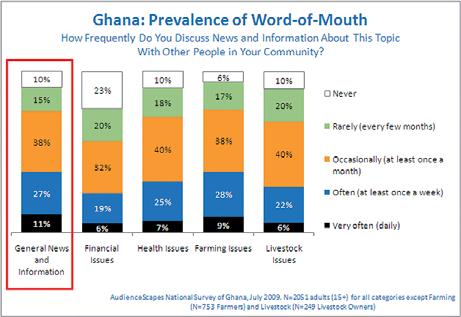
In our 2009 Ghana survey, opinion leaders for general news and information where rather demographically distinct. These hubs of word-of-mouth activity were more likely to be men (for example, for general news topics, 64% were male vs. 49% of the total sample population) and well-educated. However, a little over a quarter of opinion leaders only had a primary school education, indicating that one’s status as an opinion leader is not necessarily dependent upon formal education. While news opinion leaders generally tended to be young to middle-aged, those in rural areas included a notably higher percentage of leaders in the 60-plus age category. This may reflect a rural bias toward traditional systems of authority, which attribute more value to knowledge gained by senior members of the community.
The multiplier effect that word-of-mouth networks and opinion leaders can have on the spread of information can even be felt within media industries often thought to be more limited in scope. For example, in our 2009 Ghana survey, only about 18% of respondents said they are weekly newspaper readers. However, 34% of Ghanaian opinion leaders said they read newspapers weekly, suggesting that print
stories can make their way orally through the community, well beyond those who actually read them.
News opinion leaders overall were more likely to be regular consumers of both traditional and new media. This is particularly evident in rural areas where some 53% of news opinion leaders said they watch TV daily, while only about 30% of all rural residents said they watch daily. A partial explanation for this difference is simply access, as some 65% of rural news opinion leaders have household access to a TV, 20 percentage points higher than the rural sample as a whole. This increased level of media access allows opinion leaders to be privy to information the average rural Ghanaian would not otherwise know.
OPINIONLEADERSHIP
InterMedia continues to tweak the opinion leadership questions used in the AudienceScapes surveys to not only better understand word-of-mouth networks, but also to help us gauge the indirect reach of broadcast outlets.
For example, in a 2009 survey conducted in urban Laos, InterMedia used exploratory questions on opinion leadership, knowledge of current affairs, and word-of-mouth news dissemination to identify respondents who fit the categories of “community news broker” and "local opinion leader". It became clear that large chunks of some radio outlets' listenerships were made up of such people, suggesting that their audiences were more prone to discuss and disseminate news in their communities. Note that in some cases, these same outlets' numerical reach was relatively low. Traditionally, the success of international broadcasters has been measured by standardized consumption rates. However, as we look deeper into media environments, particularly those
that have shown to have complex word-of-mouth networks, these measures only tell part of the story. AudienceScapes and InterMedia are continuing to use innovative statistical measures to help development practitioners better understand how information spreads throughout a society. International broadcasters would do well to follow this example not only as a means to identify their audience, but also to help measure the full extent of their reach. ■
ANALYSIS | THE CHANNEL
This is a SEO version of The Channel Issue 2 2010. Click here to view full version
« Previous Page Table of Contents Next Page »