This is a SEO version of The Channel Issue 2 2010. Click here to view full version
« Previous Page Table of Contents Next Page »SPORT | THE CHANNEL
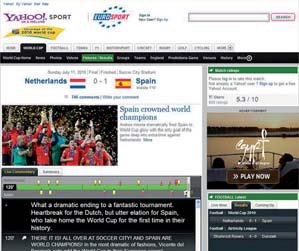
Top: Laurent-Eric Le Lay Below: Eurosport on-air from Soccer City during the FIFA World Cup; Eurosport on Facebook and Yahoo!
THE CHANNEL | ISSUE 2 2010 | 47
22 June) and all time daily records in France, Germany, Spain, Italy or the UK.
MOBILE
Mobile users of iPhone, BlackBerry and Android, as well as the iPad, were kept up-to-date with all the latest sports news in 10 languages (including Russian, Chinese and Arabic) thanks to Eurosport's applications. They could stay connected to the latest scores and results with live running commentary throughout the 64 matches of the World Cup 2010.
HOLISTICAPPROACH
Eurosport's solution to the challenges it faced for the World Cup is an example for other broadcasters. In tomorrow's media environment it will no longer be enough to be on TV, as multimedia platform support will be crucial for broadcasting, marketing and advertising; in other words, a completely holistic approach. Content is king. It is vital to give viewers the best sports entertainment experience. Eurosport prides itself on its coverage of not only premium sports events such as tennis and cycling but a variety of other sports, and on its huge amount of live output across its channels. "It is not one particular sport or programme that makes Eurosport what it is today. It is the variety and breadth of our offer, which is important. Our aim is to make sport content available anytime, anywhere and on any device," says Eurosport Chairman and CEO, Laurent-Eric Le Lay.
"Today's media environment is one in transition and in a relatively short period of time we have seen different technological
developments, some more radical than others. There has been a multiplication of TV channels but also new media growth with online, mobile, new software apps and social media."
Many commentators have been outspoken on the threat to the TV broadcaster brand at the hands of
new technologies such as the iPad, mobile and, though not so new, the Internet. But there have also been excellent recent technological developments on the TV front, such as HD and 3D. Again, the key component in all of these breakthroughs is content. This is why Le Lay believes Eurosport is not at the end of an era but at the beginning of a new one, and that in today's media environment TV is and will remain a key element.
"All broadcasters started out delivering content through a television channel. As for Eurosport, we have grown in a constantly changing environment, learning, adapting, creating, always with the same goal of delivering top quality content," adds Le Lay. "Since our launch 21 years ago, we have created more channels, such as Eurosport 2,
Eurosportnews, we have launched Eurosport HD in 2008 and pioneered 3D with Roland Garros just months ago with Panasonic. "In 2000, we launched our Internet network. It was not our strategy to create an extension of our channels, but to use new technology to create a new media. A decade later, we have 11 websites in 10 languages, making Eurosport the 6th largest sports Internet destination in the world. On mobile the Eurosport iPhone app has already broken the 2.4 million download barrier in only 12 months since launch. "New media has forced broadcasters to evolve from being TV channels into media groups. Instead of seeing these new media outlets as competitors we see them as an opportunity to develop our brands and our content." Le Lay adds: "It is content that gives the broadcaster brand its high value, but remember content is nothing without a broadcaster. Why? We bring sport to life, we promote and bring innovation to an event. So even though broadcasting is the heart of our business, we are now much, much more than a TV broadcaster." ■
This is a SEO version of The Channel Issue 2 2010. Click here to view full version
« Previous Page Table of Contents Next Page »